Rubio cites US expansion history to defend sovereignty against global institutions
Synopsis
US Secretary of State Marco Rubio used a Federalist Society address to build a sweeping historical case — from the Revolution to Hamilton — for American expansionism as a founding value, and to reject the authority of the ICC and global legal bodies. No new territorial policy was announced, but the speech offers the clearest philosophical blueprint yet for the administration's sovereigntist foreign policy posture.
Key Takeaways
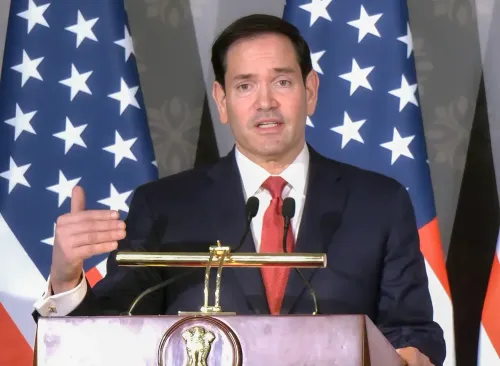
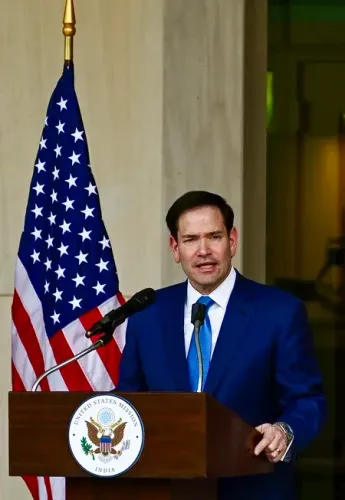
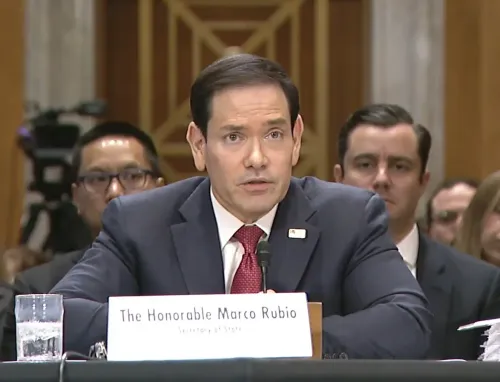
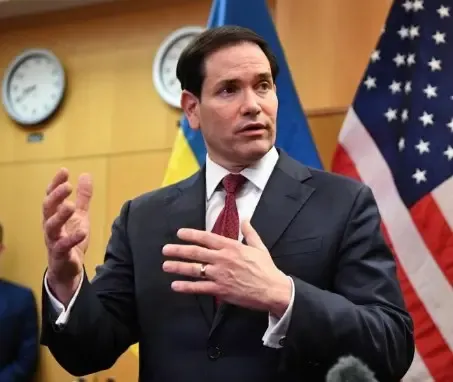
Secretary of State Marco Rubio addressed the Federalist Society's National Lawyers Convention on Friday in Washington .
Rubio cited the American Revolution , the Declaration of Independence , and Hamilton's Federalist No.
1 to argue that expansion is a core American value.
He criticised the International Criminal Court (ICC) , stating Americans had not consented to its jurisdiction; the US is not a party to the Rome Statute .
Rubio accused a global elite of using international law to advance its own interests and undermining democracy when election results challenged those interests.
No specific territorial objective or new expansion policy was announced in the speech.
US Secretary of State Marco Rubio invoked America's tradition of territorial and strategic expansion on Friday to mount a defence of national sovereignty, arguing that the country's founding ideals embodied an outward ambition that modern international institutions seek to constrain. Speaking at the Federalist Society's National Lawyers Convention in Washington, Rubio framed expansion as a core American value — not an aberration — and used that framing to challenge the legitimacy of bodies such as the International Criminal Court (ICC).
Key Remarks at the Federalist Society
Rubio drew on the American Revolution, Alexander Hamilton's first Federalist essay, and the Declaration of Independence to argue that a hunger for growth had always defined the nation. 'America has always been a nation of irrepressible ambition — ambition which, since the very beginning, extended far beyond our borders,' he said. 'Low ceilings and small horizons were never our destiny.'
He went further, characterising that drive as inseparable from the republic's legal and constitutional architecture. 'The history of our nation and our people brims with a hunger to expand, to grow, to explore and conquer, to stake a claim to new frontiers,' Rubio said. Notably, he did not announce a specific territorial objective or outline any new expansion policy in his remarks.
Historical Arguments Rubio Invoked
Rubio cited colonial-era British restrictions on westward settlement — specifically the 1763 Royal Proclamation barring colonial movement west of the Appalachian Mountains — as a grievance that fuelled revolutionary sentiment, pointing to a corresponding clause in the Declaration of Independence. He also quoted Hamilton's reference in Federalist No. 1 to 'the fate of an empire, in many respects the most interesting in the world' — a phrase Hamilton used in the context of constitutional ratification, not territorial conquest, though Rubio deployed it to illustrate American ambition.
Historians and legal scholars would note that Hamilton's framing was specifically about the survival of the proposed constitutional union, not an endorsement of expansionism — a distinction Rubio's address glossed over.
Critique of International Institutions
The Secretary of State used this historical scaffolding to attack what he called 'radical judges' and 'soulless global bureaucrats,' arguing that submitting to their authority would betray American character. 'We are not a passive, inward-looking people,' he said. 'To submit to the sterile vision of radical judges or soulless global bureaucrats would be to betray ourselves.'
Rubio specifically criticised the ICC, arguing that Americans had not consented to its jurisdiction. The United States is not a signatory to the Rome Statute, the court's founding treaty, though the ICC can exercise jurisdiction in certain circumstances involving non-member states — a legal nuance Rubio did not address in his remarks.
He also accused an unnamed global elite of wielding international law to advance narrow interests while invoking universal principles, and claimed their commitment to democracy wavered when election outcomes challenged those interests.
Context and Broader Significance
The address comes as the Trump administration, of which Rubio is a senior member, has signalled a broadly sovereigntist, America-first approach to foreign policy and international legal obligations. Rubio's speech at the Federalist Society — the influential conservative legal network — represents one of the most explicit attempts by a senior US official to construct a historical and philosophical basis for resisting multilateral institutions. This comes amid ongoing debates over US engagement with the United Nations, multilateral trade bodies, and international human rights mechanisms.
Whether the speech signals a formal policy shift or remains rhetorical framing will likely become clearer as the administration navigates specific international legal disputes in the months ahead.
Point of View
Not geographic conquest, yet Rubio repurposed it without that context. More consequentially, the ICC critique matters: with ongoing international legal proceedings touching US allies and adversaries alike, a formal philosophical rejection of the court's authority could have real diplomatic downstream effects that Friday's applause lines do not capture.
NationPress
14 Nov 2026
Frequently Asked Questions
What did Marco Rubio say at the Federalist Society convention?
Rubio argued that American expansion and national ambition are core founding values, using the Revolution, the Declaration of Independence, and Hamilton's Federalist No. 1 to support his case. He used this historical framing to reject the authority of international institutions, particularly the International Criminal Court, over American citizens.
Did Rubio announce a new US territorial expansion policy?
No. Rubio did not identify a specific territorial objective or announce any formal expansion policy in his remarks at the Federalist Society. His speech was a philosophical and historical argument about American character, not a policy directive.
Why did Rubio criticise the International Criminal Court?
Rubio argued that Americans had never agreed to submit to the ICC's authority. The United States is not a party to the Rome Statute, the court's founding treaty, though the ICC can exercise jurisdiction over non-member states in certain circumstances — a legal nuance not addressed in his speech.
How did Rubio use Hamilton's Federalist No. 1 in his argument?
Rubio quoted Hamilton's reference to 'the fate of an empire, in many respects the most interesting in the world' to illustrate American ambition. Historians note that Hamilton's original framing was about the survival of the proposed constitutional union during the ratification debate, not a broader endorsement of territorial expansionism.
What is the Federalist Society and why does this speech matter?
The Federalist Society is an influential conservative legal network in the United States whose annual National Lawyers Convention draws senior legal and government figures. A speech by the Secretary of State at this venue signals an attempt to build a formal intellectual and legal rationale for the administration's sovereigntist foreign policy approach.