What Are the Risks of a China-Dominated Minerals Supply?
Synopsis
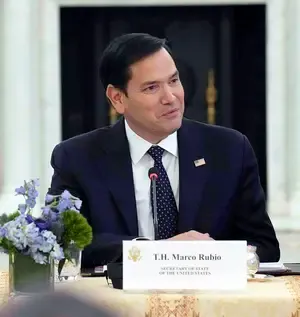
In a pressing warning, US Secretary of State Marco Rubio highlights the alarming concentration of critical minerals supply chains in one nation, raising geopolitical concerns. As the US forges new partnerships with 55 countries to diversify sourcing, the implications for economic growth and national security are profound.
Key Takeaways
Critical minerals supply chains are heavily concentrated in one nation.
The situation poses significant geopolitical risks .
The US is collaborating with 55 international partners to diversify sourcing.
Unfair competition from state-subsidized foreign entities hampers local investment.
Global cooperation is essential to secure access to critical minerals.
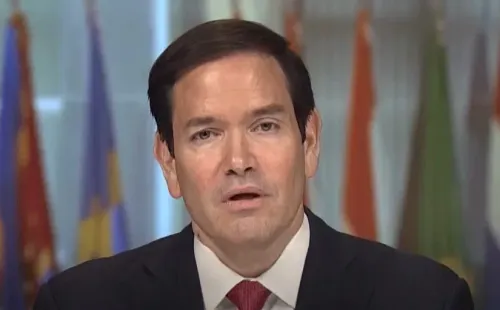
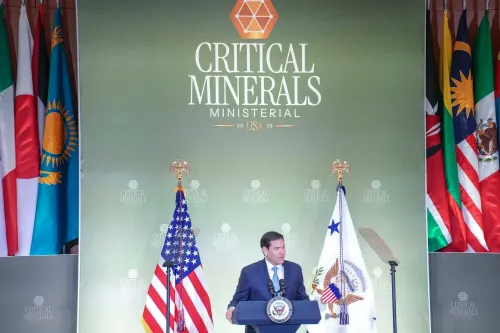
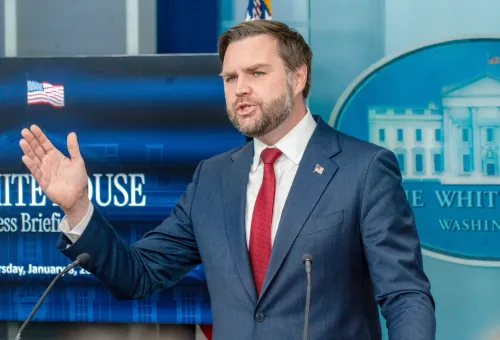
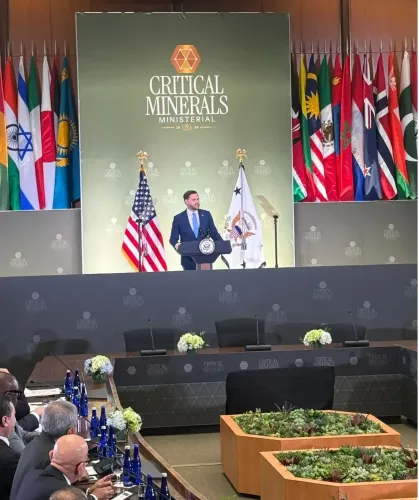
Washington, Feb 4, (NationPress): US Secretary of State Marco Rubio expressed concerns on Wednesday that the global supply chains for critical minerals are alarmingly centralized in one nation, labeling this scenario as a significant geopolitical risk. This statement comes as Washington embarks on a renewed effort to diversify sourcing through partnerships with 55 international allies.
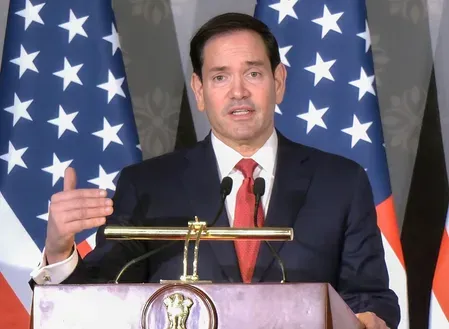
During a press briefing at the Critical Minerals Ministerial, Rubio outlined that the initiative aims to mitigate vulnerabilities that could hinder economic growth, technological advancement, and national security.
“The Critical Minerals Ministerial is off to an excellent start. We are collaborating with 55 partners, many of whom have already committed, with a straightforward objective,” he stated.
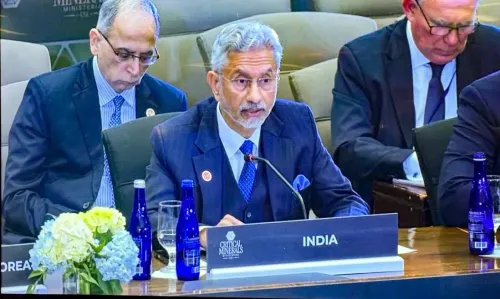
India was represented at the conference by External Affairs Minister S Jaishankar.
Rubio criticized policymakers in developed nations for neglecting the necessity of securing raw materials. “We became enamored with the design of these products but forgot that to create something, we must first be able to construct it, which requires fundamental materials,” he elaborated.
He emphasized that current supply chains are excessively concentrated in one nation, posing risks that extend beyond mere economics. “In a worst-case scenario, this could be manipulated as a leverage tool in geopolitical affairs,” Rubio remarked, highlighting that global disruptions like pandemics or political turmoil could also disrupt supplies.
Rubio mentioned that while many nations have access to critical minerals, they struggle to develop them due to unfair competition. Foreign competitors often lower prices through state subsidies, rendering mining and processing economically unfeasible. “Private sector investment is stifled because competitors undercut costs to gain market dominance,” he noted.
He cautioned that if one entity monopolizes the market, the repercussions could be severe. “When they dominate the industry and are the sole global players, they can dictate prices at will,” Rubio explained, adding that such monopolistic control could be utilized for leverage or be susceptible to global disruptions. “This is an unsustainable predicament,” he asserted.
Rubio highlighted that the United States is striving to set an example through domestic reforms and fresh demand signals. He referenced permitting reforms and President Donald Trump's announcement of a strategic stockpile of critical minerals. “We recognize that this is a global challenge requiring a collective response,” he stated.
He announced the initiation of the FORGE initiative, noting that several countries have already joined, with more anticipated. Rubio stated that U.S. agencies, including the Development Finance Corporation and the Export-Import Bank, will provide financing solutions for investments in critical minerals, with Treasury Secretary Scott Bessent concluding the ministerial later that day.
“We plan to finalize new frameworks for critical minerals with several partners today,” Rubio remarked, calling the gathering historic and referencing “the billions of dollars the United States government has already allocated towards this cause.”
Regarding Ukraine, Rubio noted that technical military teams from both Ukraine and Russia are meeting in a forum involving the United States.
“For the first time in a long time, we have technical military teams from Ukraine and Russia convening,” he stated. While urging caution against premature conclusions, Rubio mentioned that the number of unresolved issues has decreased. “That list has been notably shortened,” he observed, adding that the remaining issues are the most challenging.
Rubio highlighted that critical minerals will be pivotal to Ukraine’s recovery. “This war will eventually conclude. When it does, Ukraine must utilize all the resources at its disposal to rebuild,” he said.
In response to inquiries regarding Iran, Rubio indicated that President Trump is open to dialogue. “We do not perceive meetings as concessions,” he said, asserting that any substantial discussions must address missiles, terrorism, the nuclear agenda, and the treatment of the Iranian populace.
Rubio also emphasized the importance of partnerships with countries like Argentina and Morocco, asserting that no nation can fulfill its needs independently. “No country possesses every critical mineral that is essential,” he said, underscoring the necessity for international collaboration.
Point of View
It is evident that the issue of critical minerals supply chains is paramount not only for the United States but also for global economic stability. As nations navigate the complexities of international trade and competition, collaboration will be essential to ensure secure access to these vital resources.
NationPress
12 Oct 2026
Frequently Asked Questions
Why are critical minerals important?
Critical minerals are essential for various technologies, including renewable energy, electronics, and defense systems. Their availability directly impacts economic growth and national security.
What risks are associated with concentrated supply chains?
The concentration of supply chains can lead to vulnerabilities where geopolitical tensions or global disruptions can severely impact access to critical resources.
How is the US addressing the challenges in critical minerals supply?
The US is actively diversifying its sourcing by collaborating with international partners and implementing domestic reforms to secure a stable supply of critical minerals.
What role do international partners play in securing critical minerals?
International partners are crucial in developing and accessing critical minerals, as no single nation can fulfill all its requirements independently.
How do state subsidies affect competition in the minerals market?
State subsidies can enable foreign competitors to undercut prices, making it challenging for domestic companies to compete and invest in critical mineral development.