Sacks Cites Study: AI Boosts Jobs, Not Cuts Them
Synopsis
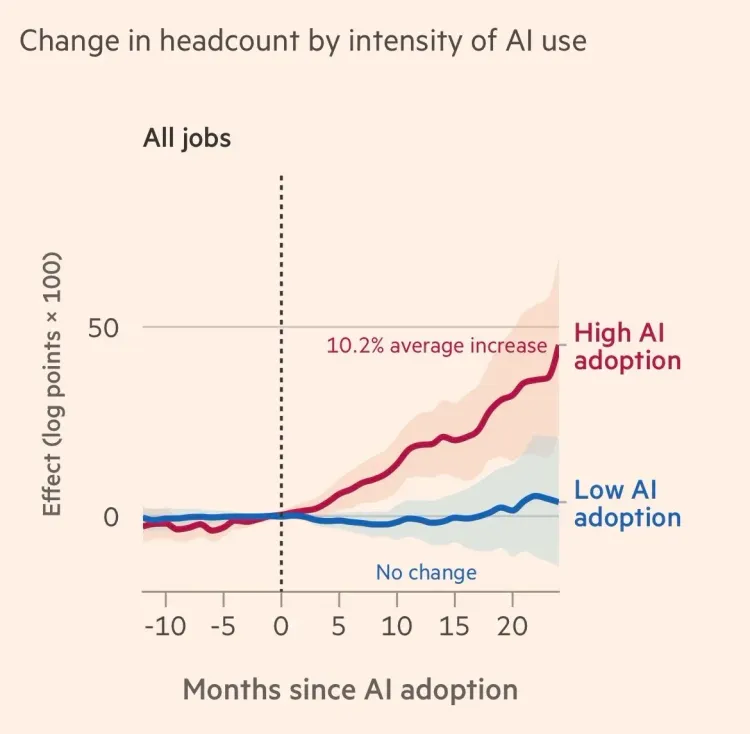
White House AI and Crypto Czar David Sacks shared a study of 21,559 U.S. firms showing that high-intensity AI adopters grew employment by 10% and entry-level headcount by 12%, directly countering predictions of broad AI-driven job losses.
Key Takeaways
White House AI and Crypto Czar David Sacks posted findings from a study of 21,559 U.S. firms on 30 June 2026 , calling them a 'narrative violation.' Firms with the highest AI investment intensity grew employment by roughly 10% following adoption.
Entry-level headcount rose 12% among high-intensity AI adopters, while low-intensity adopters saw no significant change.
Job gains were broad across engineering, sales, administration, and customer service roles, and emerged gradually.
The study used Ramp card and bill-pay spending data linked to Revelio Labs workforce records — observed behaviour, not self-reported surveys.
The findings align with the Trump administration's push for lighter-touch AI regulation and faster AI adoption across the U.S. economy.
White House AI and Crypto Czar David Sacks on Tuesday, 30 June 2026 shared findings from a large-scale study of 21,559 U.S. firms, arguing that the data directly contradicts mainstream fears about artificial intelligence eliminating jobs. Sacks framed the research as a 'narrative violation' — his term for evidence that upends the prevailing public discourse on AI and employment.
What the Study Found
The study, which draws on observed AI spending from Ramp card and bill-pay data linked to Revelio Labs workforce records, examined how firms changed their hiring patterns after adopting AI tools. Its headline finding: companies that adopt AI 'tend to grow faster following adoption.' The dataset is notable for being grounded in actual corporate spending behaviour rather than self-reported survey responses, lending it methodological credibility.
Among the most striking figures: firms making the largest AI investments saw employment grow by roughly 10% following adoption, while low-intensity adopters recorded no statistically significant change in headcount. Entry-level hiring showed an even sharper lift — entry-level headcount rose 12% for high-intensity adopters. The authors note that gains 'emerge gradually and are broad across roles, including engineering, sales, administration, and customer service.'
Context: The Jobs-vs-AI Debate
The question of whether AI destroys or creates jobs has dominated policy conversations across governments, think-tanks, and labour unions globally. Prominent economists and international bodies have warned of significant displacement, particularly for white-collar and routine cognitive tasks. Sacks, who oversees AI policy coordination for the Trump administration, has consistently pushed back against what he views as alarmist narratives, and this post fits squarely within that posture.
The study's conclusion — that 'the results counter predictions that AI adoption will lead to broad job loss' — gives the White House a data point to cite as it seeks to accelerate AI adoption across the U.S. economy. The administration has made reducing regulatory friction for AI development a central plank of its technology agenda since taking office in January 2025.
Policy Backdrop
Sacks's role as AI and Crypto Czar was created to centralise technology policy within the executive branch, giving him influence over federal AI procurement, regulation, and international competitiveness strategy. His amplification of pro-AI employment research is consistent with the administration's effort to build a public-opinion case for lighter-touch AI governance. The findings also arrive as Congress debates several AI-related bills touching on liability, transparency, and workforce retraining funding.
For India, which has positioned itself as a global AI services hub and is actively negotiating a bilateral technology partnership with Washington, the study's framing matters. Indian IT firms and policymakers tracking U.S. AI policy will note that the White House's chief AI voice is now publicly championing research suggesting AI is a net job creator — a framing that could shape future trade and technology cooperation terms.
What's Next
The study is likely to be cited in upcoming White House policy documents and Congressional testimony as the administration builds its case for pro-growth AI regulation. Labour groups and independent economists are expected to scrutinise the Ramp-Revelio methodology, particularly whether the sample of firms using Ramp's corporate card is representative of the broader U.S. business population. The gradual nature of the employment gains noted by the researchers also leaves open the question of displacement in the short term even if net hiring rises over a longer horizon. Expect the findings to fuel further debate at the intersection of AI governance, labour economics, and industrial policy on both sides of the Atlantic and Pacific.
Point of View
Not merely a retweet of interesting research. By labelling the findings a 'narrative violation,' he is directly contesting the dominant media and academic framing that AI is a net job destroyer — and doing so with corporate spending data that is harder to dismiss than survey-based research. For the Trump administration, this is ammunition for its deregulatory AI agenda ahead of expected Congressional battles over AI liability and labour-protection rules. The broader implication is that Washington's AI policy posture is increasingly built around a 'growth and jobs' narrative, which will shape how U.S. partners — including India — are expected to align their own AI governance frameworks.
NationPress
29 Sept 2026
Frequently Asked Questions
What did the AI jobs study cited by David Sacks find?
The study of 21,559 U.S. firms found that companies adopting AI tend to grow faster, with high-intensity AI adopters increasing employment by roughly 10% and entry-level headcount by 12% following adoption, countering predictions of broad job losses.
Who is David Sacks and why does his post matter?
David Sacks is the White House AI and Crypto Czar in the Trump administration, responsible for coordinating U.S. AI and cryptocurrency policy. His public statements signal the administration's official posture on AI governance and employment.
What data source did the AI employment study use?
The study used observed AI spending from Ramp corporate card and bill-pay data, linked to Revelio Labs workforce records, making it based on actual corporate behaviour rather than self-reported surveys.
Does AI adoption hurt entry-level workers?
According to the study cited by Sacks, entry-level workers at high-intensity AI-adopting firms actually saw headcount rise by 12%, suggesting that, at least among this sample, AI adoption did not eliminate entry-level roles.
What does this mean for India's AI and IT sector?
India, positioning itself as a global AI services hub, will closely watch this framing from Washington. If the U.S. administration builds policy around AI as a job creator, it could influence bilateral tech cooperation terms and the regulatory benchmarks India is expected to meet.