Senate Takes Action on Water Crisis Affecting Native American Tribes
Synopsis
As Arizona’s tribal communities grapple with severe water shortages, three Native American tribes urge the Senate to pass a crucial settlement. This legislation aims to secure $5 billion for infrastructure, ensuring reliable access to clean water for thousands of homes still without running water.
Key Takeaways
Settlement Act: Aims to resolve water disputes and provide $5 billion for infrastructure.
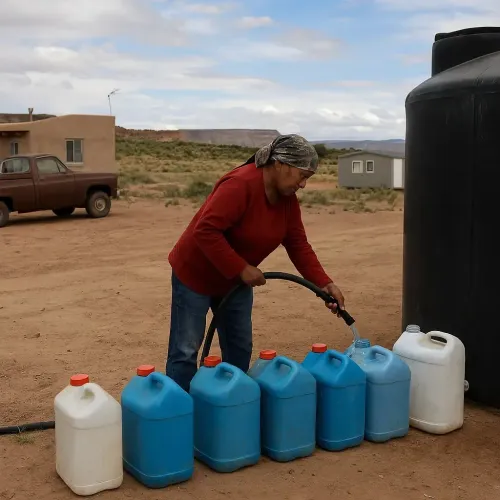
Water Shortages: Thousands of tribal homes lack running water, impacting daily life.
Tribal Sovereignty: The act supports tribal rights and self-sufficiency.
Funding Concerns: The $5 billion cost raises questions about federal commitment.
Essential Projects: Funding will enable critical water infrastructure improvements.
Washington, March 12 (NationPress) Over a century after federal legislation acknowledged that Native American reservations possess inherent water rights, senators revisited a critical issue still plaguing many tribal families in Arizona: why do thousands of residences still lack running water?
During a hearing held by the Senate Committee on Indian Affairs on Wednesday (local time), lawmakers scrutinized an extensive settlement aimed at resolving decades-long disputes concerning water in northeastern Arizona, involving the Navajo Nation, the Hopi Tribe, and the San Juan Southern Paiute Tribe.
The proposed legislation, known as S.953 -- the Northeastern Arizona Indian Water Rights Settlement Act of 2025 -- seeks to ratify a negotiated agreement among the tribes, the state of Arizona, and over 20 additional parties. It also aims to allocate approximately $5 billion in federal funding to construct pipelines, wells, and necessary infrastructure to ensure a reliable supply of drinking water for tribal communities.
For the tribal leaders who came to Washington to provide testimony, the discussion was less about legal frameworks and more about everyday survival.
“I too grew up without access to running water,” Buu, president of the Navajo Nation, shared with senators. He recounted the struggles of families transporting water in buckets over great distances, sometimes traveling more than 30 miles round trip to fulfill basic needs.
The Navajo Nation, which is the largest Indigenous nation in the U.S., serves over 420,000 tribal members, yet about one-third of households on the reservation still do not have running water.
“It is imperative for Congress to take action to resolve the water crisis,” Nygren emphasized.
This proposed settlement aims to address longstanding claims associated with the Colorado River system and provide assurance to both tribal and non-tribal water users throughout Arizona and the broader basin.
Senator Mark Kelly of Arizona, who introduced the legislation, stated that the agreement is the culmination of years of negotiations involving tribal governments, state officials, and local stakeholders.
“Access to clean, dependable water should not be a luxury in the United States,” Kelly remarked, highlighting the significant water shortages faced by the Navajo, Hopi, and San Juan Southern Paiute communities.
Although senators expressed a general consensus on the need to resolve the dispute, the financial implications of the settlement cast a shadow over the hearing.
Lisa Murkowski of Alaska, chair of the committee, noted that negotiated settlements have traditionally been the preferred approach for addressing tribal water claims since they grant tribes the resources necessary to utilize their water rights effectively.
Such agreements provide what many lawmakers in the West refer to as “wet water, not just paper rights,” she explained.
However, Murkowski cautioned that the projected federal cost of around $5 billion comes at a time when Congress is already deliberating several other tribal water settlements.
The challenge, she stated, is not only about authorizing settlements but also about ensuring the federal government delivers on the funding.
Vice Chairman Brian Schatz of Hawaii contended that inaction would have its own set of costs.
“The tribes have upheld their end of the agreement. It is high time for Congress to fulfill its obligations,” he asserted.
Scott Cameron, a senior official from the Interior Department responsible for water and science programs, informed lawmakers that the administration endorses negotiated settlements to circumvent prolonged legal battles.
“Settlements can resolve longstanding disputes, provide certainty to water users, enhance tribal sovereignty and self-sufficiency, and support the development of water infrastructure,” Cameron stated.
Nevertheless, he acknowledged the significant financial hurdles involved.
“We have genuine concerns regarding the overall expense of the settlement,” Cameron admitted, expressing hope that collaboration among lawmakers and tribes could identify ways to minimize costs while retaining the bill's core objectives.
For tribal leaders, this legislation symbolizes more than just infrastructure improvements.
Johnny Lehi Jr., vice president of the San Juan Southern Paiute Tribe, remarked that the bill would also affirm a longstanding land treaty and establish a permanent reservation for his people.
“This represents the difference between waiting for another generation and finally returning home,” he concluded.
Lamar Keevama, chairman of the Hopi Tribe, noted that approximately 30 percent of residents on the Hopi reservation similarly lack running water and must transport water to their homes.
The settlement, he mentioned, would finance essential projects, including wells, pipelines, treatment facilities, and storage systems, crucial for providing safe water to the community.
Point of View
This situation highlights the enduring struggles faced by Native American tribes in securing basic resources. The proposed legislation could represent a significant step toward addressing these inequalities, though the financial implications must be carefully navigated.
NationPress
10 Oct 2026
Frequently Asked Questions
What does the Northeastern Arizona Indian Water Rights Settlement Act aim to achieve?
The act seeks to resolve water disputes among the Navajo Nation, Hopi Tribe, and San Juan Southern Paiute Tribe, providing $5 billion for infrastructure to ensure reliable access to clean water.
Why is access to running water a significant issue for these tribes?
Many families in these communities still lack running water, forcing them to travel long distances to obtain water, affecting their daily lives and basic needs.
What are the financial implications of this settlement?
The settlement is projected to cost approximately $5 billion, which raises concerns about funding and the federal government's commitment to follow through.
How can this settlement impact tribal sovereignty?
By providing tribes with the resources needed to utilize their water rights, this settlement enhances tribal sovereignty and self-sufficiency.
What projects will the funding support?
The funding will support critical infrastructure projects like wells, pipelines, treatment systems, and storage facilities for safe water delivery.