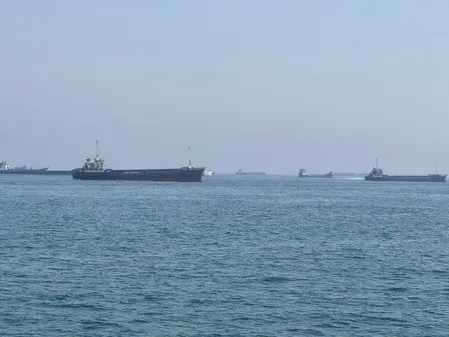
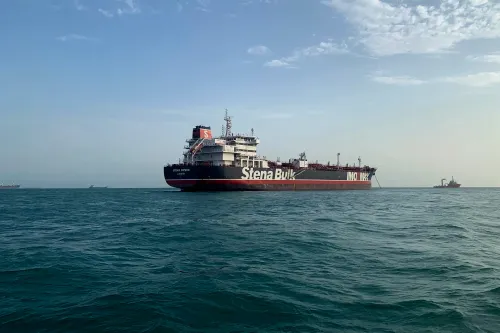
Two Singapore ships hit in Strait of Hormuz; one sinks, 43 crew safe
Synopsis
A Singapore-flagged container ship, GFS PRIDE, has sunk in the Strait of Hormuz after reportedly being struck by an unknown projectile — one of two Singapore-registered vessels hit within 24 hours. Iran's IRGC claims a ship hit a naval mine on an 'unauthorised route.' With 43 crew safely evacuated and the accounts sharply contradictory, this incident signals a dangerous new chapter in Hormuz maritime security.
Key Takeaways
GFS PRIDE , a Singapore-registered container vessel, was struck, caught fire, and sank in the Strait of Hormuz on 14 October 2026 .
A second vessel, GFS GISELLE , sustained hull damage but reached safe anchorage under its own power.
All 43 crew members across both ships — 21 on GFS PRIDE and 22 on GFS GISELLE — were safely evacuated with no injuries.
No Singaporeans were aboard either vessel, the MPA confirmed.
Iran's IRGC claimed a container ship carrying over 2,500 containers sank after striking a naval mine south of the Strait.
Iran has barred safe Hormuz passage to vessels affiliated with Israel and the US since 28 February , following joint strikes on Iranian territory.
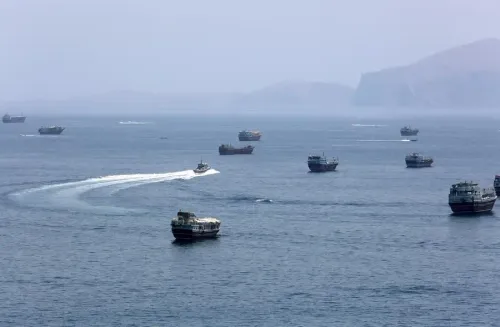
Two Singapore-registered container vessels were reportedly struck by unknown projectiles while transiting the Strait of Hormuz on Tuesday and Wednesday (Singapore time), the Maritime and Port Authority of Singapore (MPA) confirmed on Wednesday, 14 October 2026. One vessel sank after catching fire; the second reached safe anchorage under its own power. All 43 crew members across both ships were evacuated safely, with no injuries reported.
What Happened to the Two Vessels
The first vessel, GFS PRIDE, sustained critical damage after reportedly being struck, caught fire, and subsequently sank. All 21 crew members on board were safely evacuated before the vessel went under, according to the MPA.
The second vessel, GFS GISELLE, suffered hull damage but managed to reach a safe anchorage under its own propulsion. All 22 crew members were confirmed safe. The MPA said it was in contact with the vessels' management company and was closely monitoring the developing situation. It noted that no Singaporeans were aboard either ship.
Iran's IRGC Offers a Starkly Different Account
In a statement published on its official outlet Sepah News, the navy of Iran's Islamic Revolutionary Guard Corps (IRGC) offered a competing narrative. It claimed that a 'violating' container vessel — carrying over 2,500 containers — sank after striking a naval mine south of the Strait of Hormuz, having attempted to transit via an 'unauthorised and high-risk' route. The IRGC Navy urged vessels and fishing boats in the area to exercise extreme caution due to containers floating in the water.
Speaking to state broadcaster IRIB TV, IRGC Navy commander Ali Azmaei stated that the IRGC Navy controls the Gulf and the Strait of Hormuz 'round the clock.' He warned that vessels seeking to cross must obtain authorisation 'and be accountable based on international regulations,' adding that those violating shipping rules under what he described as US 'deception or provocation' would face a 'decisive response' from Iran.
Iran's Grip on the Strait Since February
Iran tightened restrictions on the Strait of Hormuz from 28 February, barring safe passage to vessels belonging to or affiliated with Israel and the United States — a move that followed joint US-Israeli strikes on Iranian territory. The latest incidents mark a significant escalation, with a Singapore-flagged vessel now sunk in what the MPA has characterised as a continued pattern of attacks on commercial shipping.
Notably, the Strait of Hormuz is one of the world's most critical maritime chokepoints, through which roughly 20% of global oil trade transits daily. Any sustained disruption threatens energy supply chains far beyond the immediate region.
MPA's Response and Broader Implications
The MPA expressed 'deep concern' over the continued attacks on commercial shipping in the Strait of Hormuz. The authority did not directly identify who was responsible for striking the vessels, describing the projectiles as 'unknown.' The divergence between the Singapore authority's account and the IRGC's mine narrative remains unresolved, with no independent verification available at the time of reporting.
This is the latest in a series of maritime security incidents in the Gulf region that have drawn international attention. Shipping insurers and global freight operators are expected to reassess risk premiums on Hormuz-transit routes in the wake of this incident. How Singapore and the international community respond — diplomatically and operationally — will be closely watched in the days ahead.
Point of View
Risk premiums across global shipping lanes will reprice sharply, and the pressure on Singapore, as a major shipping registry, to respond diplomatically will intensify. The February ban on Israeli- and US-affiliated vessels was a warning shot; this looks like an enforcement action, and the rules of that enforcement remain opaque.
NationPress
14 Oct 2026
Frequently Asked Questions
What happened to the Singapore-registered ships in the Strait of Hormuz?
Two Singapore-registered container vessels, GFS PRIDE and GFS GISELLE, were reportedly struck by unknown projectiles while transiting the Strait of Hormuz on Tuesday and Wednesday (Singapore time). GFS PRIDE caught fire and sank, while GFS GISELLE sustained hull damage but reached a safe anchorage. All 43 crew members across both vessels were evacuated safely with no injuries.
What does Iran's IRGC say caused the sinking?
Iran's IRGC Navy claimed that a container ship carrying over 2,500 containers sank after striking a naval mine south of the Strait of Hormuz, alleging the vessel was attempting to transit via an 'unauthorised and high-risk' route. This account directly contradicts the MPA's description of strikes by 'unknown projectiles,' and neither version has been independently verified.
Were any Singaporeans among the crew?
No. The Maritime and Port Authority of Singapore (MPA) confirmed that no Singaporeans were aboard either vessel. GFS PRIDE had 21 crew members and GFS GISELLE had 22, all of whom were accounted for and uninjured.
Why has Iran been restricting vessels in the Strait of Hormuz?
Iran tightened its grip on the Strait of Hormuz from 28 February, barring safe passage to vessels belonging to or affiliated with Israel and the United States. The move came in response to joint US-Israeli strikes on Iranian territory. IRGC Navy commander Ali Azmaei has stated that all vessels transiting the Gulf must obtain Iranian authorisation and comply with what he described as international regulations.
What is the strategic significance of the Strait of Hormuz?
The Strait of Hormuz is one of the world's most critical maritime chokepoints, through which roughly 20% of global oil trade passes daily. Any sustained disruption to shipping in the strait can affect global energy prices, supply chains, and freight insurance costs, making incidents there of immediate international economic and geopolitical concern.