South Korea's Lee calls for demographic overhaul, cites AI as reform lever

Synopsis
South Korea has officially become a 'super aged society' with over 21 per cent of its population aged 65 or older — and President Lee Jae Myung is now calling for the entire social and economic architecture to be rebuilt from scratch, with AI positioned not as a threat to jobs but as the central tool for redesigning welfare, education and care systems.
Key Takeaways
President Lee Jae Myung called for a full redesign of South Korea's social and economic systems on 14 October 2026 .
South Korea is now classified as a 'super aged society' , with people aged 65 and older exceeding 21 per cent of the total population.
Lee cited labour, welfare, employment, housing and childcare as sectors requiring structural policy reform.
The president positioned AI-driven innovation as an opportunity to restructure employment, education and elderly care simultaneously.
Lee also flagged growth in the immigrant population and new family structures as emerging demographic trends requiring policy attention.
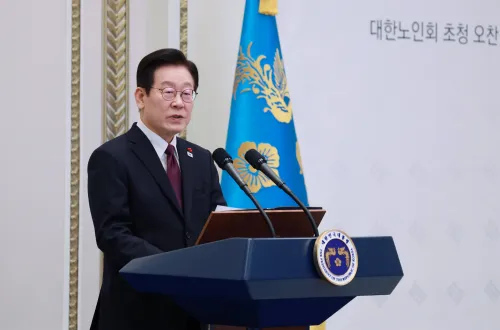
South Korean President Lee Jae Myung on Wednesday, 14 October 2026, called for a sweeping redesign of South Korea's social and economic systems to address accelerating demographic shifts, arguing that the rise of artificial intelligence (AI) offers a rare window to restructure industries, employment, education and elderly care. Lee made the remarks at a meeting of the presidential committee on population strategy, attended by government ministers and dozens of citizens tasked with shaping national population policy.
The Demographic Crisis Behind the Call
South Korea has crossed a critical threshold: people aged 65 and older now account for more than 21 per cent of the total population, formally qualifying the country as a 'super aged society' — defined as one where over 20 per cent of residents are aged 65 or above. The country has simultaneously grappled with one of the world's lowest birth rates, putting mounting pressure on welfare systems, labour markets and public finances.
Beyond ageing and low fertility, President Lee also cited a growing immigrant population and the emergence of 'various forms of family structures' as new demographic realities the policy framework must absorb. This broader framing signals a departure from a purely birth-rate-centred approach to population strategy.
What Lee Proposed
Lee called for policies that foster both 'qualitative' and 'quantitative' population growth, describing the moment as requiring 'a major turnaround' in how the state approaches demographics. 'South Korea's entire social and economic systems should be redesigned from scratch in accordance with population changes,' he said, identifying labour, welfare, employment, housing and childcare as the key sectors requiring structural reform.
The president specifically highlighted AI-driven innovation as an enabler — not merely a disruptor — of this redesign. He argued that AI could reshape employment patterns, modernise education delivery and improve elderly care and childcare infrastructure simultaneously.
The Human-Centred Vision
Lee framed the ultimate policy goal in terms of individual well-being rather than aggregate statistics. 'The clue to resolving population issues would be found only when people have hope that they and their families can grow together and be happy together, no matter where they live or with whom they live,' he said. The key priority, he stressed, is to 'make a country in which all people can enjoy happy lives throughout their life cycles.'
Why This Matters Beyond South Korea
South Korea's demographic crisis is among the most acute in the developed world, and its policy responses are closely watched by other ageing economies including Japan, several European Union states and, increasingly, China. Notably, this is one of the first times a sitting South Korean president has explicitly linked AI policy to population strategy at a formal committee level — a framing that could influence how other governments approach the intersection of technology governance and social reform. The committee's recommendations are expected to feed into upcoming legislative and budgetary decisions.
Point of View
He is attempting to recast an existential social challenge as a modernisation opportunity — a narrative that is easier to sell than austerity or forced immigration. But the gap between the vision and delivery is wide. South Korea's labour market remains structurally rigid, its welfare system is built around a shrinking taxpayer base, and past population initiatives have repeatedly failed to move the birth rate. The real test will be whether the presidential committee's outputs translate into legislative reform or remain aspirational policy documents. Invoking AI as a solution also carries risk: if automation accelerates job displacement faster than new care-sector roles are created, the demographic pressure on public finances could intensify rather than ease.
NationPress
14 Oct 2026
Frequently Asked Questions
Why is South Korea considered a 'super aged society'?
South Korea is classified as a 'super aged society' because people aged 65 and older now account for more than 21 per cent of its total population, crossing the internationally recognised 20 per cent threshold. The country has also recorded one of the world's lowest birth rates for several consecutive years, compounding the ageing trend.
What reforms did President Lee Jae Myung call for?
President Lee called for a comprehensive redesign of South Korea's social and economic systems, specifically targeting labour, welfare, employment, housing and childcare. He also stressed the need for both 'qualitative' and 'quantitative' population growth, marking a shift from policies focused solely on raising birth rates.
How does AI fit into South Korea's population strategy?
President Lee argued that AI-driven innovation presents an opportunity to restructure key sectors including employment, education and elderly and childcare services. Rather than treating AI as a labour-market threat, his framing positions it as an enabler of the systemic redesign required to manage a rapidly ageing population.
What new demographic trends did Lee identify beyond low birth rates?
Beyond ageing and low fertility, Lee highlighted a growing immigrant population and the rise of 'various forms of family structures' as new demographic realities. He stressed that policy must accommodate all life arrangements, not just the traditional family unit.
What happens next after this presidential committee meeting?
The presidential committee on population strategy, which includes government ministers and citizen representatives, is expected to feed its recommendations into upcoming legislative and budgetary decisions. No specific timeline for legislation has been publicly announced.