Oil tanker catches fire east of Hormuz Strait after hitting mines, Iran warns US and Israel
Synopsis
Three oil tankers hit by mines or fire in two days near the Strait of Hormuz — and Iran's armed forces chief has now explicitly threatened asymmetric strikes against any US or Israeli target. With Tehran barring affiliated vessels since February 2026 and Supreme Leader Khamenei's orders cited directly, this is no longer a warning shot: it is an active enforcement campaign on a waterway that carries a fifth of the world's oil.
Key Takeaways
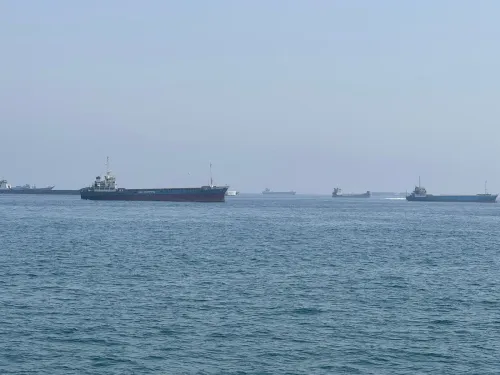
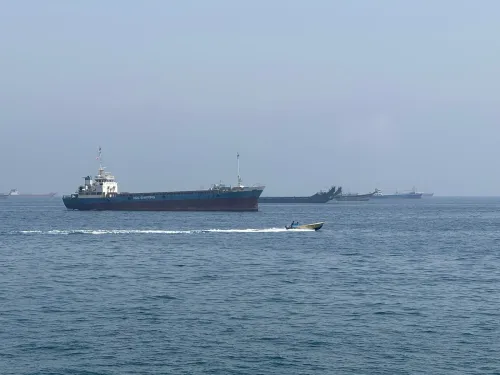
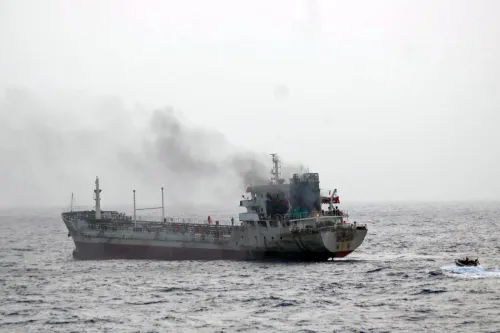
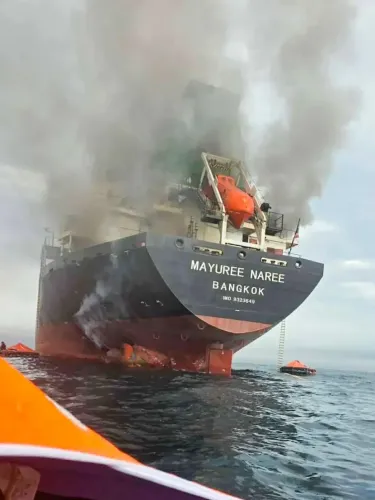
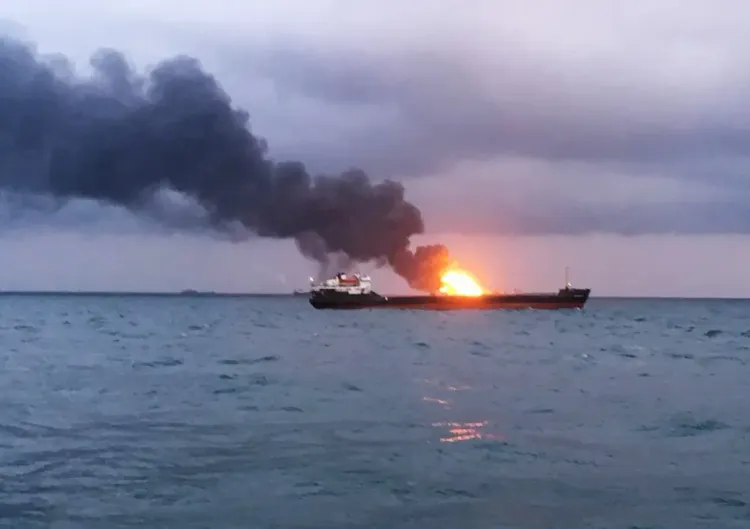
Iran's Army navy confirmed on 11 November 2026 that a 'violating' oil tanker caught fire after hitting naval mines east of the Strait of Hormuz .
On 10 November , the IRGC navy reported two separate tanker explosions on the same route — one from a mine strike, one from a separate incident reportedly involving US air support.
Both tankers on Tuesday had turned off all navigation and identification systems before the blasts, according to Sepah News .
Chief of Staff Ali Abdollahi warned the US and Israel that any threat focal point would become 'a direct target of asymmetric operations.' Iran restricted passage for US- and Israel-linked vessels through the strait from 28 February 2026 , following joint strikes on Iranian territory.
The strait handles approximately 20% of global oil trade, making sustained disruption a major energy-market risk.
Iran's Army navy said on Wednesday, 11 November 2026 that a 'violating' oil tanker caught fire in the early hours of the day after striking naval mines in waters east of the Strait of Hormuz. The incident marks the second consecutive day of tanker explosions in the strategically critical waterway, raising fears of a broader maritime confrontation.
How the Incident Unfolded
According to an Iranian naval statement, the tanker was transiting what Iran describes as an 'unsafe and forbidden' region east of the strait when it hit mines. Iran's navy stressed that safe passage through the waterway requires advance coordination with the Iranian armed forces and compliance with maritime regulations — a condition Tehran has imposed since February 2026.
The navy added that its forces are actively monitoring the strait's eastern waters, signalling that enforcement operations are ongoing rather than incidental.
Tuesday's Twin Explosions: What We Know
The Wednesday incident follows a statement on Tuesday, 10 November by the navy of Iran's Islamic Revolution Guard Corps (IRGC), which said two 'violating' oil tankers suffered massive explosions on what it called the 'unauthorised' route in the strait. Both tankers had reportedly turned off all navigation and identification systems before the blasts.
According to the IRGC's official outlet Sepah News, one vessel struck a naval mine and exploded, while the second was set ablaze following a separate incident — with US fighter aircraft described as providing support to that vessel. The US has not independently confirmed this account.
The IRGC reiterated that any vessel transiting the route 'in cooperation with the terrorist US Army' would face the same fate, in what analysts are calling an escalatory ultimatum.
Iran's Armed Forces Issue Direct Threat to US and Israel
Separately on Wednesday, Chief of Staff of the Iranian Armed Forces Ali Abdollahi issued a pointed warning to both the United States and Israel. He cautioned against any 'new miscalculation,' stating that 'any point that serves as a focal point for threats against the existence of the sacred establishment of the Islamic Republic of Iran will become a direct target of asymmetric operations.'
Abdollahi said in a message carried by Iranian state media that the armed forces would carry out orders from the country's Supreme Leader Mojtaba Khamenei 'without hesitation.' The statement underlines the chain of command behind what appears to be a deliberate naval enforcement campaign.
Background: Hormuz Restrictions Since February 2026
Iran tightened its grip on the Strait of Hormuz on 28 February 2026, barring safe passage to vessels belonging to or affiliated with Israel and the United States. The move came in direct response to joint US-Israeli strikes on Iranian territory. The strait carries an estimated 20% of global oil trade, making any sustained disruption a significant energy-market risk.
Notably, this is at least the third tanker incident in two days attributed to Iranian naval action — a pattern that suggests a deliberate policy of enforcement rather than isolated encounters. How the United States and Israel respond, and whether third-party shippers alter their routing, will determine how quickly this escalates into a full maritime crisis.
Point of View
Now backed by the explicit authority of the Supreme Leader. What mainstream coverage underweights is the deliberate use of naval mines, a weapon that creates unpredictable danger for all shipping, not just US- or Israel-affiliated vessels. Iran's framing of these incidents as enforcement against 'violating' ships gives it legal-sounding cover, but the deployment of mines in a commercially vital international strait is a threshold that few nations have crossed in the modern era. If Washington and Tel Aviv do not respond, Tehran has effectively redrawn the rules of the strait; if they do, the escalation ladder in the Gulf has no obvious stopping point.
NationPress
11 Nov 2026
Frequently Asked Questions
What happened to the oil tanker near the Strait of Hormuz on 11 November 2026?
Iran's Army navy reported that a 'violating' oil tanker caught fire after striking naval mines in waters east of the Strait of Hormuz in the early hours of 11 November 2026. The navy said the vessel was transiting an area it has designated as 'unsafe and forbidden' without coordination with Iranian forces.
What happened to the two tankers on 10 November 2026?
The IRGC navy said two oil tankers suffered massive explosions on the 'unauthorised' route through the Strait of Hormuz on 10 November 2026. One struck a naval mine and exploded; the second was set on fire in a separate incident, with the IRGC claiming US fighter aircraft were supporting that vessel — an account the US has not confirmed.
Why is Iran blocking ships in the Strait of Hormuz?
Iran restricted safe passage for vessels affiliated with Israel or the United States through the Strait of Hormuz from 28 February 2026, following joint US-Israeli strikes on Iranian territory. Tehran says any ship transiting without coordination with its armed forces is on an 'unauthorised' route.
What threat did Iran's military chief issue to the US and Israel?
Chief of Staff of the Iranian Armed Forces Ali Abdollahi warned on 11 November 2026 that 'any point that serves as a focal point for threats against the Islamic Republic of Iran will become a direct target of asymmetric operations.' He said the armed forces would act on orders from Supreme Leader Mojtaba Khamenei without hesitation.
How significant is the Strait of Hormuz for global oil supply?
The Strait of Hormuz is one of the world's most critical energy chokepoints, carrying an estimated 20% of global oil trade. Any sustained disruption to shipping through the waterway has immediate implications for international crude prices and energy security.