Trump Addresses Nation on U.S. Retaliatory Strikes Against Iran
Synopsis
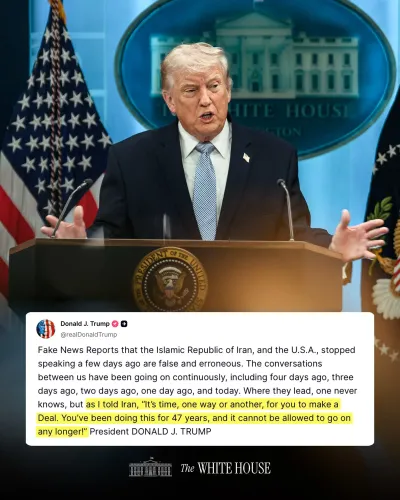
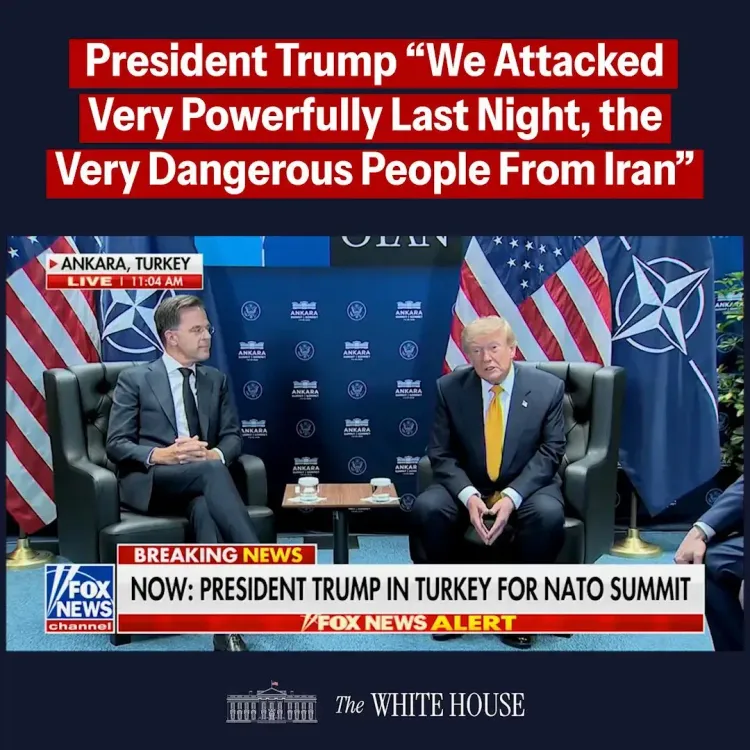
President Donald J. Trump on July 8, 2026, publicly updated the nation on retaliatory military strikes by U.S. Forces against Iran. The White House announcement marks a sharp escalation in decades-long US-Iran tensions, with implications for Gulf security, global oil markets, and India's diaspora in the region.
Key Takeaways
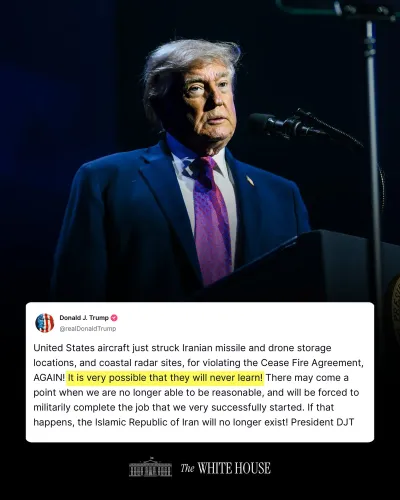
President Trump personally addressed the public on July 8, 2026 , confirming U.S. retaliatory strikes against Iran .
The White House framed the military action as 'retaliatory,' invoking a US doctrine of deterrence and self-defence.
US-Iran tensions have escalated cyclically since 1979 , with the first Trump term marked by the JCPOA withdrawal (2018) and the Soleimani strike (2020) .
Approximately 9 million Indian nationals in Gulf Cooperation Council countries could face risk if the conflict broadens.
Detailed Department of Defense briefings and UN Security Council consultations are expected in the coming days.
Iran's response — military, proxy, or diplomatic — will determine whether the situation escalates into a wider regional conflict.
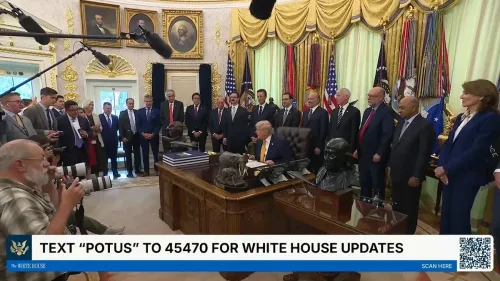
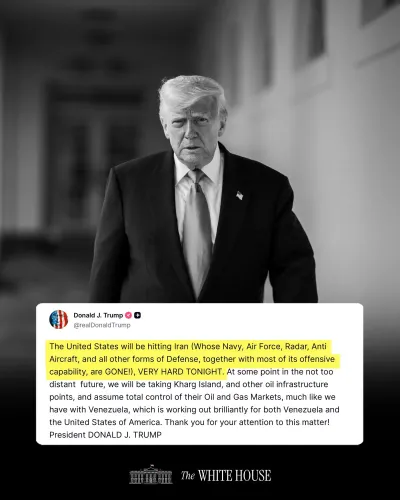
President Donald J. Trump on Wednesday, July 8, 2026, delivered a public update on retaliatory military strikes carried out by U.S. Forces against Iran, the White House announced via its official communications channel. The statement confirms direct American military action against Iranian targets, marking a significant escalation in the long-running confrontation between Washington and Tehran.
Context
The White House described the action as 'retaliatory strikes,' signalling that the military operation was framed as a response to a prior Iranian provocation. President Trump's address to the public underscores the gravity of the action, with the executive office choosing to communicate directly through official channels rather than leaving the announcement solely to the Department of Defense.
The use of the word 'retaliatory' is legally and diplomatically significant — it positions the strikes under the established US doctrine of self-defence and deterrence, a framework successive administrations have invoked when authorising limited military force against Iranian-linked targets.
Policy Backdrop
US-Iran tensions have followed a decades-long cycle of sanctions, proxy conflict, and calibrated military responses dating back to the 1979 Islamic Revolution and the 1980s Tanker War. During his first term (2017–2021), Trump withdrew the United States from the Joint Comprehensive Plan of Action (JCPOA) in May 2018 and reimposed sweeping economic sanctions on Tehran.
The most dramatic military action of that period came in January 2020, when a US drone strike killed senior Iranian Revolutionary Guard Corps commander General Qasem Soleimani near Baghdad. Iran responded with ballistic missile strikes on US bases in Iraq, a pattern that illustrated how both sides have historically sought to signal resolve while avoiding full-scale war.
Iran's nuclear programme, its ballistic missile arsenal, and its network of regional proxies across Iraq, Syria, Lebanon, and Yemen have remained the central friction points in bilateral relations. American military posture in the Middle East has been shaped around deterring both nuclear breakout and proxy attacks on US personnel and allied governments.
Stakeholders and Impact
US armed forces personnel deployed across the Middle East are the most immediate stakeholders, both as the instrument of the strikes and as potential targets for any Iranian counter-response. Gulf Arab allies, including Saudi Arabia and the United Arab Emirates, will be closely watching escalation signals, given their geographic proximity to any Iranian retaliation.
For India, which maintains significant energy ties with Iran and has a large diaspora in the Gulf region, any broader military escalation carries economic and humanitarian implications — from crude oil price volatility to the safety of approximately 9 million Indian nationals living and working in the Gulf Cooperation Council countries.
The Iranian leadership now faces the calculus of whether and how to respond — a decision that will shape regional security for months ahead. Diplomatic activity at the UN Security Council is expected to intensify as member states assess the legality and proportionality of the strikes.
What's Next
Detailed strike assessments are expected from the Department of Defense, including information on targets, munitions used, and battle-damage evaluation. The international community, including European Union partners and UN officials, is likely to call for restraint and emergency consultations.
The trajectory of US-Iran relations in the coming days will depend on whether Tehran opts for a direct military counter-strike, a proxy response through regional militant groups, or a diplomatic offensive at the United Nations. Any significant Iranian retaliation could trigger further American military action, raising the risk of a broader regional conflict with global economic consequences.
Point of View
Reinforcing his image as a commander-in-chief willing to use force. The 'retaliatory' framing is carefully chosen: it anchors the action in international law while leaving room for further escalation if Iran responds. For the broader Middle East, this moment echoes the post-Soleimani dynamic of 2020, where both sides demonstrated capability without crossing into all-out war. The episode also tests whether the second Trump administration's maximum-pressure posture can achieve deterrence without triggering the regional conflagration that Gulf allies and global energy markets fear most.
NationPress
8 Jul 2026
Frequently Asked Questions
Why did the US carry out retaliatory strikes against Iran in 2026?
The White House described the strikes as 'retaliatory,' indicating they were a response to a prior Iranian provocation, though full details of the triggering incident are expected in forthcoming Department of Defense briefings.
What is the history of US military action against Iran?
The US and Iran have a long history of confrontation, including the 1980s Tanker War, the 2018 JCPOA withdrawal, and the January 2020 drone strike that killed Iranian General Qasem Soleimani, which prompted Iranian missile attacks on US bases in Iraq.
How do the US strikes on Iran affect India?
India has significant energy ties with Iran and approximately 9 million nationals living in Gulf Cooperation Council countries, meaning any broader military escalation could impact crude oil prices and the safety of the Indian diaspora in the region.
What will Iran do in response to US strikes?
Iran's options include a direct military counter-strike, proxy responses through regional militant groups, or a diplomatic offensive at the UN Security Council — each carrying different implications for regional stability.
What happens next after Trump's announcement on Iran strikes?
The Department of Defense is expected to release detailed strike assessments, while the UN Security Council is likely to convene emergency consultations as the international community monitors the situation for further escalation.