Trump Claims Victory in Iran Conflict, Predicts Swift Resolution
Synopsis
US President Donald Trump announces significant military success in Iran, hinting at a potential end to the conflict within days. As tensions rise, he warns Tehran against jeopardizing global energy supplies and discusses the impact of extensive military operations.
Key Takeaways
Operation Epic Fury represents a significant military effort by the US and Israel against Iran.
President Trump claims substantial degradation of Iran's military capabilities.
The Strait of Hormuz remains a vital shipping route for global energy.
Trump warns Iran against disrupting shipping in the region.
Military campaign could conclude within days according to the president.
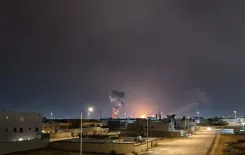
Washington, March 10 (NationPress) US President Donald Trump stated that the United States and Israel are achieving a "decisive victory" in the ongoing military operations against Iran, indicating that the conflict might conclude in just a few days. He defended the magnitude of the recent strikes and cautioned Tehran against endangering global energy supplies.
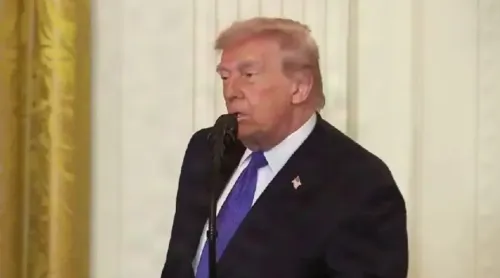
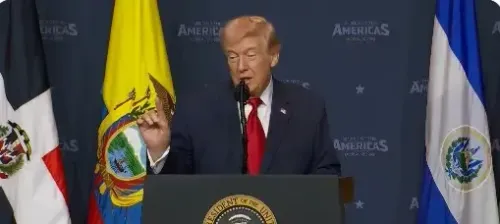
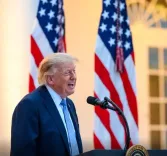
During a press conference at Trump National Doral Miami, Trump referred to the joint military effort, dubbed Operation Epic Fury, as one of the largest military operations in recent memory.
“In the last nine days, we have executed some of the most powerful and intricate military strikes and maneuvers ever witnessed,” Trump asserted.
The president claimed that the campaign has considerably weakened Iran's military strength, impacting its naval forces, drone technology, and missile launch capabilities.
“We have completely obliterated every single military force in Iran. Most of Iran's naval assets are now resting at the bottom of the ocean,” he declared.
Trump mentioned that around 50 Iranian naval vessels have been eliminated. “It's nearly 50 ships. I was just informed. It's actually 51 ships.”
He indicated that Iranian missile and drone capabilities have been drastically diminished due to relentless strikes.
“Their missile potential is reduced to about 10 percent, perhaps even less,” he remarked, noting that drone manufacturing facilities are now under attack.
“We have identified all the locations where they produce drones, and we are targeting them one by one.”
Trump reported that US forces have hit over 5,000 targets throughout the operation, which includes weapon depots, missile launchers, and production facilities.
“We have successfully struck more than 5,000 targets to date, many of which are significant,” he stated.
The president also praised the role of long-range bombers in destroying critical weapon systems.
“Our B-2 bombers recently deployed numerous 2,000-pound bombs to eliminate missile launchers concealed deep within Iranian territory.”
Trump contended that the operation has thwarted Iran's efforts to develop nuclear weapons, referencing earlier strikes under what he termed Operation Midnight Hammer.
“If we hadn't executed Midnight Hammer… they would have obtained a nuclear weapon,” he warned. “They would have used it long ago.”
The president noted that Iran had spurned diplomatic overtures concerning civilian nuclear energy.
“They even declined an offer for unlimited free nuclear fuel indefinitely. For peaceful purposes.”
Trump cautioned Tehran against jeopardizing shipping routes in the Strait of Hormuz, a vital artery for global energy.
“The Strait of Hormuz will remain secure,” he affirmed. “If Iran engages in any disruptive actions, they will face severe consequences.”
He also announced that the US would provide political risk insurance for commercial tankers navigating the Gulf. “Meanwhile, during this temporary disruption, the United States is offering political risk insurance to any tankers operating in the region.”
When asked how long the conflict might persist, Trump suggested that the military phase could wrap up soon. “Days, I believe soon,” he responded when queried if the war could conclude this week.
Trump also mentioned a conversation he had with Russian President Vladimir Putin earlier in the day. “I had a very constructive call with President Putin,” he remarked, adding that they discussed issues surrounding Ukraine and the Middle East.
Throughout the interaction with reporters, Trump acknowledged reports of eight US military fatalities connected to the conflict. He stated that the families of the fallen service members urged him to continue the operation.
“They all said the same thing, finish the job, sir, please finish the job.”
The United States initiated military strikes against Iranian military and nuclear facilities amid escalating tensions between Tehran and Israel, which Washington claims poses a growing threat to regional stability and global energy supplies.
The Strait of Hormuz, located between Iran and Oman, is among the world's most crucial oil transit routes. Approximately one-fifth of global oil consumption traverses the narrow channel, making any disruption there a significant concern for international markets.
Point of View
It is essential to view President Trump's statements through a lens of cautious optimism. While the military campaign against Iran is framed as a success, the broader implications for regional stability and international relations remain uncertain. The potential for escalation requires careful monitoring.
NationPress
20 Sept 2026
Frequently Asked Questions
What is Operation Epic Fury?
Operation Epic Fury is the name given to the ongoing military campaign conducted by the United States and Israel against Iran.
How many Iranian naval vessels have been destroyed?
President Trump stated that nearly 51 Iranian naval vessels have been destroyed during the campaign.
What is the significance of the Strait of Hormuz?
The Strait of Hormuz is a critical global energy route where about one-fifth of the world's oil passes through, making any disruption a major concern.
What impact has the military campaign had on Iranian missile capabilities?
According to President Trump, Iranian missile capabilities have been reduced to about 10 percent of their previous capacity.
Did Iran reject any diplomatic offers?
Yes, President Trump mentioned that Iran declined an offer for unlimited free nuclear fuel for civilian purposes.