Trump Presents FIFA World Cup Trophy to Spain at 2026 Tournament
Synopsis
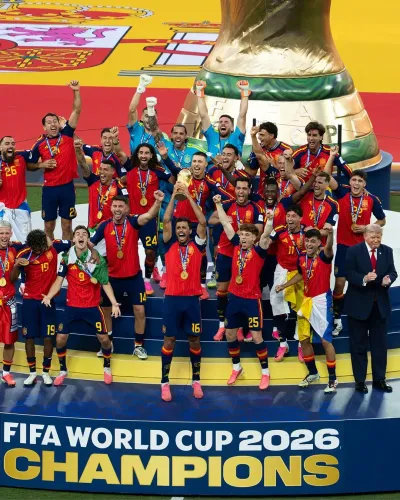
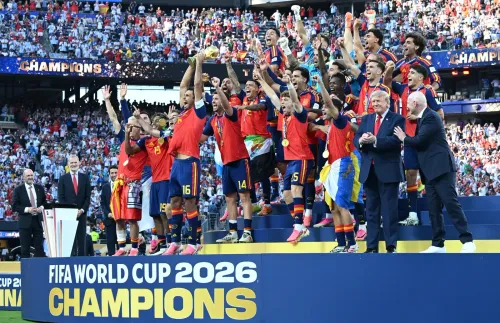
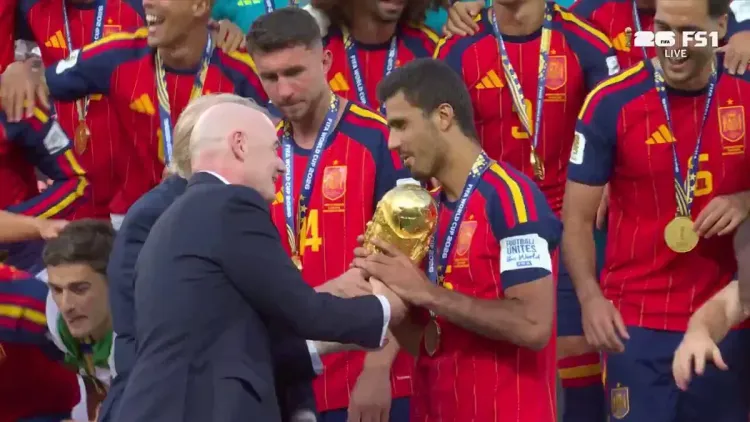
President Donald J. Trump presented the FIFA World Cup Trophy to Spain, confirmed as the 2026 FIFA World Cup champions. The White House announced the ceremony, held at the co-hosted tournament spanning the United States, Canada, and Mexico — the largest edition in the competition's history.
Key Takeaways
Spain has been confirmed as the 2026 FIFA World Cup champions.
Trump personally presented the World Cup Trophy to Spain in a formal ceremony.
The 2026 FIFA World Cup was co-hosted by the United States , Canada , and Mexico — the first edition to feature 48 teams .
Hosting rights were awarded to the United Bid in June 2018 , continuing a pattern of North American co-hosting for global football.
Spain's victory is their second FIFA World Cup title , following their 2010 triumph in South Africa.
The White House shared a video of the trophy presentation via its official X account on 20 July 2026 .
President Donald J. Trump presented the FIFA World Cup Trophy to Spain, the champions of the 2026 FIFA World Cup, in a ceremony on Sunday, 19 July 2026. The White House announced the moment via its official X account, marking a historic ceremonial role for the sitting US president at the tournament co-hosted by the United States, Canada, and Mexico.
Context
The White House post confirmed Spain as the 2026 FIFA World Cup champions, with President Trump personally handing over the coveted trophy. The announcement was accompanied by a video, offering a visual record of the ceremony. Spain's victory adds a second World Cup title to the nation's football legacy, following their 2010 triumph in South Africa.
The 2026 FIFA World Cup was the first edition to feature 48 teams, an expansion from the previous 32-team format. The tournament was spread across venues in the United States, Canada, and Mexico, making it one of the largest co-hosted sporting events in history.
Policy Backdrop
Hosting rights for the 2026 FIFA World Cup were awarded to the United Bid — a joint proposal from the United States, Canada, and Mexico — by FIFA in June 2018. The decision continued a long tradition of North American collaboration in global football, echoing the 1994 FIFA World Cup held solely in the United States.
US presidents have historically performed ceremonial roles at major international sporting events on American soil. Trump's presentation of the trophy to Spain follows this established protocol, positioning the presidency as a symbol of American hospitality on the global stage.
Stakeholders and Impact
Spain's national football team and its millions of supporters worldwide are the primary beneficiaries of this victory. For the co-host nations — particularly the United States — a successful tournament culminating in a high-profile presidential ceremony underscores the diplomatic and cultural value of staging global sporting events.
Football fans across India and the broader South Asian diaspora, many of whom followed the expanded 48-team tournament closely, witnessed a landmark moment in the sport's history. Spain's triumph is expected to fuel renewed interest in European club football globally.
What's Next
With the 2026 FIFA World Cup now concluded, attention will shift to the 2030 FIFA World Cup, which is set to be hosted across multiple continents to mark the tournament's centenary. FIFA is expected to begin detailed preparations and qualification processes in the months ahead.
For Spain, the victory is likely to trigger a new cycle of investment in domestic football infrastructure and youth development programmes. The country will also receive automatic qualification as defending champions for the 2030 edition.
Point of View
A second World Cup title cements their status among football's elite nations and arrives at a moment when European football is asserting global dominance. The ceremony also signals that the expanded 48-team format, controversial when announced, delivered a commercially and diplomatically successful tournament. Globally, this moment will be read as a validation of FIFA's decision to award co-hosting rights to North America.
NationPress
21 Jul 2026
Frequently Asked Questions
Who won the 2026 FIFA World Cup?
Spain won the 2026 FIFA World Cup, with President Donald J. Trump presenting the trophy to the Spanish team in a formal ceremony confirmed by the White House on 20 July 2026.
Where was the 2026 FIFA World Cup held?
The 2026 FIFA World Cup was co-hosted by the United States, Canada, and Mexico, making it the first World Cup spread across three nations and the first to feature 48 teams.
How many World Cups has Spain won?
Spain has now won two FIFA World Cups — their first in 2010 in South Africa, and their second in 2026 at the tournament co-hosted by the United States, Canada, and Mexico.
Why did Trump present the FIFA World Cup Trophy?
As the sitting US president and leader of one of the three co-host nations, Trump performed a ceremonial role in presenting the World Cup Trophy to Spain, continuing a tradition of US presidents participating in major international sporting events held on American soil.
When did the US get the rights to host the 2026 FIFA World Cup?
FIFA awarded hosting rights for the 2026 FIFA World Cup to the United Bid — comprising the United States, Canada, and Mexico — in June 2018.