Trump Visits Philippines, Calls It One of America's Oldest Allies

Synopsis
President Trump visited the Philippines in November 2026, calling it one of America's oldest and most important allies. The trip reinforces the 1951 Mutual Defense Treaty and signals US commitment to its Indo-Pacific posture amid ongoing South China Sea tensions.
Key Takeaways
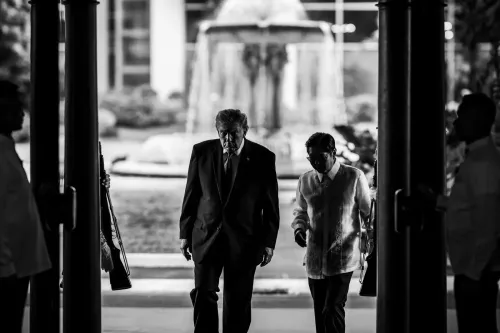
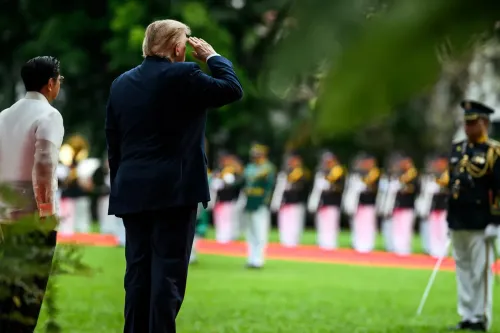
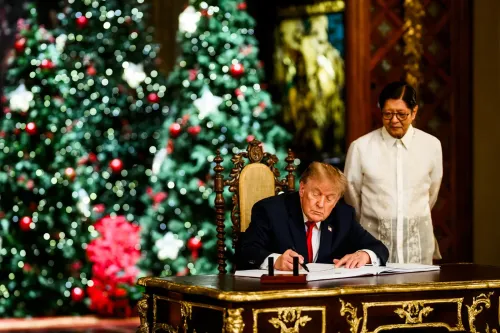
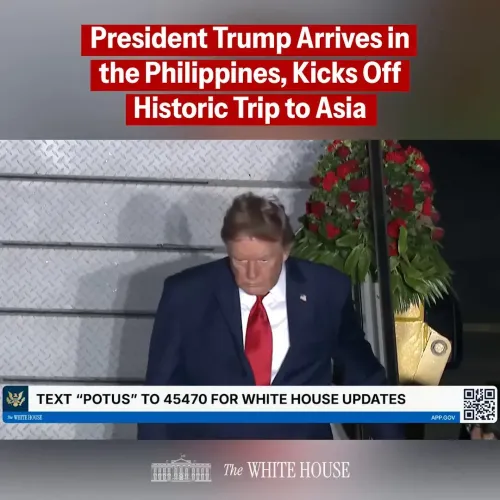
President Donald Trump arrived in the Philippines in November 2026 , marking a high-profile bilateral visit.
Trump called the Philippines 'one of America's oldest and most important allies' in official White House communications.
The US-Philippines alliance is formally grounded in the Mutual Defense Treaty of 1951 , still in force after more than seven decades.
Trump previously visited Manila in 2017 for the ASEAN Summit during his first presidential term.
The Philippines' strategic position along the South China Sea makes the visit significant for broader Indo-Pacific policy.
Potential announcements on joint military exercises or economic initiatives are expected as the visit's outcomes take shape.
A sitting American president touching down in Manila is never a routine event — and when President Donald Trump landed in the Philippines in November 2026, the White House made the stakes clear from the first words out of the gate: 'It's a true pleasure to be back in the Philippines, one of America's oldest and most important allies.'
A Bond Older Than Most Living Treaties
The US-Philippines alliance is not a recent invention of strategic convenience. It is anchored in the Mutual Defense Treaty of 1951 — a binding security commitment that has survived more than seven decades of regional turbulence, shifting governments, and the rise of China as a dominant Indo-Pacific power. That treaty obligates both sides to respond to an armed attack on either party's forces, making the Philippines one of Washington's most consequential formal treaty allies in Southeast Asia.
The historical roots run even deeper. American and Philippine destinies have been intertwined since the Spanish-American War, giving this relationship a depth that few bilateral partnerships in the region can match.
Trump's Return to Manila
This is not Trump's first time in the Philippine capital. He attended the ASEAN Summit in Manila in 2017 during his first term, meeting with Philippine leadership and reaffirming alliance commitments at a moment when regional tensions were already sharpening. The November 2026 visit marks a return — and the choice of the Philippines as a destination carries unmistakable geopolitical weight at a time when the Indo-Pacific remains the central theatre of great-power competition.
High-level US visits to Manila have historically served multiple purposes simultaneously: reinforcing military cooperation, signalling to regional partners, and anchoring trade and economic dialogue. This visit is expected to follow that pattern, with potential announcements on joint exercises or economic initiatives in the days ahead.
What Manila Means for the Indo-Pacific Chessboard
The Philippines occupies a geography that strategic planners cannot ignore — a chain of islands straddling vital sea lanes, sitting at the edge of the South China Sea. American engagement here is as much a message to Beijing as it is a conversation with Manila. When Washington reaffirms its 'oldest and most important' ally framing, it is investing in a forward position on one of the world's most contested maritime frontiers.
Watch for follow-up statements on expanded US military presence, joint exercises, or fresh economic commitments — the specifics of this visit will define its true significance.
Point of View
The White House is sending a signal that goes well beyond bilateral courtesy — it is staking out a forward position in the South China Sea theatre. For India, which shares overlapping interests in a rules-based Indo-Pacific, the durability of the US-Philippines axis has direct strategic relevance. The visit fits a consistent American pattern of using high-profile presidential travel to anchor treaty alliances before they can be eroded by Chinese economic or diplomatic pressure.
NationPress
18 Nov 2026
Frequently Asked Questions
Why did Trump visit the Philippines in November 2026?
President Trump visited the Philippines to reaffirm the longstanding US-Philippines alliance, calling it one of America's oldest and most important. The trip is consistent with American efforts to sustain Indo-Pacific partnerships amid regional competition.
What is the US-Philippines Mutual Defense Treaty?
The Mutual Defense Treaty is a 1951 security agreement between the United States and the Philippines that commits both nations to respond to an armed attack on either party's forces. It remains in force and is a cornerstone of American military alliances in Southeast Asia.
Has Trump visited the Philippines before?
Yes. Trump attended the ASEAN Summit in Manila in 2017 during his first presidential term, where he met with Philippine leadership and reaffirmed alliance commitments.
Why is the Philippines considered a key US ally in Asia?
The Philippines has been tied to the United States since the Spanish-American War and holds formal treaty ally status under the 1951 Mutual Defense Treaty. Its strategic location along the South China Sea makes it a critical anchor for US Indo-Pacific policy.
What could come out of Trump's Philippines visit?
Analysts are watching for announcements on expanded joint military exercises, US force presence, and economic initiatives. Such outcomes typically follow high-level US presidential visits to Manila.