UN General Assembly 2026: World leaders warn AI risks 'colonisation by data'

Synopsis
At the UN General Assembly, Bahamas PM Philip Davis coined a phrase that cut through the diplomatic language: 'colonisation by data.' With leaders from Bangladesh, South Korea, Maldives, Albania, Tonga and Saint Lucia all demanding a seat at the AI governance table, 26 September 2026 marked the moment the Global South formally declared the AI rules debate a sovereignty issue — not merely a technology one.
Key Takeaways
Bahamas PM Philip Davis told UNGA on 26 September 2026 that unequal AI and data control amounts to 'colonisation by data.' Bangladesh PM Tarique Rahman warned against today's digital divide becoming 'tomorrow's artificial intelligence divide', calling for technology transfer and a UN policy framework.
UN Secretary-General António Guterres said power is increasingly concentrated in data, computing capacity and algorithms, and called for a multilateral AI risk-management framework with independent oversight.
Albania, South Korea, Maldives, Tonga, Saint Lucia and Guyana all demanded inclusive AI governance, data sovereignty and protection of national cultures and traditional knowledge.
Albanian PM Edi Rama warned AI's greatest danger is 'obeying the wrong human beings perfectly', undermining democratic legitimacy without formal censorship.
India's digital public infrastructure model was cited as a Global South alternative to dependency on proprietary technology platforms.
World leaders at the United Nations General Assembly (UNGA) on 26 September 2026 issued stark warnings that Artificial Intelligence (AI) and the concentration of data could create a new form of global domination, leaving developing nations dependent on technologies and regulatory frameworks designed without their input. Speakers from Asia, Europe, the Caribbean and the Pacific collectively demanded fair access to AI, a seat at the global governance table, and protection for national languages, cultures and data sovereignty.
Sharpest Warning: 'Colonisation by Data'
Bahamas Prime Minister Philip Davis delivered what many observers considered the session's most striking formulation of the risk. 'This is colonisation by data. It does not arrive with ships and flags,' Davis told the assembly. He argued that data had become the newest raw material in the global economy, and that digital platforms could extract information from developing societies and return distorted versions of their identities — shaped by interests located elsewhere.
The imagery deliberately invokes the history of resource extraction from the Global South, reframing the AI debate not as a purely technical discussion but as a question of sovereignty and power.
Asia's Voice: Bridging Today's Divides Before They Calcify
Bangladesh Prime Minister Tarique Rahman warned that existing technological inequality must not be allowed to replicate itself in the next generation of digital systems. 'We do not want today's digital divide to become tomorrow's artificial intelligence divide,' Rahman said. Bangladesh called for technology transfer, skills development and affordable access, and urged the UN to adopt an effective policy framework covering the rapid expansion of AI and social media.
South Korean President Lee Jae Myung characterised the AI revolution as simultaneously an opportunity and a crisis, cautioning that without deliberate preparation, the technology could deepen inequality rather than spread prosperity.
Small States, Big Stakes
Smaller nations used the platform to assert that size should not determine influence over global rule-making. Maldives Vice-President Hussain Mohamed Latheef said AI could help small states overcome the disadvantages of distance and scale — improving health care, education and public services — but cautioned that the digital future must not create new dependencies. 'Every country must have a voice in shaping the global rules for AI,' he said.
Tonga acknowledged it did not need to lead every technological race but insisted on a role in shaping the rules governing emerging systems. It called for control over national data and warned that Pacific data, biodiversity and traditional knowledge must not be used to fuel technological advances while returning negligible value to island communities.
Saint Lucia Prime Minister Philip J. Pierre warned of a digital hierarchy dominated by a small number of corporations and powerful states. 'The digital future must not be owned by a few. It must be governed for the benefit of all,' he said. Guyana President Irfaan Ali framed the challenge in terms of everyday impact: 'Technology must not become the privilege of the few; it must become the servant of all humanity.'
Europe on Manipulation and Democratic Legitimacy
Albanian Prime Minister Edi Rama focused on the threat of AI-enabled manipulation, warning that the technology's greatest danger lay not in machines acting autonomously but in 'obeying the wrong human beings perfectly.' He argued that no algorithm inherited constitutional responsibility or democratic legitimacy, and that AI could multiply falsehoods at enormous speed and bury the truth without formally censoring it — a subtler and more insidious threat than outright censorship.
Guterres Calls for Multilateral AI Oversight
UN Secretary-General António Guterres acknowledged that the source of global power was fundamentally shifting. 'Today, power increasingly comes from data, computing capacity and algorithms. This new power is highly concentrated,' he said. Guterres called for information-sharing on emerging safety risks, common safeguards and a multilateral AI risk-management framework backed by independent oversight, insisting that every member state should have a role through the United Nations system.
This comes amid an accelerating global race by major technology corporations and state actors to control foundational AI models and the data infrastructure that underlies them. The UNGA debate signals that a growing coalition of nations — spanning continents and income levels — intends to push back against a governance vacuum that has, so far, largely favoured first-movers.
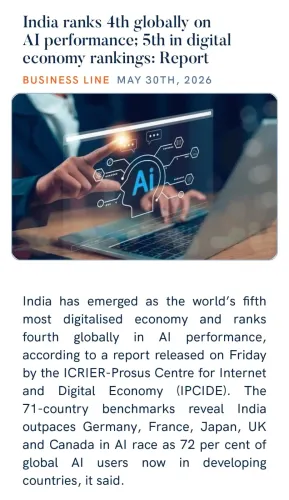
Notably, India — home to one of the world's largest information-technology industries, a rapidly expanding digital economy and one of the biggest populations of technology users globally — has separately promoted its digital public infrastructure model as a template for widening access to public services across the Global South. New Delhi's approach is increasingly cited in multilateral forums as an alternative to dependency on proprietary platforms. How the UN translates this week's rhetoric into a binding or operational framework will be the defining question in months ahead.
Point of View
Making neutrality on the issue harder to sustain. What the UNGA session exposed is a yawning gap between the urgency of the rhetoric and the absence of any binding mechanism: Guterres can call for a multilateral framework, but the states and corporations that control foundational AI models have little structural incentive to dilute that control. The Global South's collective voice is louder than at any prior UN technology debate, but volume alone does not produce enforceable rules. The real test is whether this session produces a negotiating mandate or dissolves into the familiar pattern of resolutions that acknowledge a problem without constraining the actors causing it.
NationPress
26 Sept 2026
Frequently Asked Questions
What did world leaders warn about AI at the UN General Assembly in 2026?
Leaders from multiple countries warned on 26 September 2026 that AI and data concentration could create a new form of global domination, leaving developing nations dependent on technologies and rules designed by a handful of powerful states and corporations. Bahamas PM Philip Davis described it as 'colonisation by data' — a digital parallel to historical resource extraction.
What is meant by 'colonisation by data'?
'Colonisation by data' is a phrase used by Bahamas Prime Minister Philip Davis at UNGA to describe how digital platforms can extract data from developing societies and return versions of their identities shaped by outside interests. The term frames the AI governance debate as a sovereignty issue rather than purely a technological one.
What did UN Secretary-General António Guterres call for on AI governance?
Guterres called for information-sharing on emerging AI safety risks, common safeguards, and a multilateral AI risk-management framework backed by independent oversight. He stated that global power is increasingly concentrated in data and algorithms, and that every country should have a role in shaping AI rules through the United Nations.
Which countries spoke out on AI inequality at UNGA 2026?
Bahamas, Bangladesh, South Korea, Maldives, Albania, Tonga, Saint Lucia and Guyana all addressed AI governance, data sovereignty and the risk of a new digital hierarchy at UNGA on 26 September 2026. Their speeches collectively called for technology transfer, inclusive rule-making and protection of national data and cultural identities.
What is India's role in the global AI and data governance debate?
India, home to one of the world's largest IT industries and a rapidly expanding digital economy, has promoted its digital public infrastructure model as a way to widen access to public services across the Global South. New Delhi's approach is increasingly cited in multilateral forums as an alternative model to dependency on proprietary technology platforms.