UNGA President Khalilur Rahman vows 'very serious' UNSC reform push
Synopsis
Newly sworn-in UNGA President Khalilur Rahman isn't treating Security Council reform as a ceremonial talking point — he's framing it as a trust crisis that the UN must resolve to survive. With control over IGN facilitator appointments, he holds a real procedural lever. Whether an 'old-timer' who has seen the reform debate from '360 degrees' can finally move it forward is the defining question of his tenure.
Key Takeaways
Khalilur Rahman was sworn in as UN General Assembly President on 9 September in New York .
He pledged to push for 'meaningful' UN Security Council reform 'very, very seriously.' As Assembly President, he will appoint the facilitators of the Inter-Governmental Negotiations (IGN) — the formal UNSC reform process.
Rahman argued the UN's 1945 San Francisco framework is outdated and must be overhauled for the 21st century .
He concurrently serves as Bangladesh's Foreign Minister , keeping the two roles institutionally separate.
Rahman received the symbolic gavel — Thor's Hammer — from outgoing President Annalena Baerbock .
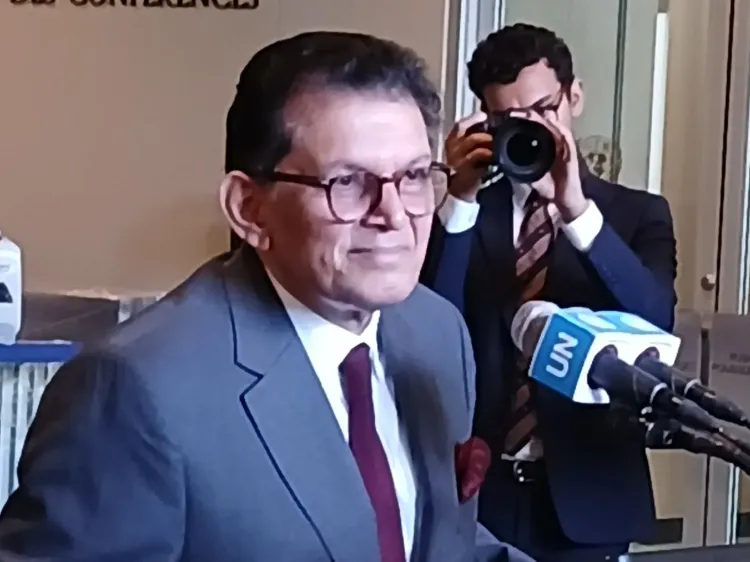
UN General Assembly President Khalilur Rahman pledged on Tuesday, 9 September to push for a 'meaningful' reform of the UN Security Council with the utmost seriousness, declaring that the world body must modernise to remain credible in the 21st century. Rahman made the remarks to reporters at the United Nations headquarters in New York shortly after being sworn in as the Assembly's President.
Rahman's Reform Mandate
'We have a situation where trust is in deficit, and the organisation must undertake deeper reform in order to make it fit for the future, not only today but tomorrow,' Rahman said. On his personal commitment to the process, he was unequivocal: 'I take this very, very seriously.'
As Assembly President, Rahman will appoint the facilitators of the Inter-Governmental Negotiations (IGN) — the formal mechanism through which Security Council reform discussions are conducted. The IGN process has been ongoing for years with limited tangible progress, making his appointment of facilitators a closely watched early test of intent.
The Case Against the Status Quo
'This is not 1945 … we are not doing the San Francisco,' Rahman said, invoking the 1945 San Francisco Conference at which the United Nations was founded to reflect the post-World War II power structure — a framework critics argue the organisation remains trapped in nearly eight decades later. 'This is the 21st century … the world has moved on,' he added.
He stressed that reforms must be substantive enough to 'regain the trust of the central organisation in the eyes of the public.' This comes amid growing frustration among member states — particularly from the Global South — that the Security Council's permanent membership and veto architecture no longer reflects contemporary geopolitical realities. Notably, this is one of the most explicit reform commitments made by an incoming Assembly President in recent memory.
Rahman's Diplomatic Background
Khalilur Rahman, who concurrently serves as Bangladesh's Foreign Minister, was elected Assembly President in June. He brings deep institutional familiarity to the role, having previously served in Bangladesh's UN mission, represented the United Nations Conference on Trade and Development (UNCTAD) in New York, and held responsibility for economic, social, and development affairs in the UN Secretary-General's executive office. 'I'm an old-timer,' he said. 'I've seen it from probably, I should say, 360 degrees.'
He is maintaining both roles — Assembly President and Foreign Minister — while keeping them institutionally separate. When asked about the significance of his presidency for Bangladesh, he was careful to note that as President he represents all member states, not his home country.
What He Declined to Address
Rahman declined to confirm whether Bangladesh Prime Minister Tarique Rahman would attend the BRICS summit in New Delhi this month, saying, 'I'm not here in national capacity, so please just forgive me' for not answering. The remark underscored his stated effort to keep his two roles clearly delineated.
Earlier in the ceremony, Rahman formally received the gavel — known as Thor's Hammer — from outgoing Assembly President Annalena Baerbock, marking the symbolic handover of the Assembly's leadership. All eyes will now be on his choice of IGN facilitators as the first concrete signal of how seriously this reform push will be pursued.
Point of View
With each Assembly session producing pledges that rarely translate into structural change. Rahman's language is notably sharper than his predecessors', but the real test lies in who he appoints as IGN facilitators — a procedural choice that historically determines whether negotiations gain traction or stall in diplomatic ambiguity. The veto-wielding P5 have consistently resisted any reform that dilutes their privilege, and no incoming Assembly President has yet found a formula to move them. Rahman's dual role as Bangladesh's Foreign Minister also raises legitimate questions about bandwidth and the potential for national interest to colour what is meant to be a multilateral stewardship role.
NationPress
24 Oct 2026
Frequently Asked Questions
What did UNGA President Khalilur Rahman say about UN Security Council reform?
Rahman pledged to push for 'meaningful' reform of the UN Security Council 'very, very seriously,' saying the organisation faces a trust deficit and must modernise beyond its 1945 founding framework. He made the remarks on 9 September after being sworn in as Assembly President in New York.
Who is Khalilur Rahman and what is his background?
Khalilur Rahman is Bangladesh's Foreign Minister and was elected President of the UN General Assembly in June. He is a veteran UN diplomat who has served in Bangladesh's UN mission, represented UNCTAD in New York, and worked in the UN Secretary-General's executive office on economic and development affairs.
What is the Inter-Governmental Negotiations process for UNSC reform?
The Inter-Governmental Negotiations (IGN) is the formal UN mechanism through which member states discuss Security Council reform, covering issues such as permanent membership, veto powers, and representation. As Assembly President, Rahman will appoint the IGN facilitators who guide these talks.
Why is UNSC reform considered urgent?
Critics argue the Security Council's structure — including its five permanent members and veto system — reflects the post-World War II order of 1945 rather than today's geopolitical realities. Growing frustration among Global South nations over their limited voice has intensified calls for reform.
Did Rahman comment on Bangladesh PM Tarique Rahman attending the BRICS summit?
Rahman declined to answer, saying he was not present 'in national capacity' and asked reporters to excuse him from responding. He is maintaining a stated separation between his roles as Assembly President and Bangladesh's Foreign Minister.