Chinese CBDC Prohibition Act 2026: US Senator moves to ban digital Yuan transactions

Synopsis
A US Republican Senator has moved to ban Venmo, Zelle, the US Postal Service, and all American money services businesses from touching China's digital Yuan — citing surveillance risk and a threat to dollar dominance. The reintroduced bill is the sharpest legislative challenge yet to Beijing's CBDC ambitions from Capitol Hill.
Key Takeaways
Senator Rick Scott reintroduced the Chinese CBDC Prohibition Act of 2026 on 23 May 2026 .
The bill would ban US money services businesses — including Venmo , Zelle , and the US Postal Service — from processing transactions in China's digital Yuan .
Scott cited surveillance risk, threat to the US dollar's reserve currency status, and national security concerns.
The bill would amend Title 31 of the US Code ; the definition of money services businesses follows existing federal regulations.
China has expanded digital Yuan pilot programmes across multiple cities for retail and cross-border payments.
This is a reintroduction, meaning the bill did not pass in its previous congressional session.
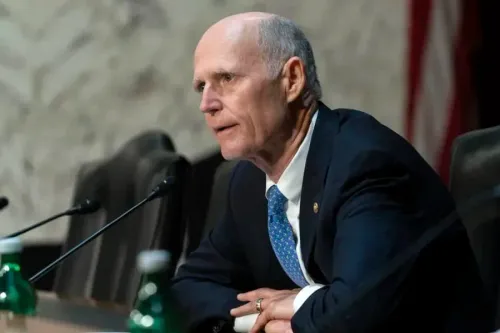
Republican Senator Rick Scott has reintroduced legislation in the US Senate that would bar American money services businesses from processing any transactions involving China's central bank digital currency (CBDC), framing the move as both an economic safeguard and a national security imperative. The bill, formally titled the Chinese CBDC Prohibition Act of 2026, was reintroduced on 23 May 2026.
What the Bill Proposes
The proposed legislation would amend Title 31 of the United States Code to make it unlawful for any money services business to engage — directly or indirectly — in transactions involving a digital currency issued by the People's Republic of China or the Chinese Communist Party (CCP), including the digital Yuan. The prohibition would extend to a broad range of financial intermediaries, including payment platforms such as Venmo and Zelle, currency dealers, and even the US Postal Service.
The definition of a money services business under the bill would follow existing federal regulations governing financial transactions and currency-related operations, according to the text of the legislation.
What Senator Scott Said
'The dollar is the reserve currency of the world and the CCP wants to undermine our leadership with a digital currency they can track and manipulate. This is unacceptable for America,' Scott said in a statement announcing the bill. He further argued that the digital Yuan was 'just another tool used by the Chinese Communist Party to spy on its people and all those who use it,' adding that 'Americans deserve privacy when it comes to their financial transactions.'
The National Security Argument
Scott framed the legislation as a dual-purpose measure — protecting US financial dominance while shielding American consumers from potential surveillance by Beijing. The press release accompanying the bill claimed that China currently deploys its digital currency 'as a mechanism to control the lives of its population' and alleged that authorities could 'cut off access to their accounts at any moment.' The statement further argued that American businesses transacting in Chinese digital currency could weaken the US dollar, expose entrepreneurs to CCP surveillance, and erode US economic competitiveness.
China's CBDC Ambitions
China has emerged as one of the world's most advanced nations in sovereign digital currency development. Beijing has expanded pilot programmes for the digital Yuan across several cities and has actively promoted the currency for retail payments and cross-border transactions. Critics of the US bill note that the digital Yuan's international footprint remains limited, though its trajectory has drawn sustained scrutiny from Western governments and financial regulators.
Legislative Context
This is a reintroduction, signalling that the bill did not advance in a prior congressional session. Its prospects in the current session will depend on committee support and broader legislative priorities. Notably, concerns over China's CBDC ambitions are shared across party lines in Washington, though the specific legislative response has varied. The bill arrives amid a wider US-China economic and technological rivalry that has seen restrictions on semiconductors, AI tools, and now digital financial infrastructure.
Whether the bill clears committee remains to be seen, but its reintroduction signals sustained congressional attention on the intersection of digital finance and geopolitical competition.
Point of View
Not present exposure. More consequentially, the bill's scope — sweeping in the US Postal Service alongside Venmo — suggests lawmakers are casting a wide net precisely because the regulatory perimeter around digital currencies remains poorly defined. If the bill advances, it could set a precedent for how the US treats foreign CBDCs more broadly, well beyond China.
NationPress
6 Oct 2026
Frequently Asked Questions
What is the Chinese CBDC Prohibition Act of 2026?
It is a US Senate bill reintroduced by Republican Senator Rick Scott that would prohibit American money services businesses from engaging in transactions involving China's central bank digital currency, including the digital Yuan. The bill amends Title 31 of the US Code and covers platforms such as Venmo, Zelle, and the US Postal Service.
Why is Senator Rick Scott pushing this legislation?
Scott argues the digital Yuan is a tool for surveillance by the Chinese Communist Party and poses a threat to the US dollar's status as the world's reserve currency. He frames the bill as both a national security and economic competitiveness measure.
Which US businesses would be affected by the ban?
The bill targets money services businesses as defined under existing federal regulations — a category that includes payment platforms such as Venmo and Zelle, currency dealers, and the US Postal Service. Both direct and indirect transactions involving the digital Yuan would be prohibited.
How advanced is China's digital Yuan programme?
China is among the world's most advanced nations in sovereign digital currency development. Beijing has rolled out pilot programmes across multiple cities and has promoted the digital Yuan for retail payments and cross-border transactions, though its international footprint remains limited.
Has this bill been introduced before?
Yes. This is a reintroduction, meaning a prior version of the bill did not advance through Congress. Its current prospects depend on committee support and broader legislative priorities in the ongoing congressional session.