US claims control of Strait of Hormuz, 1,500 ships protected
Synopsis
The White House says the US Navy has full control of the Strait of Hormuz — the world's most critical oil chokepoint — with Iranian mines cleared, 1,500 ships escorted, and Iran's own exports effectively zeroed out since July. If the claims hold, it marks the most significant shift in Gulf maritime power in decades, with direct consequences for global oil prices and India's energy security.
Key Takeaways
The White House declared on 29 August that the US Navy controls the Strait of Hormuz , citing CENTCOM .
American forces have reportedly escorted nearly 1,500 commercial vessels carrying 750 million barrels of crude oil through the strait.
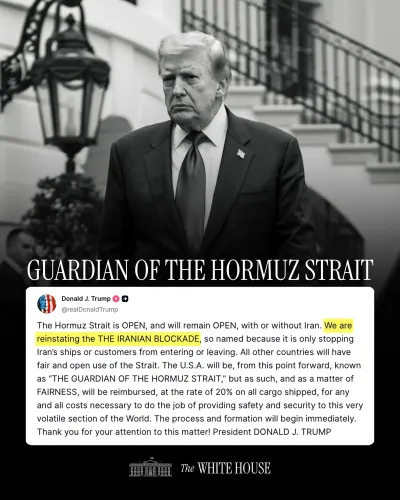
Iran has exported no oil since a US blockade resumed in July ; 75 vessels attempting to breach it were turned around.
Gulf oil exports have recovered to about two-thirds of pre-operation levels and are rising.
President Trump has repeatedly claimed '100%' US control of the strait throughout August.
The administration cited Operation Economic Outcast as part of a broader campaign to cut off Iran's revenue streams.
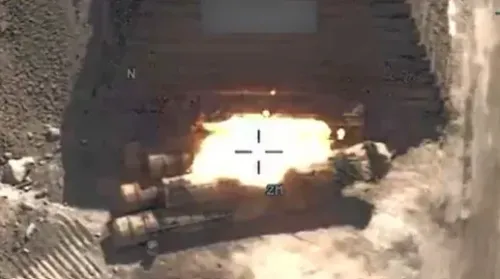
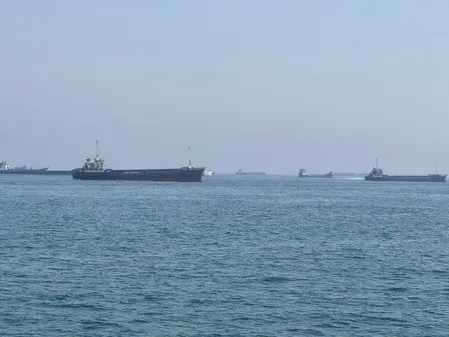
The White House on 29 August declared that the United States controls the Strait of Hormuz, asserting that American forces have cleared Iranian mines, escorted nearly 1,500 commercial vessels through the waterway, and effectively shut off Iran's oil exports since a blockade resumed in July. The statement, citing US Central Command (CENTCOM), frames the operation as a decisive shift in control over one of the world's most strategically critical maritime passages.
Key Claims from the White House
According to the administration, Iranian mines have been cleared from international shipping lanes in the strait. Nearly 1,500 commercial vessels have transited the waterway under US protection, collectively carrying an estimated 750 million barrels of crude oil to global markets. The White House also claimed that Iran has exported no oil from its shores since the American blockade was reinstated, with US forces reportedly turning around 75 vessels that attempted to breach it.
Gulf oil exports, the statement added, have recovered to roughly two-thirds of pre-operation levels and are continuing to rise.
What President Trump Said
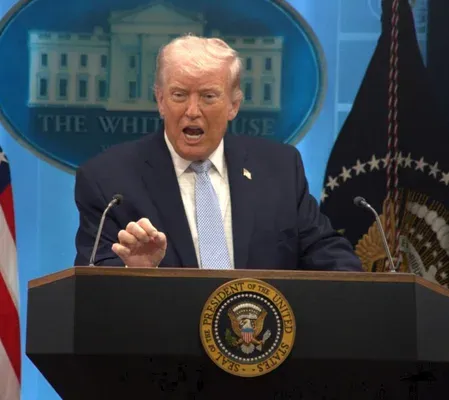
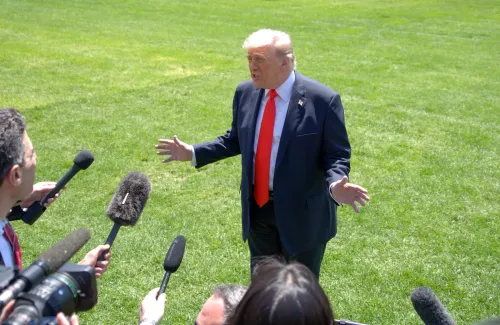
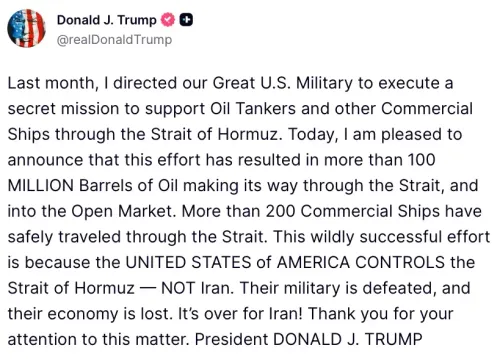
President Donald Trump has repeated the control assertion multiple times throughout August. On 10 August, he said: 'The only one that has control of the Strait of Hormuz right now is the United States Navy.' He elaborated further, stating: 'We have a blockade that's been infallible. It's a steel wall… We control the Strait, 100%.' On Thursday, Trump reiterated: 'The Strait of Hormuz is open. We have control, and we have the blockade. Iran is not getting anything; nothing is going through.'
Expert and Official Voices
Former deputy national security adviser KT McFarland, cited by the White House, argued that Iran had overplayed its hand by attempting to close the strait. 'For 50 yrs Iran blackmailed world. No longer. That card is dead,' she said. John Spencer, chair of urban warfare studies at West Point, was more direct in rebutting Tehran's counter-claims: 'Iran's claims that it has closed the Strait of Hormuz are false. It has neither closed the strait nor effectively stopped maritime traffic,' he said. The White House release did not include any response from Iran.
Operation Economic Outcast and Broader Pressure
The administration cited Operation Economic Outcast — a US campaign aimed at isolating Iran economically and disrupting what Washington describes as Tehran's remaining financial lifelines. 'The economic pressure on the Iranian regime is only tightening,' the White House said. It added that President Trump would continue applying pressure until Iran was no longer able to threaten the international community, though it did not specify what military or diplomatic conditions would lead Washington to end the blockade.
Why This Matters for India and Global Energy
The Strait of Hormuz is a narrow maritime chokepoint connecting the Persian Gulf with the Gulf of Oman and the Arabian Sea. Oil and liquefied natural gas exports from several Gulf nations — including Saudi Arabia, the UAE, Kuwait, and Iraq — flow through this passage, making its stability critical for energy-importing nations. India, which sources a significant share of its crude from the Gulf, is among the countries most exposed to any prolonged disruption. With Gulf exports reportedly recovering but still at two-thirds of normal levels, the situation continues to bear watching for oil prices and energy security.
Point of View
No independent verification of the mine-clearing claims, and no defined exit condition for the blockade. Trump's repeated '100%' framing is politically useful domestically but strategically risky: absolute claims are easy to falsify with a single incident. The deeper question is whether cutting Iran's oil revenue accelerates a diplomatic opening or hardens Tehran's calculus. For India, the two-thirds recovery in Gulf exports is partial relief, but the absence of a clear endgame means energy market uncertainty is not going away soon.
NationPress
29 Aug 2026
Frequently Asked Questions
What did the White House claim about the Strait of Hormuz?
The White House declared on 29 August that the United States controls the Strait of Hormuz, citing US Central Command. It said American forces had cleared Iranian mines, escorted nearly 1,500 commercial vessels carrying 750 million barrels of crude, and blocked Iran from exporting oil since a blockade resumed in July.
What is Operation Economic Outcast?
Operation Economic Outcast is a US campaign aimed at isolating Iran economically by disrupting what Washington describes as Tehran's remaining financial lifelines. The White House cited it as part of a broader pressure strategy to prevent Iran from threatening international commerce.
Has Iran responded to the US claims?
The White House statement did not include any response from Iran. Tehran has separately claimed it closed the Strait of Hormuz, a claim that West Point urban warfare expert John Spencer described as false, saying Iran had 'neither closed the strait nor effectively stopped maritime traffic.'
Why does the Strait of Hormuz matter to India?
The Strait of Hormuz is the primary export route for Gulf oil and LNG, including supplies from Saudi Arabia, the UAE, Kuwait, and Iraq. India sources a significant share of its crude from the Gulf, making any sustained disruption a direct energy security concern for the country.
What has President Trump said about US control of the strait?
Trump has repeatedly asserted full US control throughout August. On 10 August he said 'The only one that has control of the Strait of Hormuz right now is the United States Navy,' and later described the blockade as 'a steel wall' that is '100%' effective. He reiterated the claim on Thursday, saying Iran was receiving nothing through the strait.