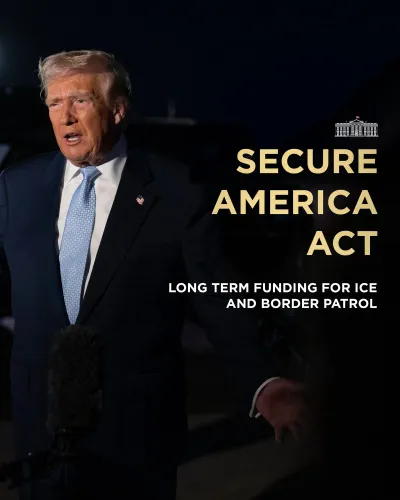
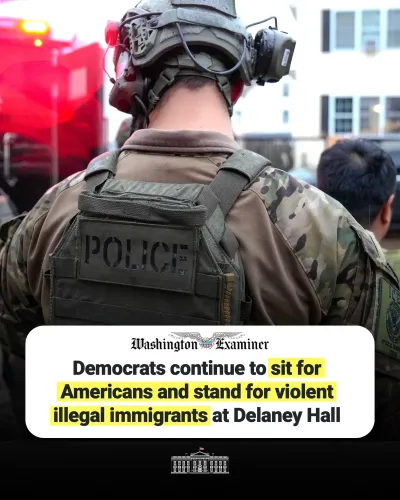
White House Backs ICE, Rejects Sanctuary for Criminal Illegals

Synopsis
The White House issued a forceful public statement on August 20, 2026, backing ICE and rejecting sanctuary policies that shield undocumented individuals with criminal records from federal deportation — reigniting a long-running federal-local standoff over immigration enforcement.
Key Takeaways
The White House posted a direct call to 'stand with ICE' and reject sanctuary protections for criminal undocumented individuals on August 20, 2026 .
Immigration and Customs Enforcement) is the DHS agency responsible for interior immigration enforcement, including arrests and deportations.
Sanctuary policies limit local cooperation with ICE, typically by refusing to honour federal detainer requests.
Executive Order 13768 (2017) previously directed agencies to withhold grants from non-cooperating jurisdictions — a legal fight that has continued across administrations.
The post signals potential new executive or legislative action targeting sanctuary jurisdictions, with likely court challenges to follow.
The White House fired a sharp message on Thursday, August 20, 2026, throwing its full weight behind federal immigration enforcement and drawing a hard line against local jurisdictions that shield undocumented individuals with criminal records from deportation.
Posting on X, the official account of the Executive Office of the President of the United States declared: 'NO SANCTUARY FOR CRIMINAL ILLEGALS. STAND WITH @ICEGOV.' The post, paired with the American flag emoji, signals a direct call for solidarity with U.S. Immigration and Customs Enforcement (ICE) — the federal agency under the Department of Homeland Security (DHS) responsible for interior immigration enforcement, including detentions and deportations.
What Sanctuary Policies Actually Do
Sanctuary policies are local or state-level measures that limit cooperation with federal immigration authorities. In practice, this often means a city or county jail declining to honour an ICE 'detainer' — a request to hold an individual in local custody beyond their release date so federal agents can take them into immigration custody. Supporters argue these policies protect immigrant communities and build trust with local law enforcement. Critics, including the current administration, contend they allow individuals convicted of crimes to walk free and evade federal removal.A Battle With Deep Legal Roots
This is not a new fight. Executive Order 13768, signed in 2017, directed federal agencies to withhold grants from jurisdictions that did not honour ICE detainers for criminal noncitizens. Sanctuary jurisdictions pushed back hard in court, challenging the federal government's authority to attach immigration conditions to funding streams. That legal tug-of-war has recurred across administrations, with no definitive national resolution. The White House's latest post fits squarely into that pattern — a high-decibel assertion that local governments must not obstruct federal immigration enforcement, particularly when the individuals in question carry criminal records.What Comes Next
The language of the post — combative, unambiguous, publicly directed at ICE's own account — suggests the administration is building political pressure ahead of potential executive action, new grant conditions, or congressional measures targeting sanctuary jurisdictions. Litigation from affected cities and states would almost certainly follow any formal policy move. For now, the message from 1600 Pennsylvania Avenue is unambiguous: cooperation with ICE is not optional, and the era of federal tolerance for sanctuary policies is, in the administration's view, over.Point of View
Suggesting the administration may be laying groundwork for new funding conditions or executive orders. For sanctuary jurisdictions, the message is a warning shot; for ICE, it is a public show of presidential backing. The broader pattern points to an intensifying federal-local conflict over immigration authority that courts have yet to fully resolve.
NationPress
21 Aug 2026
Frequently Asked Questions
What does 'no sanctuary for criminal illegals' mean?
It means the White House opposes local policies — known as sanctuary policies — that prevent or limit cooperation with ICE in detaining and deporting undocumented individuals who have criminal records.
What is ICE and what does it do?
ICE, or U.S. Immigration and Customs Enforcement, is a federal agency under the Department of Homeland Security. It handles interior immigration enforcement, including arresting, detaining, and deporting undocumented individuals inside the United States.
What is a sanctuary city?
A sanctuary city is a jurisdiction — a city, county, or state — that limits its cooperation with federal immigration authorities, often by refusing to hold individuals in jail solely on ICE detainer requests.
Can the US government defund sanctuary cities?
The federal government has attempted to withhold grants from sanctuary jurisdictions, most notably through Executive Order 13768 in 2017. Courts have repeatedly challenged or blocked such conditions, and the legal question remains unresolved at a national level.
Why does the White House support ICE publicly?
The administration has made immigration enforcement a central policy priority. Public statements backing ICE are intended to signal political commitment to that agenda and to pressure local governments to cooperate with federal deportation efforts.