White House Claims 17% Rise in Tax Refunds Under Working Families Tax Cuts
Synopsis
The White House claims the Working Families Tax Cuts produced a 17% rise in tax refunds for Americans, using the 'PROMISES MADE, PROMISES KEPT' frame to cast the policy as a delivered campaign commitment.
Key Takeaways
The White House announced on August 18, 2026 that American tax refunds rose by 17% under the Working Families Tax Cuts .
The administration used the phrase 'PROMISES MADE, PROMISES KEPT' to frame the refund increase as a fulfilled campaign pledge.
The 'Working Families' branding positions the policy as targeted relief for middle- and lower-income households.
Economists note that refund size alone does not fully capture overall tax burden, but larger refunds represent a tangible benefit for millions of households.
No independent verification of the 17% figure was available at the time of publication.
A 17 percent jump in tax refunds — that is the headline the White House is putting front and centre as it touts the impact of the Working Families Tax Cuts on Tuesday, August 18, 2026, framing the figure as proof that a campaign promise has been delivered.
The 17% Refund Claim and What It Signals
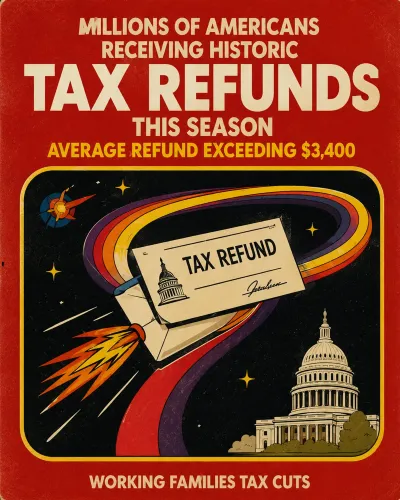
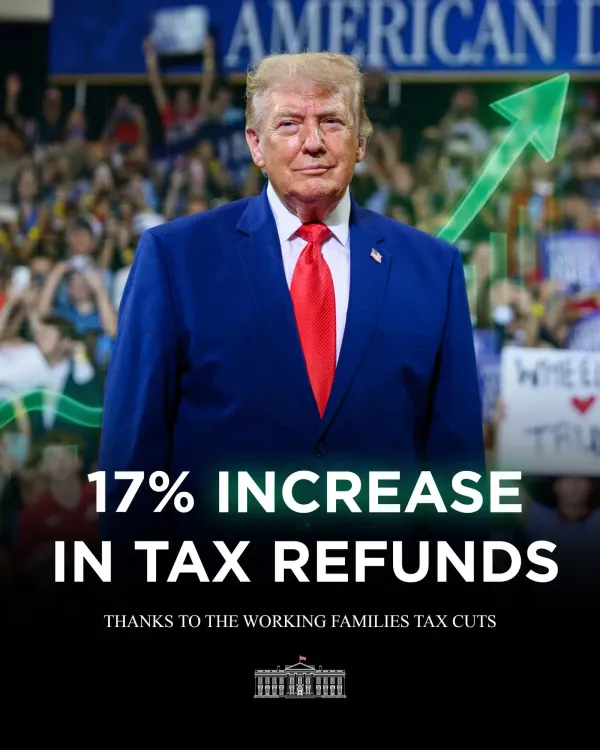
The White House posted on X that 'the American people saw a 17% INCREASE in tax refunds thanks to the Working Families Tax Cuts,' adding the signature phrase 'PROMISES MADE, PROMISES KEPT.' The administration is presenting the refund surge as direct evidence that the tax legislation is putting more money back into ordinary households — a politically potent message ahead of any upcoming electoral or legislative cycle.
Tax refunds rise when withholding exceeds actual liability, meaning a larger refund can reflect either a genuine reduction in tax burden or a change in withholding tables — or both. The White House's framing attributes the increase squarely to the Working Families Tax Cuts, a policy positioned around relief for middle- and lower-income Americans.
Why 'Working Families' Branding Matters in Washington
The label 'Working Families Tax Cuts' is a deliberate political signal — placing the policy in contrast to tax legislation critics have historically branded as benefiting corporations and the wealthy. By anchoring the announcement to a 17% refund increase, the administration is building a concrete, kitchen-table argument: households received measurably more money back this filing season. That kind of specific number is designed to travel — in speeches, in campaign materials, in social media posts exactly like this one.
The 'PROMISES MADE, PROMISES KEPT' tagline has been a recurring rhetorical device for the executive office, used to draw a direct line between pre-election commitments and post-election actions, reinforcing accountability messaging to the base.
What the Refund Number Does — and Does Not — Tell Us
A 17% increase in average refunds is a significant headline figure, but economists and tax analysts typically caution that refund size alone is an incomplete measure of tax burden. A household that overpays through the year and receives a large refund is effectively giving the government an interest-free loan. Still, for millions of Americans, a larger refund is a tangible, felt benefit — rent paid, debt cleared, savings started. That lived reality is precisely what the White House is amplifying.
With no independent research available to verify the underlying methodology, the 17% figure stands as the administration's stated claim. The policy debate over who benefits most from the Working Families Tax Cuts is certain to continue in Congress and on the campaign trail.
Point of View
Sharp number — 17% — reflects a broader communications strategy of translating complex fiscal policy into household-level impact. Framing tax relief through refund data is a time-tested political move: it makes an abstract legislative win feel concrete and personal. For India-based observers, the announcement signals that the US administration is actively building a domestic economic narrative around middle-class tax relief, a theme with clear parallels to electoral politics globally. Whether the refund increase holds up to independent scrutiny will determine how durable this talking point proves to be.
NationPress
18 Aug 2026
Frequently Asked Questions
What are the Working Families Tax Cuts in the US?
The Working Families Tax Cuts is a US tax policy promoted by the White House as relief targeted at middle- and lower-income American households, credited by the administration with increasing tax refunds by 17%.
Why did US tax refunds increase by 17%?
The White House attributes the 17% rise in tax refunds to the Working Families Tax Cuts, though independent analysts note that refund increases can also reflect changes in withholding tables rather than a reduced overall tax burden.
What does 'PROMISES MADE, PROMISES KEPT' mean in US politics?
'PROMISES MADE, PROMISES KEPT' is a recurring White House slogan used to draw a direct line between pre-election commitments and policy actions taken in office, reinforcing accountability messaging.
Is a larger tax refund always a sign of a lower tax burden?
Not necessarily. A larger refund means more tax was withheld during the year than was owed. It can reflect a genuine tax cut, a change in withholding rules, or both — economists caution that refund size alone is an incomplete measure.
How does the US Working Families Tax Cuts affect ordinary Americans?
According to the White House, the policy has resulted in Americans receiving 17% larger tax refunds, which for many households translates into a tangible lump-sum payment used for expenses, debt repayment, or savings.