White House Claims Record Oil Output, Falling Gas Prices

Synopsis
The White House on 23 June 2026 declared that US oil production has hit record levels and retail gasoline prices are tumbling. The claim, made via an official social media post, positions domestic energy output as a key policy achievement, with the EIA's forthcoming data set to confirm or complicate the narrative.
Key Takeaways
The White House posted on 23 June 2026 that US oil production is at record levels and gasoline prices are falling.
The United States first became the world's largest crude oil producer in 2019 , surpassing Saudi Arabia and Russia.
The Energy Information Administration (EIA) publishes weekly gasoline price data and monthly production figures that will verify or contradict the White House's claims.
Falling US pump prices are politically significant because they directly affect household costs for millions of American drivers.
For India , higher US crude output that moderates global prices reduces the country's import bill and eases pressure on the rupee.
OPEC+ quota decisions remain a key variable that could offset the price impact of rising American production.
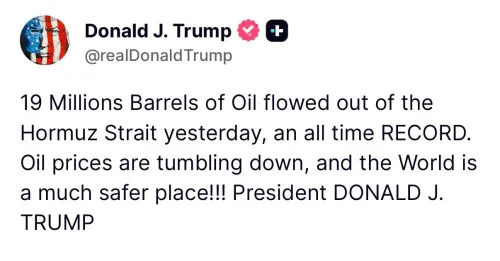
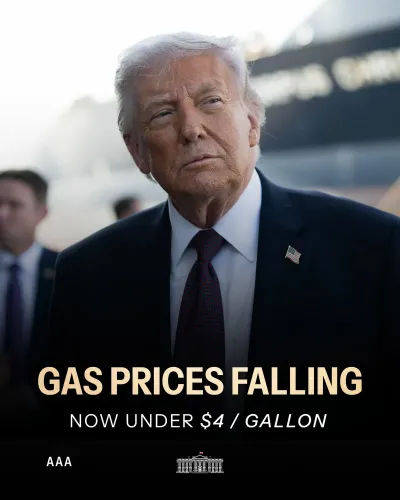
The White House declared on Tuesday, 23 June 2026 that the United States is producing oil at record levels while retail gasoline prices are falling sharply, framing both trends as a signature achievement of current energy policy.
Context
The official White House account posted that 'record oil is flowing and gas prices are tumbling,' accompanied by the American flag emoji and an image. The post is brief but pointed, signalling the administration's intent to take political credit for energy market conditions that directly affect household budgets across the country.
Retail gasoline prices are among the most visible economic indicators for ordinary Americans. A decline at the pump is broadly felt, making it a favoured data point for any sitting administration seeking to demonstrate economic competence.
Policy Backdrop
The United States Energy Information Administration (EIA), the statistical arm of the Department of Energy, tracks weekly retail gasoline prices and monthly crude oil production figures. These are the authoritative benchmarks against which any White House claim of record output or falling prices would be measured.
The US became the world's largest crude oil producer in 2019, surpassing Saudi Arabia and Russia, a position enabled by the shale revolution that accelerated after 2008. The repeal of the US crude oil export ban in December 2015 further integrated American production into global markets, meaning domestic output levels now have outsized influence on international benchmark prices.
US administrations of both parties have historically highlighted domestic production records and falling pump prices as proof of successful energy stewardship. These claims are always shaped by external forces — OPEC+ quota decisions, global demand cycles, and federal leasing and permitting policies on public lands — that sit outside any single administration's direct control.
Stakeholders and Impact
American drivers stand to benefit most immediately from lower gasoline prices, which reduce commuting costs and act as a de facto tax cut for middle- and lower-income households. For a country where personal vehicles remain the dominant mode of transport, pump prices carry outsized political weight.
Domestic oil and gas producers, meanwhile, benefit from sustained high output volumes that generate revenue and employment across energy-producing states such as Texas, North Dakota, and New Mexico. However, a sharp fall in prices can compress margins for smaller producers operating on tighter cost structures.
For India, which imports a significant share of its crude oil needs, any sustained increase in US production that moderates global benchmark prices translates into lower import bills and eased pressure on the rupee and the current account deficit — making Washington's energy posture a matter of direct economic interest to New Delhi.
What's Next
The EIA's upcoming weekly petroleum supply reports and gasoline price surveys will be the definitive test of the White House's claims. If production figures confirm a new record and pump prices continue their downward trajectory, the administration will have a durable political narrative heading into the second half of 2026.
Analysts will also watch whether OPEC+ responds to rising US output with further quota adjustments, which could partially offset the price-dampening effect of American supply. The durability of any gasoline price decline will depend heavily on that interplay between US shale volumes and cartel supply management.
Point of View
The broader the intended audience. By anchoring the message to two tangible, voter-felt metrics — production records and pump prices — the administration is building an economic-competence narrative ahead of what remains a volatile second half of 2026. The claim will be stress-tested quickly: EIA data is published weekly, and any reversal in gasoline prices or a plateau in output would hand critics an immediate rebuttal. The broader pattern here is bipartisan — every modern US administration has claimed credit for energy market tailwinds and deflected blame for headwinds, making the durability of the underlying data, not the post itself, the real story to watch.
NationPress
23 Jun 2026
Frequently Asked Questions
Is the US really producing oil at record levels in 2026?
The White House claimed on 23 June 2026 that US oil production is at record levels. The Energy Information Administration's monthly petroleum supply reports are the authoritative source for verifying such claims, and its forthcoming data will confirm whether a new production record has been set.
Why are US gasoline prices falling in 2026?
The White House attributed falling gasoline prices to record domestic oil production. In practice, US pump prices are influenced by a combination of domestic output, global crude benchmarks, OPEC+ supply decisions, refinery capacity, and seasonal demand patterns.
How does US oil production affect petrol prices in India?
Higher US crude output tends to exert downward pressure on global oil benchmarks such as Brent crude. Since India imports a large share of its crude oil needs, lower global prices reduce India's import bill, ease pressure on the rupee, and can eventually feed through to domestic fuel prices.
What is the Energy Information Administration and why does it matter?
The Energy Information Administration (EIA) is the statistical agency within the US Department of Energy responsible for tracking oil production, natural gas output, and retail fuel prices. Its weekly and monthly reports are the standard reference for verifying government claims about energy market trends.
Has the US been the world's largest oil producer before?
Yes. The United States first surpassed Saudi Arabia and Russia to become the world's largest crude oil producer in 2019, a position enabled by the shale revolution that gained momentum after 2008 and by the repeal of the US crude oil export ban in December 2015.