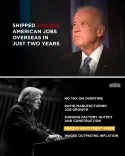
White House Claims Trump Solved Trade, NATO, Venezuela in 18 Months
Synopsis
The White House posted a sweeping second-term scorecard on 13 October 2026, crediting President Trump with rebalancing trade and NATO, toppling Nicolás Maduro, securing US energy, and fighting drug cartels — all within 18 months of his return to office.
Key Takeaways
The White House posted an official second-term scorecard on 13 October 2026 , listing five major achievements under President Trump .
Claims include rebalanced trade and protected American manufacturing , building on tariff policies begun in 2018 during the first term.
NATO burden-sharing, a pressure campaign dating to 2017 , is framed as now resolved in America's favour.
The post asserts Nicolás Maduro has been 'toppled' and links his removal to securing US energy supplies — details that remain independently unverified.
The drug-cartel fight is listed as ongoing rather than concluded, signalling it remains an active policy front.
The scorecard reads as both a governance record and a political argument ahead of future electoral and legislative cycles.
Eighteen months into President Donald Trump's second term, the White House is making a sweeping case: that a clutch of intractable foreign-policy and economic challenges — from lopsided trade balances to a defiant Venezuela — have been resolved on his watch. The official White House account posted on Tuesday, 13 October 2026, listing five headline achievements it says define the administration's record so far.
The post names five pillars: rebalanced trade, protected American manufacturing, a rebalanced NATO, the toppling of Nicolás Maduro and the securing of energy supplies for the United States, and an ongoing crackdown on drug cartels. It is a confident victory lap — and each claim carries a decades-long policy backstory.
Trump's trade war turned long-running battle
The trade rebalancing claim has the deepest paper trail. During Trump's first term, beginning in 2018, his administration imposed sweeping tariffs on Chinese imports in an attempt to correct a bilateral trade deficit that had widened for more than two decades. Those tariffs reshaped global supply chains, triggered retaliatory measures, and became a template that the second term has evidently extended. The White House now frames the outcome as a settled success — a 'rebalancing' rather than an ongoing fight.
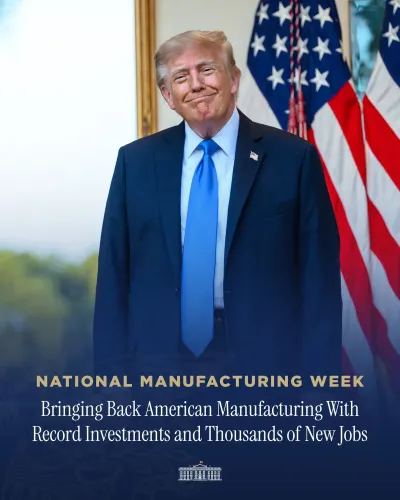
The reference to protecting American manufacturing follows directly: tariff walls and reshoring incentives have been the administration's core argument for why domestic factory employment should recover ground lost over a generation of offshoring.
NATO burden-sharing: from 2% target to a White House talking point
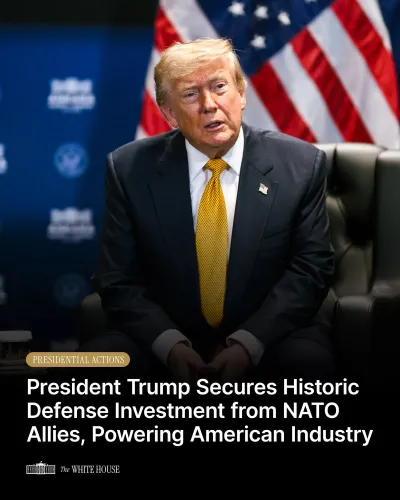
The NATO claim has roots in 2017, when Trump first publicly pressured alliance members to hit the 2% of GDP defence-spending benchmark. Several European governments resisted at first, then gradually increased budgets — a shift accelerated after Russia's full-scale invasion of Ukraine in 2022. By framing the outcome as 'rebalanced', the White House is asserting that the political and financial weight inside the 29-plus member alliance has shifted meaningfully away from near-total US underwriting.
Maduro's fall and the energy calculus
Perhaps the most consequential — and the least independently verifiable at this hour — is the Venezuela claim. The first Trump administration recognised opposition figure Juan Guaidó as interim president in 2019 and imposed severe sanctions on Caracas, yet Maduro survived. The post now asserts he has been 'toppled' and links the outcome directly to American energy security — implying that access to Venezuelan oil or the removal of a rival supplier from the board has strengthened the US energy position. The precise circumstances of Maduro's departure and any resulting energy arrangements have not been independently confirmed.
Cartels and the fifth front
The drug-cartel line — framed as an ongoing fight rather than a completed victory — signals that the administration regards the US–Mexico border security and narcotics-trafficking challenge as a live operation, not a closed file. It is a deliberate contrast with the other four claims: four wins, one battle still being waged.
Whether each achievement holds up to independent scrutiny will be the central question as Congress takes up trade and defence authorisations and as diplomatic reporting catches up with the Venezuela situation. For now, the White House has drawn its own scorecard — and it reads as a re-election-era argument as much as a governance report.
Point of View
A rebalanced trade regime and a restructured NATO carry direct consequences: Indian exporters who benefited from US–China trade friction watch any further tariff shifts closely, while a weakened or restructured NATO changes the calculus for European arms procurement in ways that ripple into India's own defence partnerships. The Venezuela energy claim, if verified, would mark a significant Western Hemisphere power shift with implications for global oil supply and, by extension, India's import bill. The combative framing — 'solved problems that have plagued our country for generations' — is also unmistakably pre-electoral positioning, suggesting the White House views this 18-month record as the centrepiece of its political messaging going forward.
NationPress
14 Oct 2026
Frequently Asked Questions
What achievements is the White House claiming for Trump's second term?
The White House claims five achievements: rebalancing trade, protecting American manufacturing, rebalancing NATO, toppling Nicolás Maduro and securing energy for the US, and fighting drug cartels — all within 18 months of Trump's second term.
Has Nicolás Maduro actually been removed from power in Venezuela?
The White House post asserts Maduro has been 'toppled', but the precise circumstances of his departure and any resulting US energy arrangements have not been independently confirmed as of the post's publication on 13 October 2026.
What is Trump's history with NATO burden-sharing?
Since 2017, Trump has publicly pressured NATO allies to spend at least 2% of their GDP on defence. Multiple European members subsequently increased budgets, and the White House now describes NATO as 'rebalanced' in America's favour.
How did Trump's trade tariffs start and what is the current claim?
The first Trump administration began imposing tariffs on Chinese imports in 2018 to address trade imbalances. The White House now claims those efforts have resulted in a full 'rebalancing' of US trade relationships.
Why does this White House post matter for India?
A rebalanced US trade regime, a restructured NATO, and potential shifts in Venezuelan oil supply all have downstream effects on Indian exports, European defence partnerships, and global energy prices — making the post relevant well beyond American domestic politics.