White House: US Manufacturing Strong, Hits Biden on Offshoring
Synopsis
The White House declared American manufacturing 'strong' on October 13, 2026, crediting President Trump for reversing Biden-era offshoring. The claim lands amid decades of US manufacturing decline and ongoing debate over whether tariff walls or industrial subsidies better protect American factory workers.
Key Takeaways
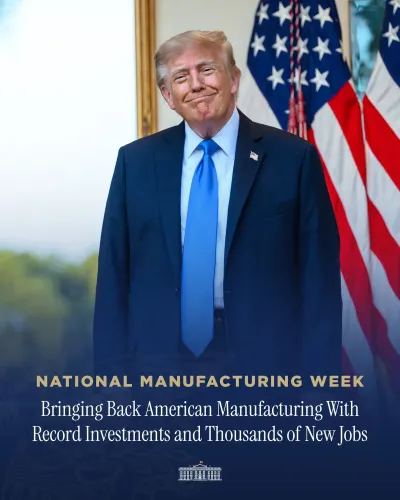
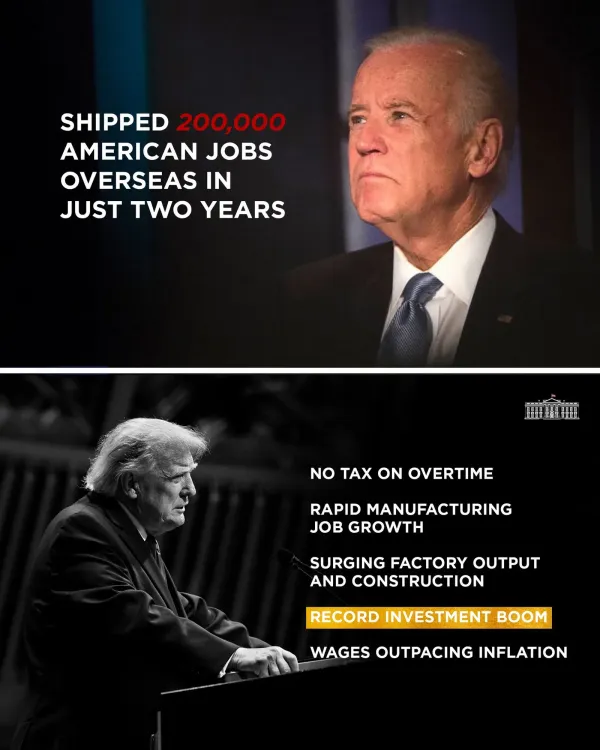
The White House posted on October 13, 2026 that 'the state of American manufacturing is strong.' The post directly blames the Biden Administration for 'shipping labor overseas' in the years prior.
President Trump's first term saw tariffs on steel and aluminium in 2018 and Chinese goods through 2019 to defend domestic manufacturing.
The Biden Administration took a subsidy-led approach via the CHIPS and Science Act and the Inflation Reduction Act , both enacted in 2022 .
US manufacturing employment has been declining since the late 1970s , driven by globalisation and automation.
Upcoming Bureau of Labor Statistics manufacturing payroll reports will be the key empirical test of the administration's claim.
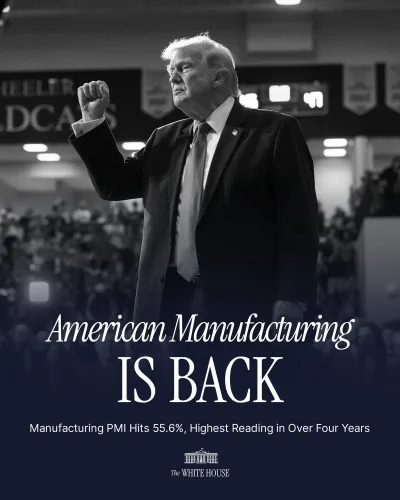
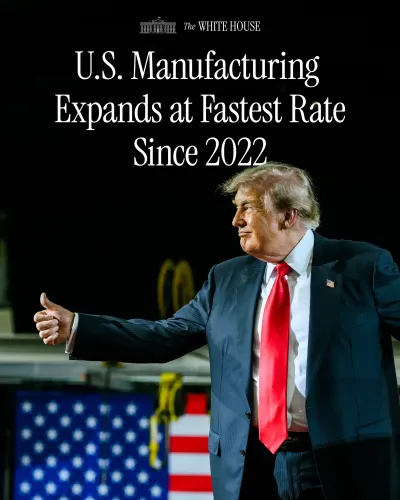
American factories are back in the spotlight — and the White House wants the world to know it. On Tuesday, October 13, 2026, the official communications account of the Executive Office of the President declared that 'the state of American manufacturing is strong,' crediting President Donald Trump for reversing what it called years of labour being shipped overseas under the Biden Administration.
The Claim at the Centre of the Debate
The post pulls no punches: 'After years of the Biden Administration shipping labor overseas, President Trump is fighting for the American worker.' The framing is a direct contrast — Biden as exporter of jobs, Trump as their defender. It is a rhetorical line with deep roots in Trump's political brand, stretching back to his first term when the administration imposed sweeping tariffs on steel and aluminium in 2018 and on Chinese goods in multiple tranches through 2019, all explicitly designed to protect domestic manufacturing employment.
Decades of Decline — and Two Very Different Prescriptions
US manufacturing employment peaked in the late 1970s and has been eroding ever since, squeezed by globalisation, automation, and the seismic shift that followed China's accession to the World Trade Organisation. The political argument over who has the better cure has defined trade policy for a generation. The Biden Administration bet on industrial subsidy — the CHIPS and Science Act (2022) and the Inflation Reduction Act (2022) directed hundreds of billions of dollars toward semiconductor fabrication and clean-energy manufacturing on American soil. The Trump approach leaned on tariff walls and bilateral pressure to make offshoring costlier.
Neither school has fully reversed the long arc of job loss, but both have generated politically potent narratives — and the White House post is firmly in one camp's corner.
What the Numbers Will Have to Prove
Bold declarations need scorecards. The most direct test will come from Bureau of Labor Statistics monthly manufacturing payroll data and any new executive actions or trade agreements the administration announces. If the employment numbers align with the 'strong' headline, the White House will have data to match the rhetoric. If they don't, the post invites scrutiny. Every upcoming jobs report becomes, in effect, a referendum on this claim.
For India, there is a stakes-level subtext: shifts in US manufacturing and trade posture directly affect supply-chain decisions by Indian exporters, IT services firms with delivery models linked to American industry, and the broader trajectory of any bilateral trade deal between New Delhi and Washington.
Point of View
The Trump administration is running the same contrast that animated its 2016 and 2024 victories, betting that the 'fighting for the worker' frame outperforms the subsidy-and-semiconductor approach in swing industrial states. For analysts tracking US-India trade, the harder question is whether a reindustrialising America becomes a partner or a competitor for Indian exporters — a tension Washington has yet to resolve.
NationPress
14 Oct 2026
Frequently Asked Questions
What did the White House say about US manufacturing in October 2026?
The White House declared on October 13, 2026 that 'the state of American manufacturing is strong,' attributing the strength to President Trump's policies and criticising the Biden Administration for offshoring American labour.
What did Trump do for US manufacturing in his first term?
During his first term, President Trump imposed tariffs on steel and aluminium in 2018 and on Chinese imports across multiple tranches through 2019 , with the stated goal of protecting domestic manufacturing jobs.
What manufacturing policies did Biden put in place?
The Biden Administration enacted the CHIPS and Science Act and the Inflation Reduction Act , both in 2022 , directing large subsidies toward semiconductor manufacturing and clean-energy production inside the United States .
Why has US manufacturing employment declined over the decades?
US manufacturing employment peaked in the late 1970s and has fallen since due to globalisation, automation, and intensified import competition — particularly after China joined the World Trade Organisation .
How does US manufacturing policy affect India?
Shifts in US trade and industrial policy affect Indian exporters, IT and services firms tied to American supply chains, and the prospects of a US-India bilateral trade deal — making Washington's factory-jobs debate directly relevant to New Delhi .