White House Launches Military Spouse Commission
Synopsis
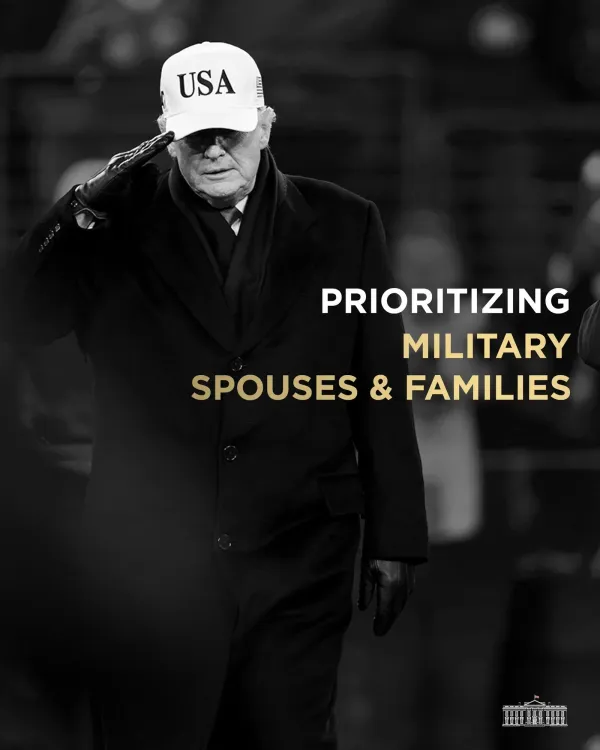
The White House has launched the Military Spouse Commission to tackle systemic challenges in housing, employment, healthcare, education, and childcare faced by US military families — marking a formal policy shift toward supporting the households behind the uniform.
Key Takeaways
The White House announced the creation of the Military Spouse Commission on August 3, 2026 .
The commission will address six key challenge areas: housing, employment, healthcare, education, childcare, and more .
Military spouses face structural unemployment and career disruption due to frequent relocations tied to service orders.
The announcement frames the commission as a presidential commitment to families who 'give up their entire livelihoods in defense of the nation.' The move represents a formal institutional response to gaps in military family welfare policy that have persisted for decades.
Every deployment, every relocation, every sacrifice — military families carry a weight most Americans never see. Now, The White House has announced the creation of the Military Spouse Commission, a dedicated body tasked with confronting the systemic challenges that follow service members' families through every stage of military life.
What the Commission Will Actually Do
The commission's mandate spans six critical pressure points: housing, employment, healthcare, education, childcare, and more. These are not abstract policy categories — they are the lived realities of families who move every two to three years on average, forcing spouses to restart careers, re-enroll children in new schools, and navigate a patchwork of state-by-state licensing rules that can strip a nurse or a teacher of her credentials the moment orders arrive.
Military spouses face an unemployment rate that routinely runs several times higher than the national average, a direct consequence of the transient nature of service life. The commission signals a structural attempt to address that gap rather than leave it to individual families to absorb alone.
A Long-Standing Gap in Military Policy
Support for the uniformed service member has long been the centerpiece of military policy — enlistment bonuses, combat pay, the GI Bill. The family standing behind that service member has historically been treated as a secondary concern. The Military Spouse Commission represents a formal acknowledgment that the support system for a soldier is inseparable from the wellbeing of the household he or she returns to — or leaves behind.
For India, which watches US military welfare policy closely given the depth of the India-US defence partnership, this kind of institutional commitment to service-family welfare offers a reference point as New Delhi continues its own conversations about veteran and military family support frameworks.
The commission's work is just beginning — but the families it is meant to serve have been waiting a long time for Washington to start.
Point of View
Not just a service-member issue — a distinction with real policy weight. By institutionalising this focus, the White House is signalling that the social contract with the armed forces extends to the family unit. For a global audience, it reflects a broader democratic-government trend of quantifying and addressing the 'hidden costs' borne by military households. Whether the commission produces binding policy or remains advisory will determine its real legacy.
NationPress
4 Aug 2026
Frequently Asked Questions
What is the Military Spouse Commission?
The Military Spouse Commission is a body announced by the White House to address challenges facing US military families in areas including housing, employment, healthcare, education, and childcare.
Why do military spouses face employment challenges?
Military families relocate frequently due to service orders, forcing spouses to restart careers and re-obtain professional licences in new states, leading to unemployment rates far above the national average.
When was the Military Spouse Commission announced?
The White House announced the Military Spouse Commission on August 3, 2026 , via an official post on X.
What issues will the Military Spouse Commission focus on?
The commission will focus on housing, employment, healthcare, education, and childcare, among other challenges specific to military family life.
Does this affect India or Indian defence policy?
While the commission is a US domestic initiative, India closely monitors US military welfare frameworks given the strong India-US defence partnership, and such models can inform Indian veteran and military family support discussions.