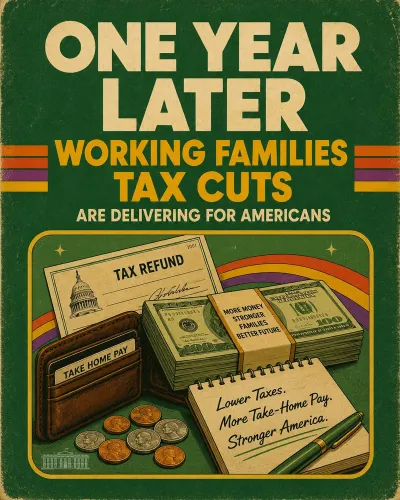
White House Says Trump Tax Cuts Eliminate Overtime Taxes

Synopsis
The White House announced on 9 July 2026 that President Trump's Working Families Tax Cuts have eliminated federal taxes on overtime pay, offering direct financial relief to hourly and shift workers across the United States.
Key Takeaways
The White House announced on 9 July 2026 that overtime pay is no longer subject to federal income tax under the Working Families Tax Cuts .
The policy builds on the foundation of the Tax Cuts and Jobs Act of 2017 , which had kept overtime compensation taxable as ordinary income.
Primary beneficiaries include hourly and shift workers in manufacturing, healthcare, logistics, and retail sectors who regularly work beyond 40 hours per week .
Implementation will depend on updated IRS withholding tables and Treasury Department guidance specifying how employers should adjust payroll.
The announcement was framed as 'Satisfying ASMR,' reflecting a social-media-first communication strategy aimed at younger audiences.
The White House, the official communications account of the Executive Office of the President of the United States, announced on 9 July 2026 that taxes on overtime pay have been eliminated under what it calls President Trump's Working Families Tax Cuts. The post, framed as 'Satisfying ASMR,' signals a deliberate effort to amplify the policy's reach-home impact for wage earners.
Context
The White House posted that, thanks to the Working Families Tax Cuts, overtime compensation is no longer subject to federal income tax. The messaging targets working families and hourly wage earners who regularly clock hours beyond the standard 40-hour work week and have historically seen a significant portion of that extra pay withheld.
The framing — 'Satisfying ASMR' — is a deliberate social-media strategy designed to make a tax-policy announcement feel viscerally rewarding, tapping into a popular internet format to reach younger and non-traditional news consumers.
Policy Backdrop
President Donald Trump's first major legislative tax achievement was the Tax Cuts and Jobs Act of 2017, which lowered marginal income tax rates across most brackets and doubled the standard deduction. That law, however, treated overtime pay as ordinary taxable income, meaning workers who took on extra shifts saw limited net gains after withholding.
The Working Families Tax Cuts package referenced in the post represents a stated expansion of that 2017 framework, specifically carving out overtime compensation from the federal tax base. Any implementing changes to IRS withholding tables or Treasury guidance would determine how quickly the benefit flows into workers' pay cheques.
Stakeholders and Impact
The primary beneficiaries, as described by the White House, are working families — particularly hourly and shift workers in sectors such as manufacturing, healthcare, logistics, and retail, where overtime is common. For a worker earning $20 per hour who regularly logs 10 overtime hours per week, the elimination of federal tax on that supplemental income could meaningfully increase annual take-home pay.
Wage earners in lower and middle income brackets stand to gain proportionally more, since overtime income previously pushed many into higher marginal rate territory. Critics of such measures have historically argued that broad tax exemptions on supplemental wages can complicate the tax code and shift the fiscal burden elsewhere.
What's Next
Analysts and tax professionals will watch for formal Treasury Department guidance and updated IRS withholding tables that would operationalise the overtime tax exemption. Congressional action or executive rulemaking would need to specify whether the exemption applies to all overtime categories or only those under the Fair Labor Standards Act definition.
The announcement is likely to feature prominently in the administration's broader economic messaging ahead of future legislative cycles, reinforcing a narrative of direct financial relief for hourly workers. How quickly employers update payroll systems to reflect the change will determine the real-world timeline for workers to see the benefit.
Point of View
Echoing the 2017 Tax Cuts and Jobs Act's framing of direct relief for working Americans. The policy, if fully operationalised through IRS rulemaking, would mark the most significant change to supplemental wage taxation in decades. The broader arc points to an administration intent on expanding the 2017 tax framework incrementally, targeting specific income categories to sustain political momentum among wage-dependent households.
NationPress
9 Jul 2026
Frequently Asked Questions
What are President Trump's Working Families Tax Cuts?
The Working Families Tax Cuts is a tax policy package announced by the Trump administration that, among other provisions, eliminates federal income tax on overtime pay for workers, aiming to increase take-home wages for hourly and shift employees.
Are taxes on overtime pay now eliminated in the US?
According to the White House, taxes on overtime pay have been eliminated under the Working Families Tax Cuts. The practical effect on pay cheques will depend on updated IRS withholding guidance and employer payroll adjustments.
How does the overtime tax cut affect Indian-origin workers in the US?
Indian-origin workers employed in the United States on valid work visas or as permanent residents who earn overtime pay would also benefit from the exemption, as the policy applies to federal income tax withholding on overtime compensation regardless of national origin.
What was the Tax Cuts and Jobs Act of 2017 and how is this different?
The Tax Cuts and Jobs Act of 2017 lowered marginal income tax rates and doubled the standard deduction but kept overtime pay taxable as ordinary income. The new Working Families Tax Cuts specifically exempts overtime compensation from federal tax, a step beyond the 2017 law.
When will workers see the overtime tax cut in their pay cheques?
The timeline depends on Treasury Department rulemaking and IRS updates to withholding tables. Once employers receive updated guidance and adjust their payroll systems, workers should begin seeing higher net overtime pay in their cheques.