White House Claims DC Transformed in 14 Months Under POTUS
Synopsis
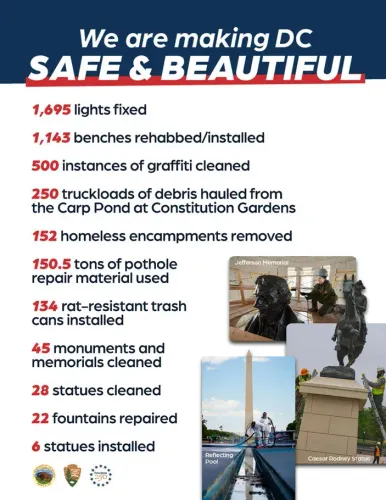
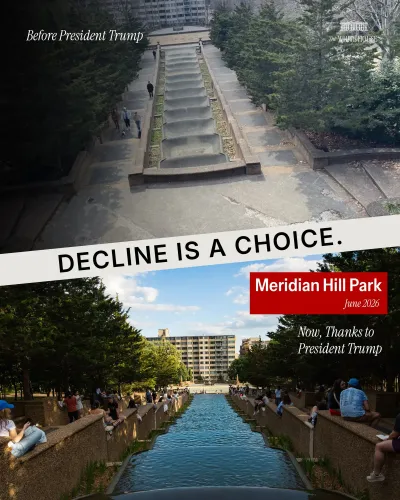
The White House claims the sitting president has transformed Washington D.C. in 14 months — clearing over 500 graffiti sites, removing 153 homeless encampments, restoring 22 fountains, and cleaning 28 statues — framing urban upkeep as a signature governance achievement.
Key Takeaways
The White House posted on June 1, 2026 , claiming 14 months of capital restoration under the sitting president.
500-plus graffiti instances cleaned across Washington, D.C., according to the post.
153 homeless encampments removed, alongside restoration of 22 fountains and cleaning of 28 statues .
Maintenance of federally owned public spaces falls primarily under the National Park Service , not the D.C. municipal government.
Independent verification through National Park Service records and Metropolitan Police data has not yet been reported.
The messaging fits a recurring pattern of administrations using visible capital upkeep to project basic governance competence.
The White House posted on Monday, June 1, 2026, claiming that the sitting president has overseen a sweeping restoration of Washington, D.C. — the United States capital — in just 14 months, citing hundreds of visible improvements to public spaces, monuments, and homeless encampments across the federal district.
Context
The post, shared from the official White House account on X, opens with a pointed declaration: 'Decline was a choice. Not anymore.' It frames the capital's transformation as a deliberate policy reversal, listing specific metrics: 500-plus instances of graffiti cleaned, 153 homeless encampments removed, 22 fountains restored, and 28 statues cleaned. The thread promises further details in a linked image series.
Washington, D.C. occupies a unique constitutional position — governed under the District of Columbia Home Rule Act of 1973, which grants the city limited self-governance while preserving ultimate congressional authority. Maintenance of federally owned public spaces, including the National Mall, monuments, and major fountains, falls primarily under the National Park Service, a federal agency, rather than the D.C. municipal government.
Policy Backdrop
Federal-local tensions over policing, homelessness, and upkeep of public assets in the capital are not new. Congressional interventions dating to the 1990s and 2010s have periodically addressed D.C. budget shortfalls, rising crime, and deferred maintenance on federally controlled properties. The current administration's messaging fits a recurring pattern in which the White House uses visible improvements to the capital to project competence in basic governance.
Homelessness policy in the district has long been a flashpoint between federal and local authorities. Encampment removals require coordination between federal agencies, the Metropolitan Police Department, and D.C. social services — making the claimed removal of 153 encampments a metric that reflects both federal intent and interagency execution. The restoration of fountains and cleaning of statues, by contrast, falls more squarely within the National Park Service's operational mandate.
Stakeholders and Impact
The most immediate beneficiaries cited in such claims are D.C. residents, the federal workforce concentrated in the capital, and the millions of tourists who visit national monuments annually. For residents, the removal of encampments carries both a public-safety dimension and a humanitarian one — critics of such policies have historically raised concerns about the welfare of displaced individuals without corresponding increases in shelter capacity.
For the federal government, the optics of a clean, functioning capital carry diplomatic and symbolic weight: foreign dignitaries, heads of state, and international delegations pass through Washington, D.C. regularly. The White House's decision to lead with a numbered list of achievements signals an intent to make urban upkeep a measurable, communicable policy win ahead of what is likely a broader political messaging cycle.
What's Next
Independent verification of the figures cited — graffiti instances, encampment counts, restored infrastructure — will likely come through National Park Service maintenance records, Metropolitan Police data, and D.C. government reports. Congressional hearings on D.C. appropriations are a standing venue where such claims are tested against audited numbers. Updated crime and cleanliness data from city and federal agencies will be the metric by which the administration's narrative is ultimately evaluated.
The White House thread signals that the administration intends to continue using the capital's physical condition as a visible benchmark of executive effectiveness — a strategy that invites ongoing scrutiny of whether the improvements are sustained or concentrated ahead of political milestones.
Point of View
Encampments removed, fountains restored — reflects a deliberate pivot toward tangible, photogenic governance metrics at a moment when abstract policy wins are harder to communicate. Framing the capital's condition as a binary choice reversed ('decline was a choice, not anymore') is a rhetorical move that implicitly assigns blame to predecessors while claiming credit for visible change. The claim lands in a long-running federal-local tension over who governs D.C. and who is accountable for its condition — a tension the administration appears willing to exploit for political messaging. Until the figures are independently audited, the post functions as a campaign-style progress report rather than a verified policy record.
NationPress
15 Oct 2026
Frequently Asked Questions
What has the White House claimed about Washington DC improvements in 2026?
The White House says that in 14 months, the administration cleaned over 500 graffiti sites, removed 153 homeless encampments, restored 22 fountains, and cleaned 28 statues across Washington, D.C.
Who is responsible for maintaining Washington DC public spaces and monuments?
The National Park Service, a federal agency, is primarily responsible for maintaining monuments, fountains, and public spaces on the National Mall and other federally owned properties in the capital.
Can the White House remove homeless encampments in Washington DC?
Encampment removals in D.C. require coordination between federal agencies, the Metropolitan Police Department, and local social services, given the city's unique status under the District of Columbia Home Rule Act of 1973.
Has the White House claim about DC restoration been independently verified?
As of the post date, independent verification through National Park Service records or Metropolitan Police data has not been publicly confirmed; congressional appropriations hearings are the standard venue where such figures are audited.
Why does the US administration highlight Washington DC cleanliness as a policy win?
Administrations historically use visible improvements to the capital to project competence in basic governance, and a clean, functioning capital carries diplomatic weight given the volume of foreign dignitaries and tourists who visit annually.