White House Urges Congress to Pass SAVE America Act

Synopsis
The White House on July 8, 2026 publicly called on Congress to pass the SAVE America Act, describing the legislation as essential to protecting US elections. The push comes ahead of the 2026 midterm elections, intensifying pressure on lawmakers to act within a compressed legislative calendar.
Key Takeaways
The White House issued an urgent public call on July 8, 2026 for Congress to pass the SAVE America Act .
The administration framed the legislation as essential to the integrity of America's elections .
The push comes ahead of the 2026 midterm elections , compressing the legislative window for passage.
The primary stakeholders are voters and election officials across all 50 US states.
Federal election law in the US has been contested since at least the Help America Vote Act of 2002 , with partisan divides over access versus security persisting for over two decades.
Congressional action — particularly in the Senate and House of Representatives — will determine whether the bill advances before the election cycle peaks.
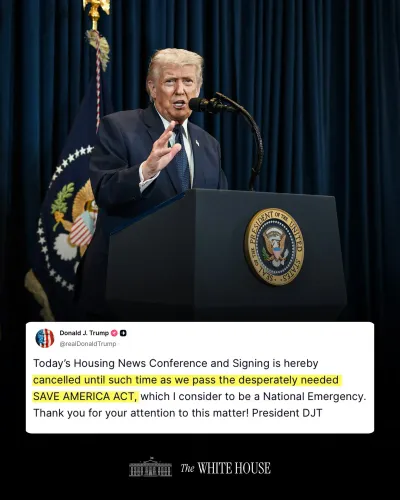
The White House, the official communications account of the Executive Office of the President of the United States, on Wednesday, July 8, 2026, issued an urgent call for Congress to advance the SAVE America Act, framing the legislation as critical to the integrity of the country's elections.
Context
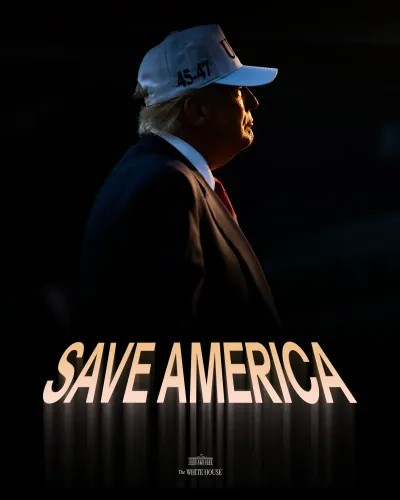
The post stated plainly: 'Fight for the SAVE America Act, America's elections are counting on it.' The message, brief and direct, signals that the White House views the legislation as a priority ahead of the 2026 midterm elections. The call to action is addressed broadly — to lawmakers, supporters, and the public — to mobilise behind the bill.
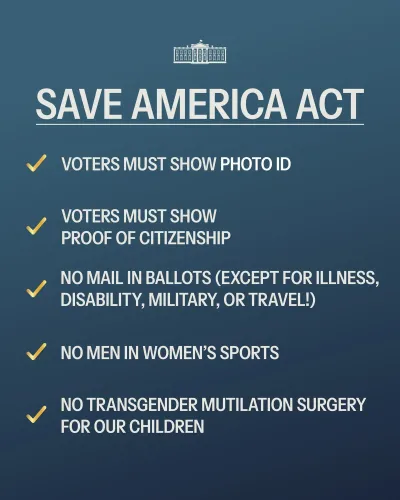
The SAVE America Act is a federal election-related legislative proposal. Its precise provisions and current legislative status are still being tracked as the bill moves through US Congress, the bicameral legislature responsible for enacting federal election laws and standards.
Policy Backdrop
Federal election legislation in the United States has a long and contested history. The landmark Help America Vote Act of 2002 established minimum federal standards for state election administration following the disputed 2000 presidential contest, addressing voting system requirements and accessibility. That law remains the primary federal framework governing how states run their elections.
Since the 2010s, court challenges and widening state-level variations in voter identification rules, registration processes, and ballot access have intensified the partisan divide over election policy. Proposals at the federal level have repeatedly sought to resolve the tension between expanding voter access and tightening election security — a debate that shows no sign of resolution.
Stakeholders and Impact
The two groups most directly affected by any federal election legislation are voters and election officials across all 50 states. Voters stand to see changes in registration requirements, identification rules, or ballot procedures depending on what the SAVE America Act ultimately mandates. Election officials, who administer the mechanics of voting at the state and county level, would be responsible for implementing any new federal standards.
The White House's decision to publicly amplify the call ahead of the midterms suggests the administration sees the bill as both a policy priority and a political signal. Federal election legislation, when passed, typically requires states to update their systems within defined compliance windows, creating immediate administrative demands on local governments.
What's Next
Congressional action on the SAVE America Act will be the critical variable to watch in the coming weeks. With the 2026 midterm elections approaching, the legislative calendar is compressed, and any bill requiring broad bipartisan support faces a narrow window for passage. State election administrators will be monitoring developments closely, as federal mandates carry implementation deadlines that can strain local resources.
The White House's public push raises the stakes for members of Congress, particularly those in competitive districts, to take a visible position on the legislation. How the bill is received in the Senate and the House of Representatives will determine whether it advances to a floor vote before the election cycle peaks.
Point of View
' the administration is making legislative inaction politically costly for members of Congress. The move also continues a decades-long federal effort — stretching back to the Help America Vote Act of 2002 — to impose uniform standards on a patchwork state-administered system. Whether this push produces legislation or serves primarily as a political marker ahead of the 2026 midterms will depend on the arithmetic of the current Congress.
NationPress
8 Jul 2026
Frequently Asked Questions
What is the SAVE America Act?
The SAVE America Act is a federal election-related legislative proposal that the White House has publicly championed as critical to protecting the integrity of US elections. Its specific provisions are being tracked as the bill moves through Congress.
Why is the White House pushing for the SAVE America Act now?
The White House issued its call on July 8, 2026, ahead of the 2026 midterm elections, signalling that the administration views the bill as both a policy priority and a time-sensitive legislative objective before the election cycle peaks.
What is the history of federal election legislation in the US?
The Help America Vote Act of 2002 is the primary federal framework governing state election administration, enacted after the disputed 2000 presidential election. Since the 2010s, court challenges and state-level variations have intensified debate over voter access versus election security.
Who would be affected by the SAVE America Act?
Voters and election officials across all 50 US states are the primary stakeholders. Voters could see changes in registration or identification rules, while election officials would be responsible for implementing any new federal standards within compliance deadlines.
What happens next with the SAVE America Act in Congress?
The bill must pass both the Senate and the House of Representatives. With the 2026 midterms approaching, the legislative calendar is compressed, making bipartisan support and floor votes critical variables to watch in the coming weeks.