26.35 crore APAAR IDs generated under One Nation One Student ID push
Synopsis
India has crossed 26.35 crore verified APAAR IDs — a 12-digit academic identity for every learner that stores credits across schools, colleges, and skill programmes. With a seven-year credit redemption window and CSC-based enrolment for remote areas, the system could fundamentally change how dropout students re-enter education.
Key Takeaways
26.35 crore verified APAAR IDs have been generated across India as of 2 July 2025 .
APAAR is a unique 12-digit student ID linked to the Academic Bank of Credits (ABC) , accessible via DigiLocker .
Credits earned are stored for a self-life of seven years , allowing students who drop out to resume studies without losing prior progress.
School education records will be creditised and mapped under the NAD-ABC framework in the next phase.
Students in remote areas can generate APAAR IDs through the nearest Common Service Centre (CSC) .
The initiative supports NEP 2020 and the National Credit Framework (NCrF) goals of flexible, lifelong learning.
A total of 26.35 crore verified APAAR (Automated Permanent Academic Account Registry) IDs have been generated across India as of 2 July 2025, according to an official factsheet released on Sunday, 5 July. The milestone marks a significant step in the government's 'One Nation, One Student ID' initiative, which aims to assign every learner a single, lifelong academic identity.
What APAAR ID Is and How It Works
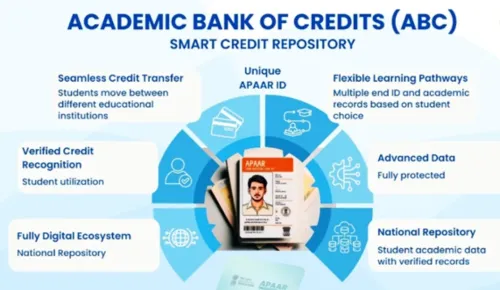
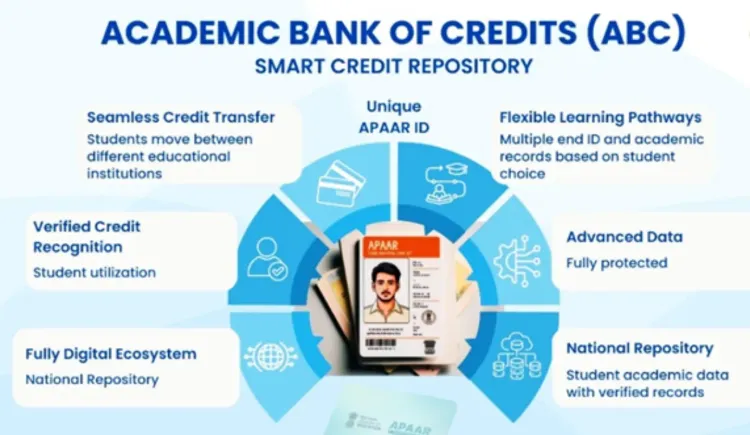
The APAAR ID is a unique 12-digit student identification number linked to the Academic Bank of Credits (ABC) system. Accessible via DigiLocker and the ABC platform, it consolidates a student's academic records spanning higher education, skill and vocational training, and other professional learning programmes onto a single digital repository.
According to the factsheet, school education records will also be creditised and mapped with APAAR IDs under the NAD-ABC framework. For students in remote and underserved areas, IDs can be generated through the nearest Common Service Centre (CSC), ensuring last-mile access.
The Role of the Academic Bank of Credits
The primary objective of the ABC is to build a flexible, learner-centric education system in which learning achievements can be recognised, stored, and utilised throughout a person's lifetime. The platform directly supports the vision of the National Education Policy (NEP) 2020 and the National Credit Framework (NCrF), enabling credit transfer, multiple entry and exit options, and cross-institutional recognition of learning.
Notably, if a student drops out after partially completing a programme, the credits already earned are preserved in the ABC data bank. These credits carry a self-life of seven years for redemption and transfer, allowing learners to resume studies at a later stage without losing prior academic progress.
Building a Connected Education Ecosystem
Together, ABC and APAAR are designed to simplify credit transfer between institutions, improve transparency in academic record-keeping, and support integration across schools, universities, skill institutions, and other education stakeholders. The platform envisions a connected education ecosystem that makes learning more flexible and accessible for every student in the country.
What This Means for Students
For millions of learners — particularly those from marginalised or economically vulnerable backgrounds — the ability to pause and resume education without forfeiting earned credits could be transformative. This is especially relevant in a country where dropout rates remain a structural challenge at the secondary and tertiary levels. The CSC-based enrolment option further broadens reach beyond urban centres.
With over a quarter of a billion IDs already generated, the government's digital academic infrastructure is scaling rapidly. The next phase — full integration of school-level records under NAD-ABC — will be a key indicator of whether the ecosystem delivers on its promise of seamless, lifelong learning recognition.
Point of View
But the harder test lies ahead: integrating school-level records under NAD-ABC, where data quality and institutional compliance are far patchier than in higher education. The seven-year credit redemption window is a genuinely progressive design choice, but its value depends entirely on whether institutions honour transfers without bureaucratic friction — something India's education system has historically struggled with. The CSC enrolment option signals intent on inclusion, but uptake in the most underserved districts will need active monitoring, not just policy announcements.
NationPress
5 Oct 2026
Frequently Asked Questions
How many APAAR IDs have been generated so far?
As of 2 July 2025, a total of 26.35 crore verified APAAR IDs have been generated across India, according to an official factsheet released on 5 July 2025.
What happens to a student's credits if they drop out?
Credits earned before dropping out are preserved in the Academic Bank of Credits (ABC) data bank for a self-life of seven years. Students can use these stored credits towards completing their studies when they choose to re-enrol at a later date.
How can students in remote areas get an APAAR ID?
Students in remote and underserved areas can generate their APAAR ID through the nearest Common Service Centre (CSC), ensuring the initiative reaches beyond urban and well-connected regions.
How does APAAR support the National Education Policy 2020?
APAAR and the ABC system directly support NEP 2020 and the National Credit Framework (NCrF) by enabling credit transfer between institutions, offering multiple entry and exit options, and recognising learning across different disciplines and institutions — key pillars of the policy's flexible education vision.