Adani Electricity cuts AT&C losses to 4.46% with 36,720 raids in FY26

Synopsis
Adani Electricity ran 36,720 raids, seized 79.25 tonnes of illegal wiring, and filed 486 FIRs in a single financial year — and still only clawed back ₹43.39 crore in assessed theft. The headline AT&C loss number of 4.46% is impressive by Indian discom standards, but the scale of the enforcement effort needed to get there reveals just how entrenched power theft remains in Mumbai's dense urban pockets.
Key Takeaways
Adani Electricity reduced AT&C losses to 4.46% in FY 2025-26 , down from 4.7% the previous year, ranking among India's lowest for a discom.
The company conducted 36,720 mass raids and registered 486 FIRs during the financial year.
5,897 power theft cases were booked; 79.25 tonnes of unauthorised wires and equipment were seized.
Total assessed theft stood at 19.82 million units worth ₹43.39 crore .
Three high-value theft cases — worth ₹1.63 crore , ₹80 lakh , and ₹48.73 lakh — were detected in Malad (West) , Goregaon (West) , and Malad (East) respectively.
Odd-timing raids increased by 40% year-on-year as part of the intensified enforcement strategy.
Adani Electricity has driven its Aggregate Technical and Commercial (AT&C) losses down to 4.46% in FY 2025-26, from 4.7% the previous year — a reduction of 0.24 percentage points — placing the Mumbai-based distribution company among the best-performing power discoms in the country, according to a company statement issued on Tuesday, 14 July 2025. The improvement is attributed to an intensified anti-theft campaign that included tens of thousands of raids across the utility's network.
Scale of the Anti-Theft Drive
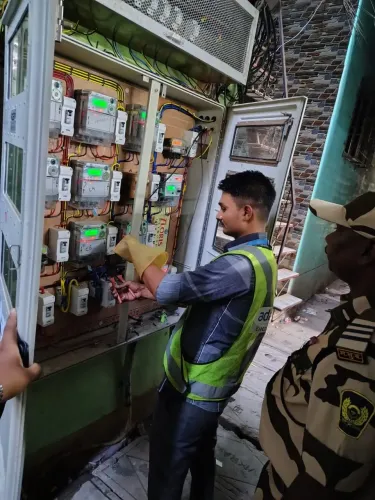
During FY 2025-26, Adani Electricity conducted 36,720 mass raids and registered 486 First Information Reports (FIRs) against those accused of power theft. The company also reported a 40% increase in raids carried out at unconventional hours — including early mornings, late evenings, and public holidays — as part of a strategy to catch offenders off-guard.
In total, 5,897 power theft cases were booked during the year. Raids resulted in the seizure of 79.25 tonnes of unauthorised wiring and equipment. The assessed value of electricity stolen stood at 19.82 million units, amounting to a financial loss of ₹43.39 crore.
High-Value Cases Detected
Among the notable detections, the company's vigilance team uncovered a theft case worth ₹1.63 crore on 7 November 2025 at Swastik Compound, Chincholi Bandar Road, Malad (West), involving direct power supply for moulding activity. A second high-value case of ₹80 lakh was booked on 4 July 2025 at Motilal Nagar, Goregaon (West), also linked to moulding operations. A third case — valued at ₹48.73 lakh — was registered in June 2025 at Malad (East) under similar circumstances.
Legal Framework and Police Coordination
Power theft in India is a non-bailable offence under Section 135 of the Electricity Act, 2003, which prescribes a fine, imprisonment of up to three years, or both, upon conviction. Adani Electricity has been conducting joint operations with police authorities to apprehend offenders and confiscate equipment used for illegal connections.
The company noted that power theft is particularly acute in high-density areas and slum clusters, where space constraints limit network expansion. Unauthorised tapping in such zones overloads existing infrastructure, leading to more frequent cable and transformer failures and elevated maintenance costs — expenses that are ultimately borne by law-abiding consumers.
What the Company Said
An Adani Electricity spokesperson stated: 'Power theft unfairly burdens honest, paying consumers. Adani Electricity is committed to eliminating the menace of power theft. By combating such unlawful activities, we safeguard the interests of our customers. We will intensify our efforts in specific areas to further reduce AT&C losses this year.'
The spokesperson added: 'The significant reduction in AT&C losses this year is a direct result of our intensified efforts against power theft. This not only safeguards our infrastructure but also alleviates the financial burden on our honest, paying consumers by enabling us to maintain competitive tariffs.'
With AT&C losses already among the lowest for any Indian discom, Adani Electricity has signalled it will push further in the year ahead, targeting specific high-risk zones for concentrated enforcement activity.
Point of View
Dragged down by political reluctance to prosecute theft in vote-sensitive slum clusters. Adani Electricity's willingness to file FIRs and conduct holiday raids signals an operational seriousness that public utilities rarely match. Yet the numbers also reveal the scale of the problem: ₹43.39 crore in assessed theft recovered from nearly 37,000 raids suggests that detection rates remain low relative to the likely universe of illegal connections. The real test is whether loss levels can be pushed below 4% — a threshold that would require tackling not just opportunistic theft but systemic infrastructure gaps in high-density zones where honest metering is structurally difficult.
NationPress
12 Oct 2026
Frequently Asked Questions
What are AT&C losses and why do they matter?
Aggregate Technical and Commercial (AT&C) losses measure the gap between electricity a discom injects into its network and what it actually bills and collects. High AT&C losses translate into higher tariffs for paying consumers and financial stress for the utility; reducing them improves grid efficiency and revenue recovery.
How much did Adani Electricity reduce its AT&C losses in FY 2025-26?
Adani Electricity cut its AT&C losses from 4.7% in FY 2024-25 to 4.46% in FY 2025-26 — a reduction of 0.24 percentage points — placing it among the best-performing distribution companies in India, according to the company's statement.
How many raids did Adani Electricity conduct and what was recovered?
The company conducted 36,720 mass raids during FY 2025-26, resulting in 486 FIRs and 5,897 cases booked. Raids led to the seizure of 79.25 tonnes of unauthorised wiring; total assessed theft was 19.82 million units valued at ₹43.39 crore.
What is the legal penalty for electricity theft in India?
Under Section 135 of the Electricity Act, 2003, power theft is a non-bailable offence. On conviction, an offender can face a fine, imprisonment of up to three years, or both.
Why is power theft particularly damaging in slum areas?
In high-density areas and slum clusters, space constraints make network expansion difficult, so illegal tapping overloads existing cables and transformers. This increases the frequency of infrastructure failures and drives up maintenance costs — expenses that are passed on to paying consumers through higher tariffs.