Adani Defence fires Bagheera AT1 anti-tank missiles at Pokhran in Army demo
Synopsis
Adani Defence has test-fired four Bagheera AT1 anti-tank guided missiles at Pokhran before senior Army and MoD observers — a system that hits targets at 8 km (double the range of existing land-based ATGMs), rides a laser beam to defeat electronic jamming, and fires two rounds in quick succession to defeat a tank's active protection. It arrives as India's ATGM inventory is widely seen as ageing and under-strength.
Key Takeaways
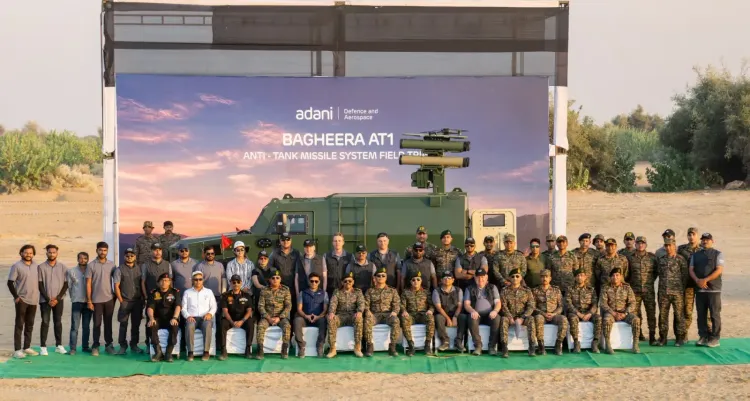
Adani Defence & Aerospace demonstrated the Bagheera AT1 ATGM at Pokhran Field Firing Ranges on 20 November 2026 .
The system engages armoured targets at up to 8 km — roughly twice the range of conventional land-based anti-tank missiles.
Each vehicle carries 12 missiles total: 4 on the automated launcher and 8 reloads.
Laser beam-riding guidance makes the system highly resistant to electronic jamming ; two missiles can be fired in succession to defeat a tank's Active Protection System.
India's defence production hit a record ₹1.78 lakh crore in FY 2025-26, with the private sector accounting for 24% of output.
India's existing ATGM backbone — Milan-2T and Konkurs-M — is second-generation; Spike and Javelin acquisitions are under way to bridge the gap.
Adani Defence & Aerospace successfully demonstrated its vehicle-mounted anti-tank guided missile (ATGM) system, the 'Bagheera AT1', at the Pokhran Field Firing Ranges in Rajasthan on 20 November 2026, with senior representatives of the Indian Army, Department of Military Affairs, and Ministry of Defence (MoD) in attendance. The 'No Cost No Commitment' (NCNC) trial saw four ready-to-fire missiles engage targets successfully, marking a significant milestone for India's private defence sector.
What the Bagheera AT1 System Offers
The Bagheera AT1 is the product of 18 months of design and development, during which Adani Defence customised the missile system for Indian terrain, climate, and operational requirements. The complete combat system comprises the missile, an automated launcher, day and night sights, all mounted on an Adani Defence-designed 4x4 high-mobility armoured vehicle.
The system can engage armoured targets at ranges of up to 8 km — roughly twice the approximately 4 km range of conventional land-based anti-tank missiles. Each vehicle carries four ready-to-fire missiles on the automated launcher and 8 reloads, giving a total onboard capacity of 12 missiles per vehicle.
Key Technical Capabilities
Unlike many existing systems, the Bagheera AT1 uses laser beam-riding guidance rather than a radio link, making it highly resistant to electronic jamming — a critical advantage on battlefields increasingly shaped by drone warfare and electronic countermeasures. Notably, two missiles can be fired in rapid succession along the same laser beam at a single target: the first engages the target tank's Active Protection System (APS), and the second is designed to penetrate its defences.
Beyond armoured targets, the system can also engage aerial threats at extended range. The crew can engage from cover and relocate swiftly, reducing exposure to counter-battery and enemy fire.
India's ATGM Gap and the Modernisation Imperative
India's requirement for modern anti-tank guided missiles remains substantial, with reported gaps in the ATGM inventory underlining the urgency of continued modernisation. According to Adani Defence, the in-service backbone currently relies on second-generation systems — the 'Milan-2T' and 'Konkurs-M' — with Spike missiles inducted subsequently to address immediate operational needs. India is also reportedly progressing with the acquisition of 'Javelin' systems.
This comes amid growing recognition, drawn from recent global conflicts, that range and mobility are decisive in armoured engagements. The Bagheera AT1 is positioned as an additional long-range, mobile ground-based capability alongside man-portable and helicopter-launched missile options.
India's Defence Production Surge
The Pokhran trial reflects a broader shift in India's defence manufacturing landscape. India's defence production reached a record ₹1.78 lakh crore in FY 2025-26. The private sector's share rose to 24%, or approximately ₹42,000 crore, up from 22% in the preceding year. Defence exports also hit a record ₹38,424 crore in the same period.
The Bagheera AT1 demonstration underscores the expanding role of India's private sector in developing, integrating, and delivering advanced defence systems tailored to the operational requirements of the armed forces. The Army's next steps — including formal trials and potential procurement discussions — will determine whether Bagheera enters the acquisition pipeline.
Point of View
And battlefield lessons from recent conflicts have elevated long-range, mobile anti-armour capability from a 'nice-to-have' to a priority. What is notable here is that a private Indian company — not DRDO or a public-sector undertaking — has produced a system with an 8 km reach and electronic-countermeasure resistance in just 18 months. The harder question is whether the Army's procurement cycle can match the pace of private sector development; past trials by private players have stalled in lengthy evaluation pipelines. With Javelin and Spike acquisitions already under way, the MoD will need to decide whether a domestically developed alternative at competitive cost warrants accelerated testing and induction rather than a prolonged queue.
NationPress
21 Nov 2026
Frequently Asked Questions
What is the Bagheera AT1 anti-tank guided missile system?
The Bagheera AT1 is a vehicle-mounted anti-tank guided missile (ATGM) developed by Adani Defence & Aerospace over 18 months, designed for Indian terrain and operational conditions. It is mounted on a 4x4 high-mobility armoured vehicle and can engage armoured targets at ranges of up to 8 km.
What happened at the Pokhran trial on 20 November 2026?
Adani Defence conducted a 'No Cost No Commitment' (NCNC) demonstration at the Pokhran Field Firing Ranges in Rajasthan, successfully firing four Bagheera AT1 missiles. The trial was witnessed by senior representatives of the Indian Army, Department of Military Affairs, and Ministry of Defence.
How is Bagheera AT1 different from India's existing anti-tank missiles?
The Bagheera AT1 offers a range of up to 8 km — roughly twice that of conventional land-based ATGMs. It uses laser beam-riding guidance instead of radio links, making it resistant to electronic jamming, and can fire two missiles in quick succession to defeat a tank's Active Protection System.
Why does India need new anti-tank guided missiles?
India's current ATGM inventory relies heavily on ageing second-generation systems like the Milan-2T and Konkurs-M. Reported gaps in the inventory, combined with lessons from recent global conflicts highlighting the importance of long-range, mobile anti-armour capability, have made modernisation a priority. India has inducted Spike missiles and is progressing with Javelin acquisition as interim measures.
What does the Bagheera AT1 trial mean for India's private defence sector?
It reflects the growing capability of India's private sector in developing advanced defence systems indigenously. India's private sector accounted for 24% — approximately ₹42,000 crore — of a record ₹1.78 lakh crore in total defence production in FY 2025-26, and exports reached a record ₹38,424 crore in the same year.