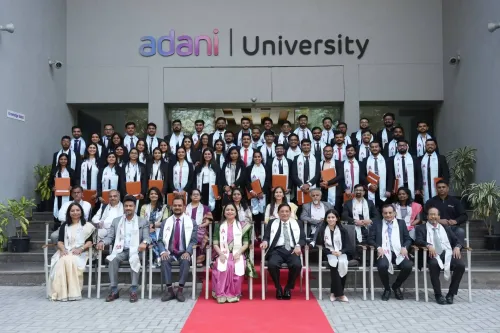
Adani University overhauls curriculum for 2026-27 with mandatory AI course
Synopsis
Adani University is making artificial intelligence compulsory for every Engineering and Science student from 2026-27 — not as an elective, but as a core course covering prompt engineering and AI ethics. Paired with a three-stage internship ladder and new minors in Robotics and VLSI, the overhaul is one of the more structured NEP 2020-aligned curriculum redesigns announced by an Indian private university this year.
Key Takeaways
Adani University announced a full curriculum overhaul on 26 June for the 2026–27 academic year.
A compulsory AI for Engineers course covering prompt engineering and ethical AI will be mandatory for all Engineering and Science students.
The MBA in Infrastructure Management programme now integrates AI, analytics, ESG principles, and Indian Knowledge Systems.
Students will complete three structured internships — community service, professional development, and industry — across their academic years.
New minor specialisations include Robotics , VLSI Design , and Financial Data Analytics .
Project-based courses developed with e-Yantra, IIT Bombay and Studio Learning modules have been added to reinforce practical skills.
Adani University on Friday, 26 June announced a sweeping redesign of its academic curriculum for the 2026–27 academic year, introducing compulsory artificial intelligence coursework, three structured internships, and new minor specialisations across its Engineering, Science, and Management programmes. The overhaul, developed in consultation with industry experts and benchmarked against leading institutions in India and abroad, is aligned with the National Education Policy (NEP) 2020.
The AI-First Mandate
A defining feature of the revised framework is a compulsory course titled AI for Engineers, to be offered to all Engineering and Science students. The course covers foundational artificial intelligence concepts, prompt engineering, and ethical AI practices. Beyond this standalone course, AI concepts and applications have been embedded across multiple disciplines to prepare graduates for an increasingly AI-driven workplace.
The Faculty of Management Sciences has also redesigned its flagship MBA in Infrastructure Management programme, weaving in themes such as artificial intelligence, analytics, environmental, social and governance (ESG) principles, and Indian Knowledge Systems. Sector-specific specialisations and expanded experiential learning through internships and capstone projects are part of the updated offering.
Three-Stage Internship Structure
The university has restructured experiential learning around three mandatory internships spread across the academic journey. Students will undertake a community service internship after the first year, a professional development internship after the second year, and an industry internship after the third year. This staged model is designed to progressively build real-world competence alongside classroom learning.
Practical training has been further reinforced through project-based courses developed in partnership with e-Yantra, IIT Bombay, focusing on hardware development and software programming. Studio Learning modules have also been introduced in selected programmes to encourage hands-on problem-solving from the first year itself.
New Specialisations and Flexible Pathways
Students will gain access to more flexible learning pathways through Massive Open Online Courses (MOOCs), interdisciplinary electives, and the option to pursue minor degrees alongside their major programmes. Emerging fields including Robotics, VLSI Design, and Financial Data Analytics have been introduced as minor specialisations — areas where industry demand has outpaced traditional university offerings.
Indian Knowledge Systems Integration
As part of a broader push to embed Indian heritage into modern education, Adani University has made Indian Knowledge Systems a mandatory credit-based component of its academic framework, supplemented by subject-specific modules. These are designed to expose students to India's scientific traditions, philosophical thought, ethics, and sustainability practices — a requirement consistent with NEP 2020 directives.
What Comes Next
The revised curriculum takes effect from the 2026–27 academic year. With industry bodies increasingly flagging the gap between graduate skills and workplace needs, the success of the overhaul will ultimately be measured by graduate employability outcomes and the depth of industry partnerships that follow.
Point of View
But the real differentiator will be execution — specifically, whether the 'AI for Engineers' course is taught by faculty with current industry exposure or recycled from older data-science syllabi. The three-stage internship ladder is structurally sound, yet its value depends entirely on the quality of employer partnerships Adani University can secure. Indian private universities have a pattern of announcing NEP 2020 alignment without the institutional infrastructure to back it up. Adani University's corporate parentage gives it an unusual advantage in industry access — whether it converts that into verifiable placement outcomes will be the real test of this redesign.
NationPress
25 Sept 2026
Frequently Asked Questions
What changes has Adani University made to its curriculum for 2026-27?
Adani University has overhauled its Engineering, Science, and Management curricula for 2026-27, introducing a compulsory AI for Engineers course, three structured internships, new minor specialisations in Robotics, VLSI Design, and Financial Data Analytics, and mandatory Indian Knowledge Systems modules. The redesign is aligned with the National Education Policy 2020.
What is the AI for Engineers course at Adani University?
AI for Engineers is a newly introduced compulsory course for all Engineering and Science students at Adani University. It covers foundational artificial intelligence concepts, prompt engineering, and ethical AI practices, and is part of the university's broader push to embed AI across multiple disciplines.
How are internships structured under the new Adani University curriculum?
Students will complete three mandatory internships: a community service internship after the first year, a professional development internship after the second year, and an industry internship after the third year. The staged structure is designed to build real-world competence progressively.
Which new specialisations has Adani University introduced?
Adani University has introduced Robotics, VLSI Design, and Financial Data Analytics as new minor specialisations. Students can pursue these alongside their major programmes, and also have access to MOOCs and interdisciplinary electives for flexible learning.
How does the Adani University curriculum redesign align with NEP 2020?
The revised curriculum incorporates NEP 2020 directives including mandatory Indian Knowledge Systems courses, flexible learning pathways through MOOCs and minor degrees, and a stronger emphasis on experiential and project-based learning. The changes were benchmarked against leading institutions in India and abroad.