Amit Shah Credits CAPF for Zero Deaths in Bengal Polls

Synopsis
Union Home Minister Amit Shah credited CAPF personnel for ensuring zero deaths in West Bengal's 2026 assembly elections, calling Bengal the toughest challenge after violence-free polls in Uttar Pradesh and Bihar — framing central force deployment as a replicable security model.
Key Takeaways
Amit Shah declared that not a single person died in the 2026 West Bengal elections .
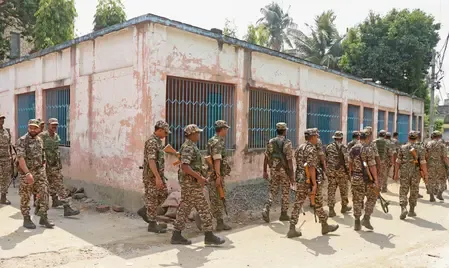
He credited CAPF (Central Armed Police Forces) personnel directly for the fatality-free outcome.
Shah described West Bengal as 'the biggest challenge', placing it after Uttar Pradesh and Bihar on a list of states where electoral violence has been curbed.
CAPF units operate under the Union Home Ministry and are deployed independently of state governments during elections.
The post positions central force deployment as a scalable model for peaceful elections across India's most contested states.
When the ballots were being cast in West Bengal, the Union Home Ministry had one overriding mission: make sure no one died. Union Home Minister Amit Shah declared on Wednesday, October 21, 2026, that the mission succeeded — crediting the Central Armed Police Forces (CAPF) for ensuring not a single fatality during the state's assembly elections.
Shah posted in Hindi: 'इस वर्ष पश्चिम बंगाल में हुए चुनावों में एक भी व्यक्ति की मृत्यु नहीं हुई, जिसका श्रेय CAPF के जवानों को जाता है' — 'In this year's West Bengal elections, not a single person died, and the credit for this goes to the CAPF personnel.'
Why Bengal Was the Hardest Test
Shah framed the achievement against a deliberately sequenced comparison. Uttar Pradesh and Bihar, he said, had already shed their histories of electoral violence. Bengal, however, 'was the biggest challenge.' The state has long carried allegations of poll-related clashes — a record that made it the sharpest test of central force deployment.
That framing matters politically. By positioning Bengal last on a list that moves from solved to solved to finally solved, Shah is arguing a progression — not an accident, but a replicable model.
CAPF's Expanding Election-Security Role
The Central Armed Police Forces, which operate under the Union Home Ministry, have been deployed in state assembly elections for decades — most intensively in constituencies flagged as sensitive by the Election Commission of India. Their presence supplements state police forces and operates outside the direct command of state governments, which is precisely the point when the governing party at the state level is an election contestant.
The 2021 West Bengal assembly elections saw extensive CAPF deployment amid widespread reports of booth-level violence and post-poll clashes. The contrast Shah is drawing — from that contested cycle to a fatality-free one — is the centrepiece of his claim.
A Template Shah Is Staking His Ministry On
The Home Minister's post is not just a tribute to jawans. It is a political argument: that central force deployment, managed from New Delhi, can override the local conditions that historically produced violence. The UP-Bihar-Bengal arc he sketches is a before-after story designed to be cited in future election cycles.
Whether the Election Commission's own incident data corroborates a zero-death count in Bengal will determine how durable that argument proves to be. For now, the CAPF personnel Shah praised are the ones carrying the weight of the claim.
Point of View
Not just a tribute. By anchoring Bengal's success at the end of an UP-Bihar-Bengal progression, he is building a longitudinal case for the Home Ministry's election-security doctrine — one that implicitly positions central force deployment as superior to state-managed policing in high-violence contexts. The claim of zero deaths, if borne out by official data, would significantly strengthen the BJP's governance narrative ahead of any future electoral cycle. The post also signals to CAPF cadres that their election duties carry direct political salience at the ministerial level.
NationPress
21 Oct 2026
Frequently Asked Questions
What did Amit Shah say about West Bengal elections?
Amit Shah stated that not a single person died in the 2026 West Bengal assembly elections and credited CAPF personnel for ensuring the peaceful outcome.
What is CAPF and why is it deployed in elections?
CAPF stands for Central Armed Police Forces, a group of paramilitary units under the Union Home Ministry. They are deployed in state elections — especially in sensitive constituencies — to supplement state police and provide independent security oversight.
Was West Bengal always considered a violent election state?
West Bengal has historically faced allegations of poll-related clashes and booth-level violence, most notably during the 2021 assembly elections, which saw extensive central force deployment.
How does West Bengal's 2026 poll compare to earlier elections in UP and Bihar?
Shah presented all three states as having moved away from electoral violence, calling Bengal 'the biggest challenge' — suggesting it was the hardest to pacify and therefore the most significant achievement.
Who oversees CAPF deployment during state elections?
CAPF deployment is coordinated between the Election Commission of India and the Union Home Ministry. Since CAPF units report to the central government, they operate independently of the state government in whose territory they are deployed.