Amit Shah Invokes Ganga Corridor in BJP Poll Push
Synopsis
Union Home Minister Amit Shah on 28 May 2026 invoked the full course of the Ganga — from Gangotri to Gangasagar — to assert BJP's political dominance across the riverine heartland, signalling the party's intent ahead of the 2026 West Bengal assembly elections.
Key Takeaways
Union Home Minister Amit Shah posted on X on 28 May 2026 claiming BJP's saffron flag flies across the entire Ganga corridor.
The post spans the river's source at Gangotri, Uttarakhand to its mouth at Gangasagar, West Bengal — roughly 2,500 km .
The BJP has governed Uttarakhand since 2017 and Uttar Pradesh since 2017 , forming the bulk of the river's political corridor.
West Bengal , where the Ganga meets the sea, remains under Trinamool Congress rule with BJP as principal opposition.
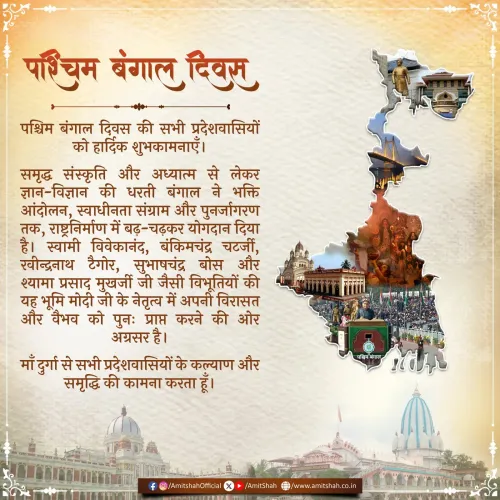
The 2026 West Bengal assembly elections are the immediate electoral context for Shah's messaging.
The post was accompanied by a video and is part of the BJP's long-standing cultural-political outreach along the Ganga basin.
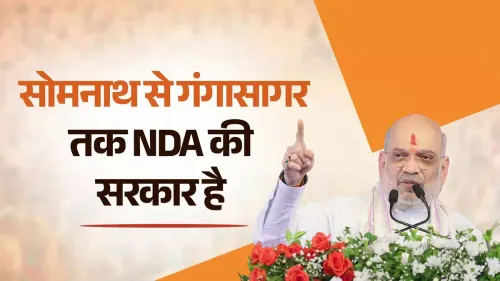
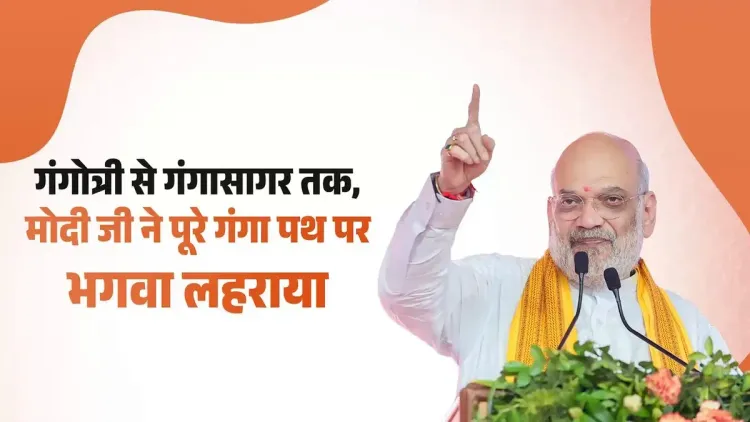
Union Home Minister Amit Shah on Thursday, 28 May 2026 invoked the entire course of the Ganga river — from Gangotri in Uttarakhand to Gangasagar in West Bengal — to assert the BJP's political dominance across the riverine heartland under Prime Minister Narendra Modi.
Posting in Hindi on X, Shah declared: 'Modi ji ke netritva mein Uttarakhand ke Gangotri se lekar Bengal ke Gangasagar tak, maa Ganga ke sampoorna path par maa Bharati ka bhagwa lahraaya hai' — meaning, 'Under Modi ji's leadership, the saffron of Mother India has flown across the entire course of the Ganga, from Gangotri in Uttarakhand to Gangasagar in Bengal.' The post was accompanied by a video.
Context
The Ganga originates at Gangotri glacier in Uttarakhand and travels roughly 2,500 kilometres before meeting the Bay of Bengal at Gangasagar in West Bengal. Shah's imagery maps this entire geographical arc as a single political corridor under saffron — the colour associated with the Bharatiya Janata Party.
The framing is deliberate: it connects a BJP-governed state at the river's source (Uttarakhand) to a state at its mouth (West Bengal) where the party remains in opposition to the ruling Trinamool Congress. The invocation of 'Mother India' alongside the river carries both cultural and electoral weight in the BJP's messaging vocabulary.
Policy Backdrop
The BJP's consolidation along the Ganga basin began in earnest after the 2014 Lok Sabha elections, when the NDA secured a parliamentary majority under Modi. The party subsequently formed governments in Uttarakhand in 2017 and retained power there in 2022, and has held Uttar Pradesh — through which the Ganga flows for much of its middle course — since 2017.
Bihar, another Ganga-basin state, has been part of NDA alliance arrangements since 2014. The riverine geography thus represents a near-continuous belt of BJP or BJP-allied governance, a fact the party has consistently highlighted in its political communication.
Stakeholders and Impact
BJP workers and voters in the Ganga basin states are the primary audience for Shah's message, which reinforces organisational morale and cultural identity ahead of electoral cycles. For West Bengal, where assembly elections are due in 2026, the reference to Gangasagar is pointed: it signals the party's intent to extend its footprint into the state's political landscape.
The saffron-flag metaphor also speaks to a broader constituency of voters who associate the Ganga with religious and civilisational identity. By casting the river's entire course as a domain of BJP influence, Shah is appealing simultaneously to cultural sentiment and electoral ambition.
What's Next
The 2026 West Bengal assembly elections will be the immediate test of whether the BJP's claimed presence along the Ganga corridor translates into seats in a state that has resisted the party's advances in previous cycles. Political observers will watch for follow-up announcements on Ganga-related infrastructure or cultural programmes that could give the messaging a policy anchor. Shah's post signals that the riverine narrative will remain central to the BJP's outreach strategy in eastern India in the months ahead.
Point of View
He simultaneously consolidates the party's base in states it already governs and frames West Bengal as the next frontier. The timing — ahead of the 2026 West Bengal assembly elections — suggests this is as much an organisational signal to BJP workers as it is a public declaration. The Ganga corridor narrative has been a durable BJP motif since 2014, and Shah's invocation indicates the party intends to push it harder in eastern India as the electoral calendar tightens.
NationPress
11 Oct 2026
Frequently Asked Questions
What did Amit Shah say about the Ganga in his 28 May 2026 post?
Amit Shah declared that under PM Modi's leadership, the BJP's saffron flag has flown across the entire course of the Ganga, from Gangotri in Uttarakhand to Gangasagar in West Bengal.
Why did Amit Shah mention Gangasagar in West Bengal?
Gangasagar is where the Ganga meets the sea and lies in West Bengal, a state the BJP is targeting in the 2026 assembly elections. Mentioning it signals the party's political ambition in a state currently governed by the Trinamool Congress.
Which states does the Ganga corridor cover in BJP's political messaging?
The BJP's Ganga corridor messaging covers Uttarakhand, Uttar Pradesh, Bihar, and West Bengal — states through which the river flows from its Himalayan source to the Bay of Bengal.
Is West Bengal governed by BJP?
No. As of the available record, West Bengal is governed by the Trinamool Congress. The BJP is the principal opposition party in the state and has been seeking to expand its presence there.
What is the significance of the saffron flag reference in Amit Shah's post?
Saffron is the colour associated with the BJP and with Hindu cultural identity. Describing the saffron flag flying over the Ganga's entire course is a political metaphor asserting the party's dominance and cultural connect across the riverine heartland.