Amit Shah Vows to End Middlemen, Pay Farmers in 48 Hours
Synopsis
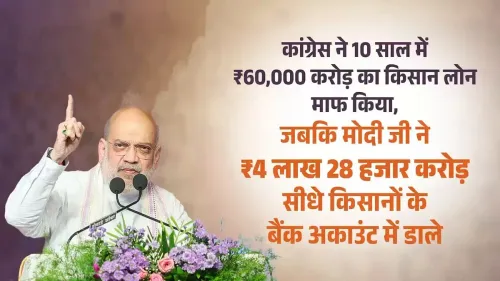
Union Home Minister Amit Shah on June 23, 2026 pledged to eliminate agricultural middlemen and ensure farmers receive their earnings directly in their bank accounts within 48 hours, reinforcing the central government's push to expand direct-benefit architecture into farm-produce transactions via the cooperative sector.
Key Takeaways
Amit Shah announced on June 23, 2026 that agricultural middlemen will be eliminated and farmers paid within 48 hours directly into their bank accounts.
The pledge aligns with the mandate of the Ministry of Cooperation , established in July 2021 , to organise farmers through cooperatives and improve market access.
The Direct Benefit Transfer (DBT) framework, operational since 2013 and expanded post-2014, provides the technical backbone for direct farm-payment settlements.
PM-KISAN , launched in February 2019 , established precedent for large-scale direct transfers to farmer households using Aadhaar-linked accounts.
Implementation will require coordination with state governments on mandi regulations and possible integration with platforms such as e-NAM .
Small and marginal farmers stand to gain most, as payment delays currently push many into high-cost informal credit to meet household needs.
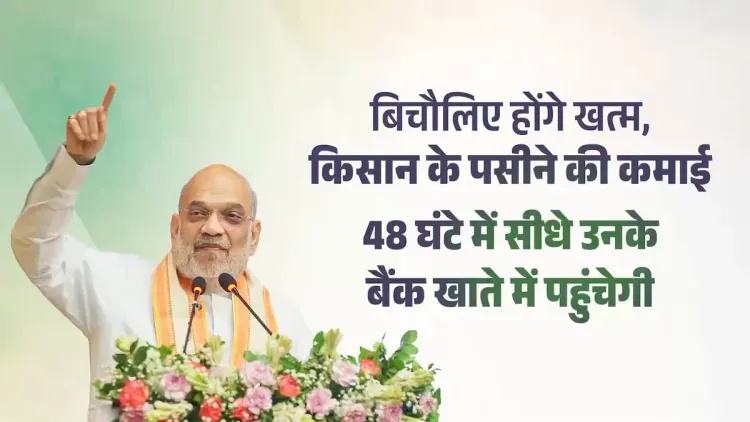
Union Home Minister and Minister of Cooperation Amit Shah on Tuesday, June 23, 2026, pledged to eliminate agricultural middlemen and ensure that farmers receive payment directly into their bank accounts within 48 hours of a transaction. The announcement, made via a post on X, signals a sharpened push under the Ministry of Cooperation to close the gap between farm-gate earnings and what actually reaches the cultivator.
Shah wrote in Hindi: 'Bichauliye honge khatam, kisan ke paseene ki kamai 48 ghante mein seedha unke bank khate mein pahunchegi' — translated as, 'Middlemen will be eliminated; the hard-earned income of the farmer will reach their bank account directly within 48 hours.'
Context
The statement zeroes in on one of Indian agriculture's most persistent structural problems: the role of intermediaries who sit between the farmer and the buyer, often capturing a disproportionate share of the value chain. Small and marginal farmers, who account for the bulk of India's cultivator population, have historically had little bargaining power and limited access to formal payment infrastructure.
Shah's tweet frames the 48-hour direct-payment commitment as a concrete, time-bound remedy to this structural disadvantage, placing the onus on institutional mechanisms rather than market goodwill.
Policy Backdrop
The announcement builds on two interlocking policy pillars. First, the Direct Benefit Transfer (DBT) architecture, introduced in 2013 and significantly expanded after 2014, which uses Aadhaar and Jan Dhan linkages to route government payments directly into beneficiaries' accounts, cutting out leakages. Second, the Ministry of Cooperation, established in July 2021 under Shah's charge, was created precisely to strengthen farmer collectives and improve their market access by organising procurement through cooperative structures.
The PM-KISAN scheme, launched in February 2019, demonstrated that periodic direct cash transfers to farmer families at scale — providing Rs 6,000 annually per eligible household — were operationally feasible using the DBT backbone. Shah's latest pledge appears to extend that logic to transaction-linked payments for agricultural produce, not just welfare transfers.
The broader pattern is consistent with the central government's sustained effort since 2014 to digitise agricultural transactions and expand the DBT architecture, with cooperatives serving as the institutional channel for collective marketing and direct procurement.
Stakeholders and Impact
Small and marginal farmers stand to benefit most if the 48-hour settlement mechanism is operationalised. Delays in payment — sometimes stretching weeks through commission agents and mandi intermediaries — force many cultivators into informal credit at high interest rates to meet immediate household expenses. A guaranteed, time-bound direct transfer would significantly reduce that financial stress.
Conversely, agricultural middlemen and commission agents (arhatias), who are a politically and economically significant constituency in several states, would see their role curtailed. The transition would require careful coordination with state governments, which control mandi regulations under the concurrent list, and with existing platforms such as e-NAM, the national electronic agriculture market.
What's Next
The immediate question is implementation: whether the 48-hour payment commitment will be backed by a formal scheme notification, legislative change, or integration with existing cooperative procurement pilots. Watchers will look for budgetary provisions, possible amendments to state APMC frameworks, and the role of primary agricultural credit societies and other cooperative bodies in facilitating direct procurement.
If rolled out at scale, a time-bound direct-payment system for farm produce could mark a significant structural shift in how India's agricultural value chain is organised — and would test the cooperative sector's readiness to absorb that operational responsibility.
Frequently Asked Questions
What did Amit Shah announce about farmers and middlemen?
Amit Shah announced on June 23, 2026 that middlemen in agricultural trade will be eliminated and farmers will receive their earnings directly in their bank accounts within 48 hours of a transaction.
What is the Ministry of Cooperation and what does it do for farmers?
The Ministry of Cooperation was established in July 2021 under Amit Shah to strengthen cooperative institutions, promote farmer collectives, and improve agricultural market access by reducing the role of intermediaries.
How does Direct Benefit Transfer help farmers in India?
Direct Benefit Transfer, launched in 2013, uses Aadhaar and Jan Dhan bank linkages to route government payments directly to beneficiaries, cutting out middlemen and reducing leakages. Schemes like PM-KISAN use this system to transfer Rs 6,000 annually to eligible farmer families.
What is PM-KISAN and how much do farmers get?
PM-KISAN, or Pradhan Mantri Kisan Samman Nidhi, was launched in February 2019 and provides annual income support of Rs 6,000 directly to landholding farmer families through the Direct Benefit Transfer mechanism.
Will middlemen be completely removed from Indian agriculture?
Amit Shah's statement commits to eliminating middlemen so farmers are paid directly, but full implementation would require coordination with state governments on mandi laws and integration with existing agricultural market platforms such as e-NAM.