Bhupender Yadav: Amur Falcons Return to Manipur After 23-Country Journey
Synopsis
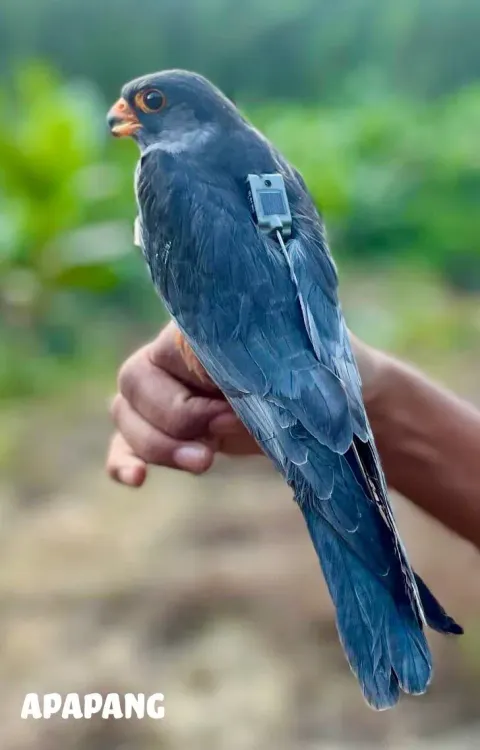
Two satellite-tagged Amur Falcons, Apapang and Alang, completed a near-yearlong, 23-country circuit and landed in Manipur's Tamenglong district. Union Environment Minister Bhupender Yadav shared the milestone, highlighting WII's tracking effort and community conservation that transformed a former hunting ground into a global flyway sanctuary.
Key Takeaways
Two Amur Falcons named Apapang and Alang , tagged by Wildlife Institute of India (WII) scientists in November 2025 , have completed their round-trip migration and arrived in Manipur on October 22, 2026 .
Their tracked route crossed 23 countries across Asia and Africa, spanning nearly a full year.
The falcons will spend two to three weeks in Tamenglong district , feeding on termites to build fat reserves for their next leg.
The next leg is a six-day nonstop flight of nearly 6,000 km to Somalia, including a 3,000 km Arabian Sea crossing .
Community conservation in Manipur and Nagaland has shifted the region from large-scale falcon hunting to active local stewardship since the early 2010s .
Union Environment Minister Bhupender Yadav highlighted the tracking as evidence of India's commitment to migratory-species conservation under the Convention on Migratory Species.
Eleven days out of northeastern China, two Amur Falcons have touched down in Manipur — completing a near-yearlong tracking odyssey across 23 countries and two continents. Union Environment Minister Bhupender Yadav announced on Friday, October 23 that the falcons, named Apapang and Alang, have arrived back at their stopover grounds in Tamenglong district, closing the loop on a round-trip journey that began with satellite tagging by scientists of the Wildlife Institute of India (WII) in November 2025.
From China to Manipur: The Route That Crosses Continents
The two falcons departed their breeding grounds in northeastern China and made their way southwest across Asia and Africa before reversing course toward India. Their tracked route spanned 23 countries — a corridor that makes the Amur Falcon one of the most far-ranging migratory raptors on the planet. As Minister Yadav put it, the birds are 'truly global citizens.'
The WII-led satellite telemetry effort, part of India's expanding programme to document long-distance avian migrants, has provided one of the most detailed records yet of the species' full annual circuit. India's participation in such tracking aligns with its commitments under the Convention on Migratory Species and broader flyway-conservation cooperation across the Asian-African corridor.
Tamenglong's Two-Week Feast — and Why It Matters
For the next two to three weeks, Apapang and Alang are expected to linger in the mountainous tracts of Tamenglong district, gorging on termites that emerge around their traditional roost sites. That feeding binge is not incidental — it is physiologically essential. The fat reserves accumulated here will fuel the falcons' most gruelling leg: a six-day, nonstop flight of nearly 6,000 km from Manipur to Somalia, a journey that includes a punishing 3,000 km crossing of the Arabian Sea with nowhere to land.
Miss the refuelling stop, and the bird does not survive the crossing. Which is precisely why the community protection model at Tamenglong — built over more than a decade — carries outsized conservation stakes.
How a Hunting Ground Became a Guardian Community
The transformation of Manipur and neighbouring Nagaland from sites of large-scale falcon hunting into models of community stewardship is one of Indian conservation's more striking turnarounds. Since the early 2010s, local communities have shifted from harvesting Amur Falcons in bulk — historical accounts describe tens of thousands killed annually at roost sites — to actively protecting them. Today, Minister Yadav notes, 'local people now eagerly wait for their return year after year and protect the falcons.'
That social contract, combining WII's scientific rigour with grassroots guardianship, is increasingly cited as a replicable model for migratory-species conservation across India's northeastern flyway.
What Researchers Will Watch Next
With the Tamenglong stopover under way, WII scientists will monitor whether Apapang and Alang depart on schedule for Somalia and whether their satellite tags continue to transmit across the Arabian Sea crossing — the most data-sparse and ecologically critical segment of the entire route. Any new central or state conservation notifications for Manipur's Amur Falcon stopover habitats are also expected to follow the heightened attention this tracking cycle has generated.
Two small birds, a continent-wide arc, and a community standing watch in the hills of Manipur. The next transmission from over the Arabian Sea will tell us whether the gamble paid off.
Point of View
A model the Environment Ministry has been quietly scaling across the northeastern flyway. For Minister Yadav, amplifying this story serves a dual purpose: it telegraphs India's seriousness on migratory-species commitments under the Convention on Migratory Species ahead of international forums, while spotlighting Manipur's conservation turnaround as a soft-power narrative. The real test will come when the birds attempt the 3,000 km Arabian Sea crossing — a segment where data routinely goes dark — and whether the tracking programme can survive that gap. If it does, India will have one of the most complete Amur Falcon migration datasets in the world, with significant implications for future flyway policy.
NationPress
23 Oct 2026
Frequently Asked Questions
What are Amur Falcons and why do they come to Manipur?
Amur Falcons are small raptors that breed in northeastern China and Siberia and undertake one of the longest migrations of any bird of prey, travelling to southern Africa each year. Manipur, particularly the Tamenglong district , is a critical stopover site where the falcons rest and feed on termites before their nonstop Arabian Sea crossing.
Who are Apapang and Alang?
Apapang and Alang are two Amur Falcons that were satellite-tagged by scientists from the Wildlife Institute of India (WII) in November 2025 to track their full annual migration route across Asia and Africa.
How far do Amur Falcons migrate from Manipur?
After their Manipur stopover, Amur Falcons undertake a nonstop flight of nearly 6,000 km to Somalia over approximately six days , a leg that includes a 3,000 km crossing of the Arabian Sea with no opportunity to land.
How has Manipur protected Amur Falcons?
Since the early 2010s , local communities in Manipur and neighbouring Nagaland have shifted from large-scale hunting of Amur Falcons to actively protecting roost sites, creating one of India's most cited examples of community-driven migratory-bird conservation.
What is the Wildlife Institute of India's role in Amur Falcon tracking?
The Wildlife Institute of India (WII) , an autonomous body under the Ministry of Environment, Forest and Climate Change , leads satellite telemetry studies on long-distance migrants including Amur Falcons, generating data that informs India's flyway conservation policy and its obligations under the Convention on Migratory Species.