Arunachal CMO highlights frontier schools as first line of defence
Synopsis
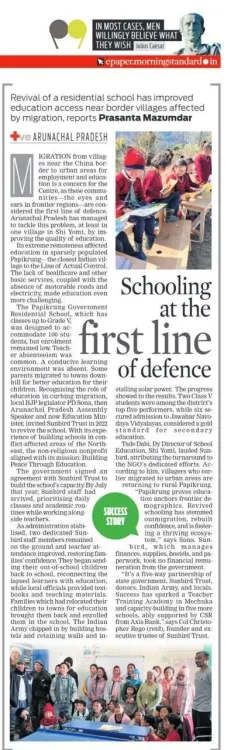
The Chief Minister's Office of Arunachal Pradesh has highlighted frontier schools as a first line of defence, spotlighting how classrooms in remote border districts serve both young communities and national security interests along India's northeastern frontier.
Key Takeaways
The Arunachal Pradesh CMO described frontier classrooms as a 'first line of defence' on June 7, 2026 .
Arunachal Pradesh borders China , Myanmar , and Bhutan , making its border districts among India's most strategically significant.
The Vibrant Villages Programme (2023) funds schools and hostels in select border villages of the state.
The Border Area Development Programme , running since the late 1980s, has long supported education and connectivity in border blocks.
National Education Policy 2020 and revised Samagra Shiksha Abhiyan guidelines both earmark resources for frontier and tribal schooling.
Enrolment data and utilisation certificates under the Vibrant Villages Programme for 2025-26 are awaited as a key performance indicator.
The Chief Minister's Office of Arunachal Pradesh, on Sunday, June 7, 2026, shared a reflection on the role of schools in the state's remotest border regions, framing education as integral to both human development and national security at India's northeastern frontier.
Context
The post, shared from the official Arunachal Pradesh CMO account, stated: 'The first line of defence sometimes is a classroom. From the farthest frontiers of Arunachal emerge stories of young minds, determined communities, and schools that are shaping both futures and national security.' The message drew attention to frontier communities where schooling intersects with the state's strategic geography.
Arunachal Pradesh shares international borders with China, Myanmar, and Bhutan, making it one of India's most geopolitically sensitive states. Its remote border blocks are home to tribal communities that have historically faced limited access to quality education and basic infrastructure.
Policy Backdrop
The framing aligns with a sustained policy thrust at both the central and state levels to treat educational institutions in border districts as instruments of territorial presence alongside human development. The Vibrant Villages Programme, notified by the central government in 2023, specifically targets last-mile infrastructure — including schools and hostels — in select border villages of Arunachal Pradesh and other Himalayan states.
The longer-running Border Area Development Programme, operational since the late 1980s, has channelled funds for education, health, and connectivity in blocks adjoining international borders. Under the Samagra Shiksha Abhiyan guidelines revised in 2018, additional resources were earmarked for residential schools and student transport in aspirational and border districts across the Northeast.
The National Education Policy 2020 further directed states to ensure universal access to schooling in geographically difficult and tribal areas, reinforcing the policy architecture within which Arunachal's frontier schools now operate.
Stakeholders and Impact
At the centre of this narrative are students in frontier villages and their tribal communities — populations that have long navigated difficult terrain, sparse connectivity, and seasonal disruptions to attend school. For these families, a functional school is not merely an educational facility but an anchor that keeps children within their home regions rather than migrating to distant towns.
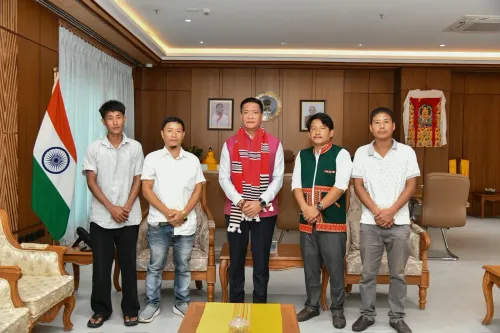
Chief Minister Pema Khandu, who has led the state since 2016, has made road connectivity, power supply, and school infrastructure in border blocks a stated priority. The CMO's post reinforces that framing by elevating the classroom to the status of a strategic institution — one that secures communities by educating them in place.
Security and defence planners have long recognised that a populated, educated, and economically active border belt is a more durable form of territorial assertion than physical infrastructure alone. Schools that retain local youth in frontier villages contribute directly to that objective.
What's Next
Observers will watch for the release of enrolment data and utilisation certificates under the Vibrant Villages Programme for 2025-26, which would provide a measurable indicator of how effectively frontier schooling is being scaled. State budget announcements on new border hostels and teacher deployment in remote blocks are also anticipated.
The CMO's post signals that the Arunachal Pradesh government intends to keep frontier education in public focus — a posture that could translate into legislative and budgetary commitments in the months ahead, as the state continues to balance development imperatives with its unique position on India's northern and eastern borders.
Point of View
Achieved through schooling, as a security imperative no less important than road or fence construction. This posture is consistent with the broader shift under the Vibrant Villages Programme, which treats populated and educated border belts as a form of soft territorial assertion. The messaging also positions the Pema Khandu government to justify continued and expanded budgetary outlays for frontier education in the face of competing fiscal priorities.
NationPress
19 Sept 2026
Frequently Asked Questions
Why are schools in Arunachal Pradesh called the first line of defence?
Schools in Arunachal Pradesh's border districts are described as a first line of defence because educating and retaining local communities in frontier villages strengthens India's demographic and territorial presence along sensitive borders with China, Myanmar, and Bhutan.
What is the Vibrant Villages Programme and how does it help Arunachal Pradesh?
The Vibrant Villages Programme, notified by the central government in 2023, funds last-mile infrastructure including schools and hostels in select border villages of Arunachal Pradesh and other Himalayan states to improve living conditions and reduce outmigration.
What schemes fund education in Arunachal Pradesh's border areas?
The Border Area Development Programme (operational since the late 1980s), the Vibrant Villages Programme (2023), and the Samagra Shiksha Abhiyan (with revised guidelines from 2018) are the primary schemes funding education in Arunachal Pradesh's border districts.
Who is the Chief Minister of Arunachal Pradesh in 2026?
Pema Khandu is the Chief Minister of Arunachal Pradesh and has held the position since 2016, prioritising road connectivity, power supply, and school infrastructure in the state's border blocks.
What does the National Education Policy 2020 say about schools in remote tribal areas?
The National Education Policy 2020 directs states to ensure universal access to schooling in geographically difficult and tribal areas, providing the policy foundation for expanded frontier school infrastructure in states like Arunachal Pradesh.