Assam's first IVF Lakhimi calf born at Guwahati varsity, CM Sarma hails historic feat
Synopsis
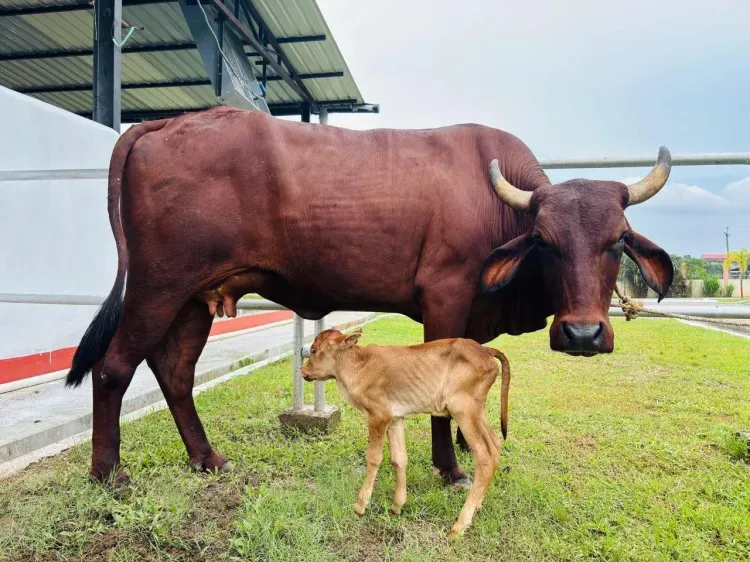
A world-first in livestock science has quietly happened in Guwahati: the IVF Laboratory at Assam's veterinary university has produced the first-ever IVF-born female calf of the Lakhimi breed — Assam's own indigenous cattle. Backed by the Rashtriya Gokul Mission, the breakthrough opens a credible scientific pathway to conserve a native breed under pressure, while potentially transforming the state's dairy economy.
Key Takeaways
The world's first IVF-born female Lakhimi calf was delivered at the Assam Veterinary and Fishery University, Khanapara, Guwahati .
Chief Minister Himanta Biswa Sarma announced the milestone on 22 August , calling it historic for Assam's biotechnology ecosystem.
The IVF Laboratory was established under the Rashtriya Gokul Mission , the Centre's indigenous breed conservation programme.
The achievement follows Assam's earlier first — an IVF-born Gir calf in Sonapur — confirming the viability of embryo-transfer technology in field conditions.
Scientists say the technique can accelerate multiplication of genetically superior Lakhimi stock, boosting milk productivity and farmer incomes .
Assam has registered a world-first in livestock biotechnology with the birth of an IVF-conceived female calf of the indigenous Lakhimi breed at the Assam Veterinary and Fishery University in Khanapara, Guwahati. Chief Minister Himanta Biswa Sarma announced the development on Saturday, 22 August, calling it a convergence of Assam's culture, civilisation, and scientific creativity.
The Breakthrough and Where It Happened
The birth took place at the IVF Laboratory of the College of Veterinary Science under the Assam Veterinary and Fishery University, Khanapara. The laboratory was established with funding support under the Rashtriya Gokul Mission, the Centre's flagship programme for the conservation and development of indigenous bovine breeds.
Sarma, posting on social media platform X, said: The world's first IVF female calf of the Lakhimi breed — native to Assam — has been born at the Assam Veterinary and Fishery University.
He described the newborn as small in size but immense in scientific significance for Assam's biotechnology ecosystem.
Why the Lakhimi Breed Matters
The Lakhimi is Assam's indigenous cattle breed, valued for its adaptability to the state's agro-climatic conditions. Scientists note that advanced assisted reproductive technologies — including in vitro fertilisation (IVF) and embryo transfer — allow faster multiplication of genetically superior animals while safeguarding native genetic resources that could otherwise be diluted through crossbreeding.
The conservation angle is particularly pressing: indigenous breeds across India have faced population decline as farmers shifted to high-yield crossbred varieties. A proven IVF pathway for the Lakhimi offers a scientifically credible route to reversing that trend.
Building on Earlier Milestones
This achievement follows an earlier landmark earlier in 2025, when scientists at the same veterinary college produced Assam's first IVF-born calf — a female Gir calf delivered in Sonapur — demonstrating that embryo-transfer technology could work reliably under field conditions in the state. The Lakhimi birth now extends that capability to an indigenous Assamese breed for the first time anywhere in the world.
Potential Impact on Assam's Dairy Sector
According to Chief Minister Sarma, the breakthrough could contribute to indigenous breed conservation, improved disease resistance, and higher milk productivity — outcomes that, over time, are expected to strengthen Assam's dairy economy and raise incomes for livestock farmers.
Scientists working in the field have said IVF-based multiplication of superior genetic stock can compress breeding timelines significantly compared with conventional methods, accelerating herd improvement at scale. Industry observers note that if the technique is replicated across breeding stations in the state, it could meaningfully shift productivity benchmarks for Assam's dairy sector.
Government and Scientific Recognition
Sarma extended congratulations to the veterinary scientists and professionals involved, saying their work had the potential to usher in a new era for Assam's dairy sector.
He concluded by invoking Gau Mata
and framed the milestone as carrying significance well beyond the birth of a single calf.
With the Rashtriya Gokul Mission providing institutional backing and the university's IVF laboratory now demonstrating world-first results, Assam's livestock biotechnology programme is positioned to scale — and the scientific community will be watching whether this success can be replicated at the herd level in the months ahead.
Point of View
But its real test lies in replication at scale. A single successful birth in a controlled university laboratory is proof of concept — not yet proof of programme. Assam's earlier Gir IVF calf showed the technology can work in field conditions, which is encouraging, but converting that into a statewide breeding intervention for an indigenous breed requires sustained funding, trained veterinary personnel at district level, and a cold-chain infrastructure that rural Assam does not uniformly possess. The Rashtriya Gokul Mission provides the policy scaffolding, but state governments have historically struggled to translate centrally funded livestock schemes into measurable herd-level outcomes. If Assam can build on this moment with a credible scale-up plan — not just a headline — it would mark a genuinely transformative shift for indigenous breed conservation in India.
NationPress
22 Aug 2026
Frequently Asked Questions
What is the significance of Assam's IVF-born Lakhimi calf?
The calf is the world's first IVF-conceived female of the Lakhimi breed, Assam's indigenous cattle variety. The birth, achieved at the Assam Veterinary and Fishery University in Khanapara, Guwahati, demonstrates that advanced reproductive biotechnology can be applied to conserve and multiply native genetic stock that might otherwise decline.
Where was the IVF Lakhimi calf born?
The calf was born at the IVF Laboratory of the College of Veterinary Science under the Assam Veterinary and Fishery University in Khanapara, Guwahati. The laboratory was set up with support from the Rashtriya Gokul Mission.
What is the Rashtriya Gokul Mission?
The Rashtriya Gokul Mission is a Central Government programme aimed at the conservation and development of indigenous bovine breeds in India. It funds infrastructure such as IVF laboratories and breed improvement centres at state veterinary institutions.
Has Assam produced IVF calves before?
Yes. Earlier in 2025, scientists at the same veterinary college produced Assam's first IVF-born calf — a female Gir calf delivered in Sonapur. The Lakhimi birth is the next step, applying the same technology to an indigenous Assamese breed for the first time in the world.
How could this benefit Assam's dairy farmers?
Scientists say IVF-based multiplication of genetically superior Lakhimi cattle can improve milk productivity and disease resistance while preserving native genetic diversity. Over time, wider adoption of the technique is expected to strengthen Assam's dairy economy and raise incomes for livestock farmers across the state.