Assam Budget 2026: GSCDA to Drive Guwahati Aerotropolis

Synopsis
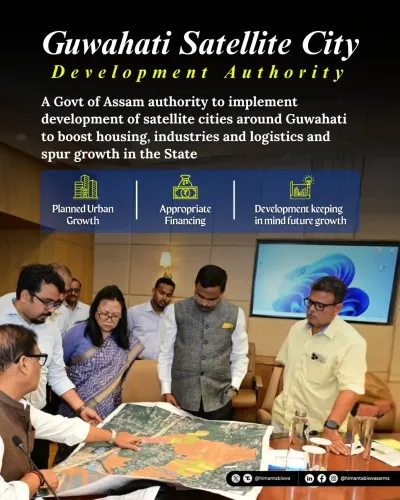
The Chief Minister's Office of Assam announced in the Assam Budget 2026 that the Guwahati Aerotropolis will be executed by the GSCDA, a dedicated Special Purpose Vehicle, aiming to build a world-class urban and economic hub around Guwahati's international airport.
Key Takeaways
The Assam Budget 2026 includes a flagship Aerotropolis project for Guwahati .
Implementation will be led by the Guwahati Satellite City Development Authority (GSCDA) , constituted as a Special Purpose Vehicle of the Government of Assam .
The project aims to create a 'world-class urban and economic hub' anchored around Lokpriya Gopinath Bordoloi International Airport .
The initiative aligns with national programmes including UDAN , AMRUT , and India's Act East Policy .
Key next steps include release of Detailed Project Reports , land-acquisition notifications, and tendering by the new SPV.
The Chief Minister's Office of Assam announced on Friday, 10 July 2026 that the Aerotropolis project for Guwahati will be implemented through the Guwahati Satellite City Development Authority (GSCDA), a dedicated Special Purpose Vehicle of the Government of Assam, as part of the Assam Budget 2026 highlights.
Context
The official post from the Chief Minister's Office, shared under the hashtag #AssamBudget2026, described the Aerotropolis initiative as a plan 'to create a world-class urban and economic hub.' The GSCDA has been constituted as a Special Purpose Vehicle — a legally distinct entity set up to execute a single, large-scale project — ensuring focused governance and ring-fenced finances for the undertaking.
An aerotropolis is an airport-centric development model that clusters aviation infrastructure, business districts, logistics corridors, and residential zones around a major airport. In Guwahati's case, the nucleus is Lokpriya Gopinath Bordoloi International Airport, the primary gateway to Northeast India.
Policy Backdrop
Guwahati was selected under India's Smart Cities Mission in 2015, which kick-started integrated urban planning and infrastructure upgrades across the city. Successive Assam state budgets have built on that foundation, progressively positioning Guwahati as a logistics and services hub for the Northeast.
The aerotropolis model complements national programmes such as UDAN — which targets regional air connectivity — and AMRUT, which emphasises airport-linked urban growth. Similar aerotropolis-style projects have been advanced in other Indian states to attract private capital and generate employment, making the Assam Budget 2026 announcement part of a broader national pattern.
The initiative also aligns with India's Act East Policy, which prioritises connectivity and economic nodes in frontier regions as a strategic lever for trade and diplomacy with Southeast Asia.
Stakeholders and Impact
The primary beneficiaries of the GSCDA-led Aerotropolis are urban investors, the aviation and logistics sector, and existing businesses in and around Guwahati. A world-class economic hub near the airport is expected to attract warehousing, cargo, hospitality, retail, and technology companies seeking a Northeast India base.
Residents of the satellite city zone stand to gain from improved infrastructure, while the broader state economy could see multiplier effects through job creation and increased tax revenues. The SPV structure is designed to insulate the project from routine bureaucratic delays, a common challenge in large public infrastructure programmes.
What's Next
The immediate milestones to watch are the release of detailed Detailed Project Reports (DPRs) by the GSCDA, followed by land-acquisition notifications and the first rounds of tendering. These steps will be closely tracked in subsequent Assam Legislative Assembly sessions and through official GSCDA communications.
How swiftly the new SPV operationalises its mandate — securing land, finalising master plans, and onboarding private partners — will determine whether the Guwahati Aerotropolis transitions from a budget announcement to a construction-ready project within this fiscal cycle.
Point of View
Making it easier for investors and the legislature to track progress. Seen alongside Assam's consistent use of successive budgets to build Guwahati's regional hub credentials, the aerotropolis fits a deliberate, multi-year strategy rather than a one-off announcement. The real test will be how quickly GSCDA moves from incorporation to ground-breaking, since SPV formation alone does not guarantee execution speed.
NationPress
10 Jul 2026
Frequently Asked Questions
What is the Guwahati Aerotropolis project?
The Guwahati Aerotropolis is a planned airport-centric urban and economic hub to be developed around Lokpriya Gopinath Bordoloi International Airport, combining aviation infrastructure, business districts, logistics zones, and residential areas into a single integrated development.
What is GSCDA and what is its role?
The Guwahati Satellite City Development Authority (GSCDA) is a Special Purpose Vehicle set up by the Government of Assam specifically to implement the Aerotropolis project, giving it a focused mandate and ring-fenced governance separate from regular state departments.
Was the Aerotropolis announced in the Assam Budget 2026?
Yes, the Chief Minister's Office of Assam shared the announcement on 10 July 2026 as a highlight of the Assam Budget 2026, identifying GSCDA as the implementing body.
How does the Guwahati Aerotropolis relate to India's Act East Policy?
The project aligns with the Act East Policy's emphasis on building connectivity and economic nodes in India's northeastern frontier to facilitate trade and integration with Southeast Asia, with Guwahati serving as a key gateway city.
What are the next steps for the Guwahati Aerotropolis?
The immediate milestones include the release of Detailed Project Reports by GSCDA, land-acquisition notifications, and the commencement of tendering, all of which are expected to be tracked through upcoming Assam Legislative Assembly sessions.