Assam CM Himanta's Zero-Tolerance Drive: 68% Crime Drop, Convictions Surge

Synopsis
The Chief Minister's Office of Assam reports a 68% drop in crime and a fivefold rise in convictions under CM Himanta Biswa Sarma's zero-tolerance policy, with the chargesheet rate reaching 87.66% and conviction rate at 30.88%, signalling a sharper police-prosecution pipeline.
Key Takeaways
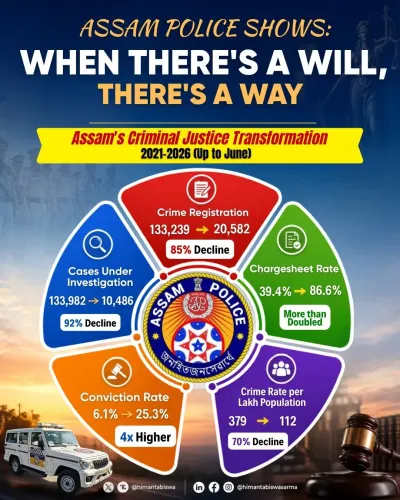
Assam has recorded a 68 percent drop in crime rate under Chief Minister Dr.
Himanta Biswa Sarma 's zero-tolerance policy.
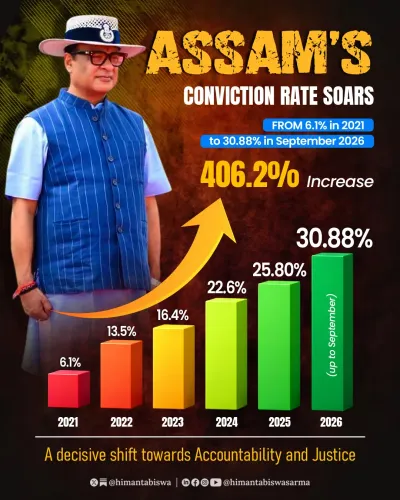
The conviction rate has surged fivefold , reaching 30.88 percent .
The chargesheet rate now stands at 87.66 percent , reflecting more complete police investigations before courts.
Assam Police has been the primary instrument of these reforms since the Sarma government took office in May 2021 .
The state has historically dealt with insurgency and border pressures; the current focus has shifted toward measurable everyday-crime accountability.
Official annual crime statistics from the National Crime Records Bureau will serve as the independent benchmark for verifying these figures.
A 68 percent drop in crime rate and a fivefold jump in conviction rate — that is the headline Assam's government is putting on the record as proof that its hardline law-and-order strategy is delivering. The Chief Minister's Office of Assam announced on Monday, 9 November 2026, that Chief Minister Dr. Himanta Biswa Sarma's zero-tolerance policy is reshaping the state's crime landscape in measurable ways.
The numbers behind the claim
The figures cited are striking by any benchmark. The chargesheet rate — the proportion of registered cases in which police file a formal charge-sheet before a court — has climbed to 87.66 percent, a marker of investigative thoroughness. The conviction rate has reached 30.88 percent, representing the fivefold leap the government is highlighting as evidence that faster investigation is translating into actual courtroom accountability.
A high chargesheet rate matters because it closes the gap between a crime being reported and a suspect being formally tried. Historically, low chargesheet rates in many Indian states have allowed accused persons to walk free on default bail, undermining victim confidence in the justice system. Assam's figure of 87.66 percent suggests investigators are completing their work and presenting it to courts at a significantly higher frequency than before.
Himanta Biswa Sarma's policing doctrine since 2021
Dr. Himanta Biswa Sarma assumed office as Chief Minister of Assam in May 2021, pledging publicly to pursue a zero-tolerance approach to crime alongside police modernisation and faster case disposal. Assam, a northeastern state with a complex history of insurgency and border-management pressures, has long required a calibrated law-and-order strategy. The Sarma administration has consistently cited conviction and chargesheet metrics in official communications as evidence of administrative performance — signalling that it views judicial outcomes, not just FIR numbers, as the real scorecard.
The broader pattern across northeastern India has been a gradual shift away from legacy insurgency management toward addressing everyday crime — dacoity, drug trafficking, violence against women — with more institutional tools. Assam Police has been positioned at the centre of this pivot, backed by central government schemes for police infrastructure in the region.
What accountability looks like on the ground
Swift chargesheeting and rising convictions point to a system where the police-prosecution chain is functioning with less friction. When chargesheet rates are high, courts can proceed to trial without long investigative delays; when conviction rates follow, it signals that the evidence assembled is holding up under judicial scrutiny. Together, the two metrics suggest Assam Police is building cases that stick — not merely arresting people.
The government's framing of 'transparent justice delivery' reflects a wider political argument: that law enforcement credibility is rebuilt not through optics but through outcomes visible to residents and victims alike.
The next verification checkpoint will be the official annual crime data from Assam Police and the National Crime Records Bureau, which will independently corroborate or nuance these figures — and any state assembly debate on police funding could sharpen the picture further. If the numbers hold, Assam's model of metrics-driven policing will carry weight well beyond its northeastern borders.
Point of View
Who took office promising administrative transformation in a state with a turbulent security history, this data-forward messaging is as much a governance argument as a political one. If independently verified by the NCRB, the figures could position Assam as a template for other northeastern states navigating the transition from insurgency-era policing to civilian justice delivery. The metric-first approach also raises the bar for future accountability — having set measurable benchmarks publicly, the administration will be held to them.
NationPress
9 Nov 2026
Frequently Asked Questions
What is the crime rate drop in Assam under CM Himanta Biswa Sarma?
Assam has recorded a 68 percent drop in crime rate under Chief Minister Dr. Himanta Biswa Sarma's zero-tolerance policy, as announced by the Chief Minister's Office on 9 November 2026.
What is Assam's conviction rate in 2026?
Assam's conviction rate has reached 30.88 percent in 2026, representing a fivefold increase under the current administration's policing reforms.
What does chargesheet rate mean and what is Assam's current rate?
A chargesheet rate is the percentage of registered cases in which police formally file charges before a court. Assam's chargesheet rate has surged to 87.66 percent , indicating that investigators are completing their work and presenting it to courts at a significantly higher frequency.
When did Himanta Biswa Sarma become Chief Minister of Assam?
Dr. Himanta Biswa Sarma assumed office as Chief Minister of Assam in May 2021 , after which the state government announced a zero-tolerance approach to crime with emphasis on police modernisation.
How is Assam's crime data independently verified?
The official annual crime statistics released by Assam Police and the National Crime Records Bureau (NCRB) serve as the independent benchmarks against which government-cited figures are verified.