Assam CMO spotlights Mission Senehjori to globalise Muga silk

Synopsis
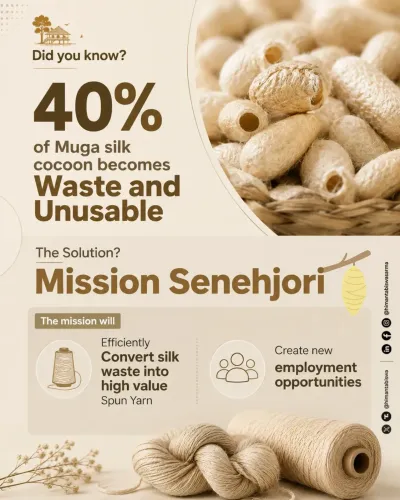
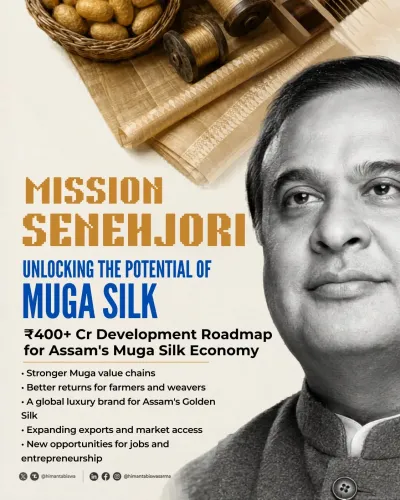
The Chief Minister's Office of Assam has spotlighted Mission Senehjori, a flagship initiative to take the state's GI-tagged Muga silk from farm gate to global markets. The programme aims to lift rural incomes by integrating sericulture farmers, weavers and cooperatives into export-oriented value chains anchored on Assam's heritage golden silk.
Key Takeaways
The Chief Minister's Office of Assam flagged Mission Senehjori as a landmark state initiative on 3 June 2026 .
The programme targets taking Muga silk from the farm gate to global markets.
Muga silk holds a Geographical Indication tag since 2007 , enabling premium export branding.
Key stakeholders include sericulture farmers, handloom weavers and rural cooperatives in Assam.
The push aligns with the Northeast's broader strategy of converting heritage crafts into export industries under the Act East framework.
The Chief Minister's Office of Assam on 3 June 2026 flagged a special coverage of Mission Senehjori, describing it as a landmark state initiative aimed at taking Assam's iconic Muga silk from the farm gate to global markets. The post, published on the official handle of the CMO, positions the mission as a flagship value-chain intervention for one of the state's most celebrated heritage products.
In its message, the CMO called the programme 'Assam's landmark initiative to take its iconic Muga silk from the farm gate to global markets', and pointed readers to a long-form feature for details.
Context
Muga silk is a golden-hued wild silk produced by the moth Antheraea assamensis and is found almost exclusively in Assam. Prized for its natural lustre and durability, it has historically clothed Assamese royalty and remains central to the state's handloom identity.
The silk received a Geographical Indication (GI) tag in 2007, granting it legal protection and a recognised origin marker that can be leveraged for branding in premium export markets. That tag has been the cornerstone of subsequent attempts to position Muga as a globally traded luxury fibre rather than a purely domestic craft input.
Policy backdrop
The administration of Chief Minister Himanta Biswa Sarma, in office since May 2021, has consistently framed value-chain development for traditional textiles and agricultural produce as a rural-income strategy. Mission Senehjori, as highlighted by the CMO, fits within that template, focusing on the journey of Muga from the rearing field to international buyers.
The initiative also sits within a wider arc in the Northeast, where state governments have increasingly treated heritage crafts as export-oriented industries. This effort runs parallel to national programmes promoting GI products and integrating regional supply chains under the Act East Policy framework, which seeks to deepen India's economic ties with Southeast and East Asia.
Stakeholders and impact
The most direct beneficiaries are sericulture farmers, handloom weavers and rural cooperatives spread across Muga-rearing belts in upper and central Assam. A farm-to-export pipeline, if executed at scale, could compress middlemen layers, improve realisation per metre for weavers and embed quality-assurance norms required by overseas buyers.
For the broader state economy, scaling Muga exports offers a way to diversify rural incomes beyond paddy and tea, the two traditional mainstays. It also strengthens the soft-power narrative of Assam as a luxury-textile origin, similar to how Banarasi or Kanjeevaram silks anchor their respective states.
What's next
Watchpoints in the near term include the release of export data or fresh buyer agreements for Muga products at upcoming trade fairs, and any dedicated allocations for sericulture infrastructure in the state budget for the next fiscal year. Capacity expansion at the farm end — including host-plant plantations and cocoon-rearing units — will determine whether global demand can be matched by reliable supply.
The CMO's framing of Mission Senehjori as a 'landmark' initiative signals that the programme will likely receive sustained political backing, with branding, market linkages and quality certification as the next phase of work. Whether it can convert Assam's heritage advantage into measurable export earnings will be the defining test of the mission.
Point of View
Muga is both an economic and identity asset, and bundling farmers, weavers and cooperatives into a single farm-to-global pipeline is a politically resonant rural-income story. The real test will be supply-side scaling — host plantations, cocoon volumes and certification — without which global demand cannot be honoured. Execution data, not branding, will decide whether this mission delivers.
NationPress
18 Oct 2026
Frequently Asked Questions
What is Mission Senehjori in Assam?
Mission Senehjori is an Assam government initiative, highlighted by the Chief Minister's Office, aimed at taking the state's iconic Muga silk from the farm gate to global export markets by strengthening the entire value chain.
Why is Muga silk unique to Assam?
Muga silk is a naturally golden-hued wild silk produced by the moth Antheraea assamensis, found almost exclusively in Assam, and it received a Geographical Indication tag in 2007 that legally ties it to the state.
When did Muga silk get its GI tag?
Muga silk was granted Geographical Indication status in 2007, giving it legal protection of origin and enabling branded positioning in domestic and international markets.
Who benefits from Assam's Muga silk export push?
Sericulture farmers, handloom weavers and rural cooperatives across Assam's Muga-rearing belts are the primary beneficiaries, as a farm-to-export pipeline can improve their realisations and reduce dependence on intermediaries.
How does Mission Senehjori fit with the Act East Policy?
By preparing a heritage GI product for global trade, Mission Senehjori aligns with the Act East Policy's goal of integrating northeastern supply chains with Southeast and East Asian markets through value-added exports.