CM Himanta Unveils ₹400cr Muga Silk Plan in Assam Budget

Synopsis
Assam CM Himanta Biswa Sarma unveiled a ₹400 crore Mission Senehjori in the Assam Budget 2026 to modernise the Muga Silk sector, enhance its global market value, and improve livelihoods for silk weavers and sericulture farmers across the state.
Key Takeaways
₹400 crore allocated for sericulture in Assam Budget 2026-27 , announced by CM Himanta Biswa Sarma on 10 July 2026 .
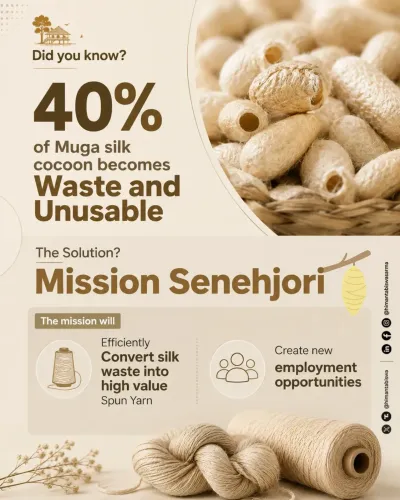
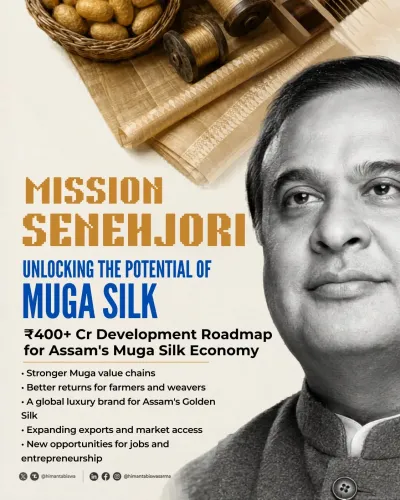
The funds will be channelled through a dedicated programme called Mission Senehjori , focused specifically on Muga Silk .
Muga Silk is a GI-tagged, golden-yellow variety produced exclusively in Assam and is among India's most prized natural fibres.
The mission aims to boost Muga Silk's global value while providing direct support to weavers and sericulture farmers.
Detailed scheme guidelines and disbursement targets are awaited once the full Assam Budget 2026-27 documents are tabled in the legislature.
The announcement continues a policy pattern of successive Assam governments treating sericulture as a priority rural livelihood and export sector.
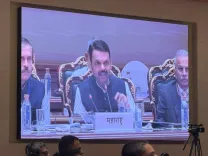
Assam Chief Minister Himanta Biswa Sarma on Friday, 10 July 2026 announced a comprehensive ₹400 crore plan to strengthen the state's sericulture sector, with a special focus on the globally prized Muga Silk through a dedicated mission called Mission Senehjori. The announcement came as part of the Assam Budget 2026, with the stated aim of boosting Muga Silk's global value and supporting the livelihoods of weavers across the state.
Context
Muga Silk is a rare, golden-yellow variety of silk produced exclusively in Assam and holds a Geographical Indication (GI) tag, making it one of the state's most distinctive cultural and economic assets. The fibre is produced by the Antheraea assamensis silkworm, which feeds on the leaves of Som and Sualu trees found in the Brahmaputra valley. The silk commands premium prices in domestic and international markets, yet the sector has long faced challenges around modernisation of reeling technology, marketing infrastructure, and weaver welfare.
CM Sarma's post declared that Mission Senehjori — the name means 'strengthening' or 'bonding' in Assamese — will be the vehicle for channelling the ₹400 crore outlay. The mission is intended to elevate the silk's global standing while providing direct economic support to the artisan and farming communities that sustain the industry.
Policy Backdrop
Assam has a centuries-old tradition of sericulture, encompassing three primary varieties: Muga, Eri, and Mulberry silk. State budgets since 2016 have repeatedly earmarked funds for silk clusters under the state sericulture directorate, with an emphasis on modernising cocoon rearing, reeling, and weaving units. The current BJP-led government under CM Sarma has consistently integrated handloom and sericulture into broader rural livelihood and export-promotion frameworks.
The ₹400 crore allocation announced for 2026-27 represents a focused, mission-mode approach — consolidating what had previously been spread across smaller, fragmented scheme heads. Linking the outlay to GI branding and global value signals a shift from subsistence-support to market-oriented positioning for Muga Silk.
Stakeholders and Impact
The most immediate beneficiaries of Mission Senehjori are the silk weavers and sericulture farmers concentrated in districts such as Sualkuchi, Jorhat, Sibsagar, and Golaghat — communities where Muga cultivation is woven into the agrarian economy. Improved reeling infrastructure and organised marketing linkages could translate into higher incomes for thousands of weaver households.
On a broader canvas, elevating Muga Silk's global profile aligns with India's export-promotion agenda for handloom and handicraft products. A stronger GI identity backed by state investment could open premium retail and designer channels in Europe, Japan, and the United States, where demand for authenticated, artisanal natural fibres is growing.
What's Next
The detailed scheme guidelines, disbursement schedule, and physical targets for Mission Senehjori are expected to be tabled once the full Assam Budget 2026-27 documents are presented to the state legislature. Observers will watch for specifics on how the ₹400 crore is split between infrastructure, weaver support, research and development, and international marketing.
If implementation follows through at the scale announced, Mission Senehjori could set a template for GI-backed sericulture development in other silk-producing states — and cement Assam's position as the custodian of one of the world's most exclusive natural fibres.
Point of View
Branded ₹400 crore vehicle rather than distributing funds across disparate scheme heads, a structural shift that signals greater accountability and visibility. Tying the outlay explicitly to Muga Silk's 'global value' suggests the state is pivoting from welfare-first to market-first logic, positioning a traditional GI product as an export commodity. This fits a broader BJP governance pattern in the Northeast of packaging cultural heritage assets into economic narratives ahead of electoral cycles. The real test will be whether Mission Senehjori's implementation architecture — disbursement timelines, weaver enrolment, and export linkages — matches the scale of the announcement.
NationPress
9 Oct 2026
Frequently Asked Questions
What is Mission Senehjori in Assam?
Mission Senehjori is a dedicated government programme announced under the Assam Budget 2026-27 with an outlay of ₹400 crore to strengthen the sericulture sector, particularly Muga Silk production, and to support weavers and silk farmers across the state.
What is Muga Silk and why is it special?
Muga Silk is a rare, golden-yellow natural silk produced exclusively in Assam by the Antheraea assamensis silkworm. It holds a Geographical Indication (GI) tag, making it unique to the region, and commands premium prices in both domestic and international markets.
How much has Assam allocated for sericulture in Budget 2026?
Assam Chief Minister Himanta Biswa Sarma announced a ₹400 crore plan for the sericulture sector as part of the Assam Budget 2026-27, with the funds to be deployed through Mission Senehjori.
Who will benefit from Mission Senehjori in Assam?
The primary beneficiaries are silk weavers and sericulture farmers, particularly those in Muga Silk-producing districts such as Sualkuchi, Jorhat, Sibsagar, and Golaghat, who stand to gain from improved infrastructure, marketing support, and weaver welfare measures.
What does Senehjori mean?
'Senehjori' is an Assamese word broadly meaning 'strengthening' or 'bonding,' reflecting the mission's aim to reinforce the sericulture sector and its weaver communities.