CM Himanta Pitches Muga Silk Global Push via Mission Senehjori
Synopsis
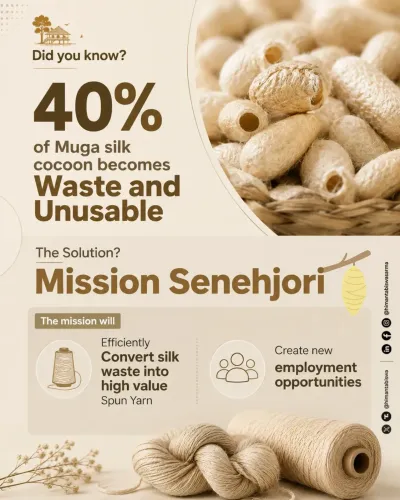
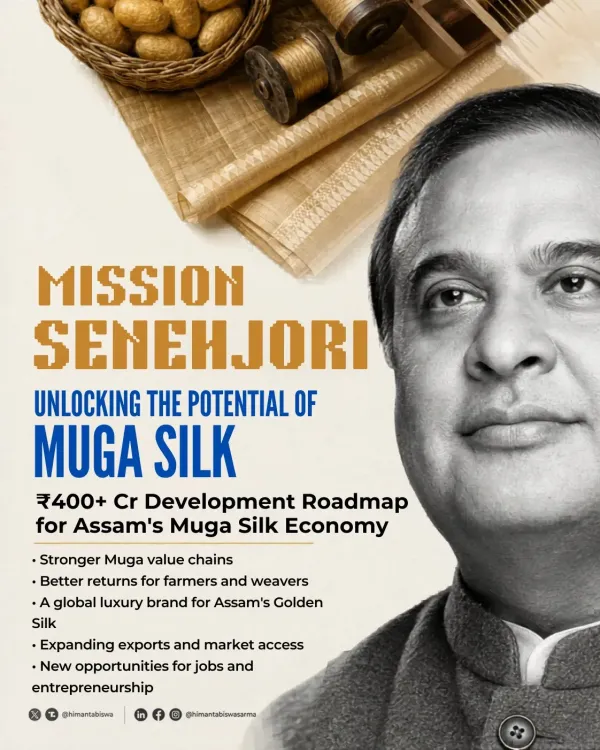
Assam Chief Minister Himanta Biswa Sarma has announced a push to take the state's GI-tagged Muga silk global through Mission Senehjori, a scheme he says will invest in artisans behind the golden thread and expand Assam's Muga economy across domestic and international markets.
Key Takeaways
Assam CM Himanta Biswa Sarma announced a global push for Muga silk through Mission Senehjori on 3 June 2026.
The scheme targets artisans 'behind the golden thread' and aims to expand Assam's Muga economy.
Muga silk holds a Geographical Indication tag granted in 2007, recognising its unique Assamese origin.
Key beneficiaries include rural weavers, cocoon rearers and cooperatives, many in Upper Assam districts.
Specific budget, targets and timeline for Mission Senehjori were not disclosed in the post.
Assam Chief Minister Himanta Biswa Sarma on Wednesday, 3 June 2026, said his government is working to take the state's prized Muga silk 'from local to global' through a flagship state initiative branded Mission Senehjori. In a post on X, the Chief Minister framed the programme as an investment in the artisans 'behind the golden thread' and a vehicle to expand Assam's wider Muga economy.
'Taking Assam's Muga Silk from Local to Global,' the Chief Minister wrote, adding that #MissionSenehjori is aimed at 'investing in the people behind the golden thread and creating new opportunities for Assam's Muga economy to flourish.' He directed readers to a longer note published on his LinkedIn page for further details.
Context
Muga is a wild silk variety endemic to Assam, prized for its natural golden lustre and durability. It is woven into mekhela chadors, sarees and stoles, and forms part of the cultural identity of the Brahmaputra valley.
The Chief Minister's post positions Muga as both a heritage product and an export-ready commodity, echoing a recurring theme in his administration's economic messaging: that traditional crafts can anchor rural livelihoods while raising Assam's profile in national and global markets.
Policy backdrop
Muga silk received its Geographical Indication (GI) tag in 2007, formally recognising its unique Assamese origin and shielding the name from misuse outside the designated production zone. The GI status has since been used by successive state governments as a marketing peg for premium positioning in domestic and overseas markets.
Mission Senehjori, as described by Himanta Biswa Sarma, slots into this lineage. Since the early 2000s, Assam governments have repeatedly treated traditional textiles as drivers of rural employment and state branding, layering state-level skill and market interventions on top of central textile schemes for GI-tagged handloom products.
Specific budget allocations, beneficiary targets and the implementation timeline of Mission Senehjori were not detailed in the Chief Minister's post.
Stakeholders and impact
The most direct stakeholders are Muga weavers and rural silk artisans, many of them women, spread across districts such as Sivasagar, Jorhat, Dhemaji and Lakhimpur, where Muga rearing and weaving are concentrated. For these households, sericulture is often a supplementary but significant source of cash income alongside agriculture.
Cocoon rearers, reelers, dyers, designers and cooperative societies sit further along the value chain and stand to gain if state interventions translate into steadier raw-material supply, better prices and wider market access. Exporters and boutique retailers in metros are likely beneficiaries on the demand side, particularly if branding around the GI tag is reinforced.
The political constituency is also notable. Assam's handloom belt overlaps with rural seats where the BJP and its allies have invested heavily in cultural-economic outreach, making Muga a politically resonant vehicle as much as an economic one.
What's next
Attention will turn to the operational contours of Mission Senehjori, including any published guidelines, district-level rollout plans and convergence with existing central sericulture and handloom programmes. Key indicators to watch over the next two financial years include changes in Muga cocoon production, reported artisan incomes and any uptick in export orders for GI-tagged Assam silks.
If the mission delivers measurable gains on these fronts, it could become a template for similar interventions across the Northeast, where indigenous crafts are increasingly being leveraged for both livelihood generation and regional economic visibility. For now, the Chief Minister's post serves as a public marker that Muga silk remains near the top of Assam's economic branding agenda.
Point of View
GI-tagged products rather than commodity manufacturing alone. By branding the intervention as Mission Senehjori, the state is signalling that handloom and sericulture remain politically central, not residual cultural sectors. The real test, however, will be whether the scheme moves beyond branding into measurable gains in artisan incomes, cocoon yields and export orders. Until rollout data emerges, the announcement is best read as a strategic positioning move within a broader Northeast craft-economy template.
NationPress
19 Sept 2026
Frequently Asked Questions
What is Mission Senehjori in Assam?
Mission Senehjori is an Assam government initiative announced by Chief Minister Himanta Biswa Sarma to support Muga silk artisans and expand the state's traditional silk economy. The CM has described it as a programme to take Muga silk 'from local to global' by investing in the people behind the golden thread.
Why is Assam's Muga silk special?
Muga silk is a wild silk variety endemic to Assam, known for its natural golden colour, durability and lustre. It received a Geographical Indication tag in 2007, which formally recognises its unique Assamese origin and protects the name from misuse outside the designated production zone.
Who benefits from the Muga silk push under Mission Senehjori?
The primary beneficiaries are Muga weavers, cocoon rearers and rural silk artisans in Assam, many of them women in districts such as Sivasagar, Jorhat, Dhemaji and Lakhimpur. Cooperatives, reelers, designers and exporters along the value chain are also expected to gain from improved market access and branding.
When did Muga silk get its GI tag?
Muga silk received its Geographical Indication tag in 2007. The recognition links the product exclusively to its Assamese origin and has since been used by successive state governments as a premium marketing peg in domestic and global markets.
What did Himanta Biswa Sarma say about Muga silk on X?
In a post on 3 June 2026, Himanta Biswa Sarma said Assam is 'Taking Muga Silk from Local to Global' through Mission Senehjori. He described the scheme as an investment in artisans behind the golden thread that will create new opportunities for the state's Muga economy.