CM Himanta: Assam MLAs take oath in Karbi, Rabha, Rajbongshi
Synopsis
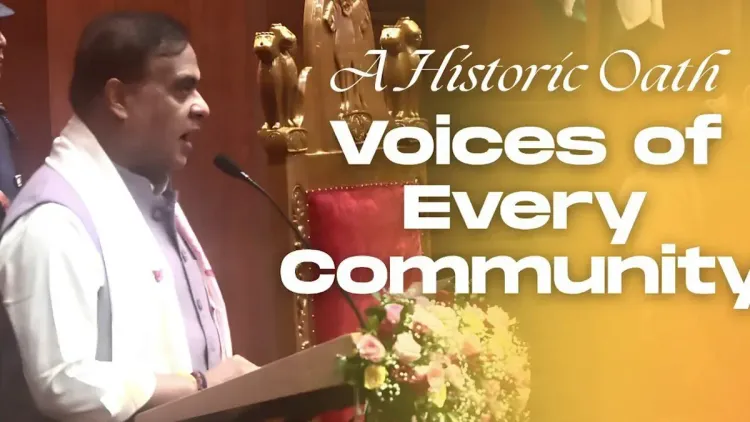
For the first time, Assam MLAs took oaths in indigenous languages including Karbi, Rabha and Rajbongshi during an Assembly session, Chief Minister Himanta Biswa Sarma announced on 21 May 2026, calling it a new precedent that goes beyond conventional limitations of the House.
Key Takeaways
MLAs in the Assam Legislative Assembly took oaths in indigenous languages including Karbi , Rabha , and Rajbongshi for the first time.
Chief Minister Himanta Biswa Sarma described the development as 'setting a new precedent in the House.' The Assam Official Language Act of 1960 designates Assamese as the primary official language, making this oath-taking a notable departure from convention.
Indigenous languages such as Karbi and Rabha already have limited official use under the Sixth Schedule autonomous council framework.
The move extends symbolic legislative recognition to communities in the Karbi Anglong , Goalpara , and surrounding belts.
Whether future proceedings — debates, questions, committee reports — will follow suit remains an open question requiring rule amendments and translation infrastructure.
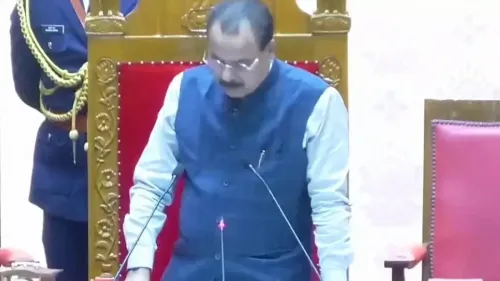
Assam Chief Minister Himanta Biswa Sarma announced on Thursday, 21 May 2026 that members of the Assam Legislative Assembly took their oaths in indigenous languages including Karbi, Rabha, and Rajbongshi — marking what he described as a first for the House and a new precedent in the state legislature.
Context
Sarma posted on X that 'the Assam Assembly echoed with the voices of our indigenous languages,' noting that MLAs went 'beyond conventional limitations' by taking oath in languages other than Assamese or English. The development signals a formal, if symbolic, recognition of the state's deep linguistic plurality within its highest elected chamber.
Assam is home to dozens of distinct linguistic communities. Languages such as Karbi, Rabha, and Rajbongshi are spoken by significant tribal and plains-ethnic populations whose political representation in the assembly has grown steadily over the past two decades.
Policy Backdrop
The Assam Official Language Act of 1960 designated Assamese as the primary official language of the state, while permitting limited use of other languages in specified regions and proceedings. That framework has long been a point of contention for communities whose mother tongues fall outside the Assamese mainstream.
Separately, the Sixth Schedule of the Constitution — notified in 1950 — established autonomous councils for tribal areas, enabling languages such as Karbi and Rabha to be used in local administration and education. Thursday's oath-taking extends that recognition, at least symbolically, to the floor of the state legislature itself.
The move continues a broader pattern in Assam of gradually accommodating indigenous languages within state institutions while formally maintaining the primacy of Assamese — a balance the ruling dispensation has sought to project as inclusive rather than competitive.
Stakeholders and Impact
For Karbi, Rabha, and Rajbongshi communities, the oath-taking carries considerable cultural weight: it positions their languages as worthy of the solemnity of a constitutional proceeding, not merely of folk or local-body use. Tribal MLAs and community organisations in the Karbi Anglong, Goalpara, and Bodoland belts are likely to view the precedent as a step toward fuller linguistic parity.
Chief Minister Sarma, who also serves as convenor of the North-East Democratic Alliance (NEDA), has consistently framed ethnic and linguistic recognition as central to his governance model in the Northeast. The announcement reinforces that positioning ahead of the political cycle in the region.
What's Next
The immediate question is whether this precedent will extend beyond the oath-taking ceremony to substantive legislative proceedings — debates, questions, or committee reports conducted in indigenous languages. Any such expansion would require translation infrastructure and formal rule amendments in the Assam Legislative Assembly.
Observers will also watch whether the state government moves to extend official-language status or state-funded translation facilities to Karbi, Rabha, Rajbongshi, and other recognised indigenous tongues — a step that would give Thursday's symbolic gesture lasting administrative weight.
Point of View
The BJP-led government attempts to neutralise longstanding grievances without disturbing the primacy of Assamese — a tightrope the Sixth Schedule framework has always required. The move also reinforces Sarma's positioning as the dominant broker of multi-ethnic politics across NEDA states. The real test of intent will be whether the government follows through with translation infrastructure and rule amendments that give these languages a functional, not merely ceremonial, role in the legislature.
NationPress
6 Oct 2026
Frequently Asked Questions
Which languages were used for the first time in the Assam Assembly oath?
MLAs took oath in Karbi , Rabha , and Rajbongshi , among other indigenous languages, marking the first time such languages were used for the oath-taking ceremony in the Assam Legislative Assembly.
What did Assam CM Himanta Biswa Sarma say about the oath-taking?
Chief Minister Himanta Biswa Sarma said the Assam Assembly 'echoed with the voices of our indigenous languages' and that MLAs went 'beyond conventional limitations,' setting a new precedent in the House.
What is the official language of Assam?
Under the Assam Official Language Act of 1960 , Assamese is the primary official language of the state, though limited use of other languages is permitted in specified regions and proceedings.
What is the Sixth Schedule and how does it relate to Assam's tribal languages?
The Sixth Schedule of the Constitution , notified in 1950 , established autonomous councils for tribal areas in Assam, enabling languages such as Karbi and Rabha to be used in local administration and education — a framework that predates their use in the state legislature.
Will indigenous languages now be used for debates in the Assam Assembly?
That has not been announced. The current precedent covers only the oath-taking ceremony; extending these languages to debates, questions, or committee reports would require formal rule amendments and translation facilities in the Assam Legislative Assembly .