What Happened at the Second Session of 'Atal Smaran Lecture Series' in Gandhinagar?
Synopsis
Explore the highlights from the second session of the 'Atal Smaran Lecture Series' in Gandhinagar, where esteemed speakers celebrated the legacy of Atal Bihari Vajpayee while discussing values that guide effective governance.
Key Takeaways
Celebration of Vajpayee's Centenary Guided by Vision, Governed by Values Keynote by Sujan R.
Chinoy Focus on National Security Diplomatic Relations with China and Pakistan
Gandhinagar, Oct 29 (NationPress) In a tribute to the centenary of Bharat Ratna and former Prime Minister Atal Bihari Vajpayee, the Gujarat government has initiated the 'Atal Smaran Lecture Series' throughout the state.
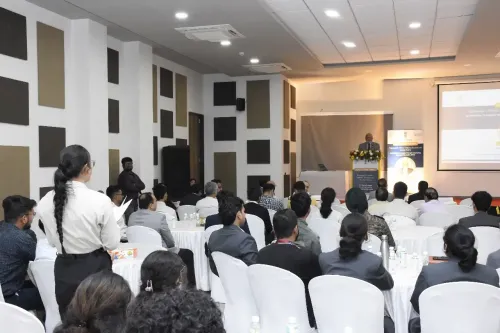
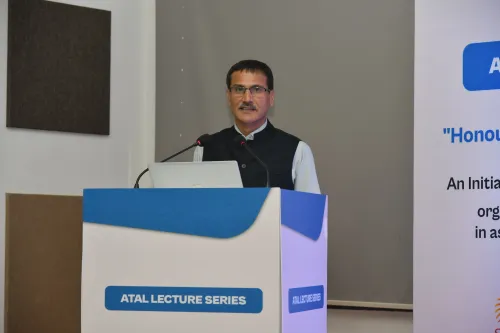
The second session of this enlightening series took place at the Sardar Patel Institute of Public Administration (SPIPA), Gandhinagar, in partnership with the Ahmedabad Management Association (AMA), as reported by officials today.
The theme for this session was 'Guided by Vision, Governed by Values'.
Keynote speaker Sujan R. Chinoy, Director General of the Manohar Parrikar Institute for Defence Studies and Analyses (MP-IDSA) in New Delhi and a former Ambassador of India, lauded Vajpayee as a monumental figure—an intellectual, poet, philosopher, and an unparalleled statesman.
"Vajpayeeji never permitted power, status, or politics to compromise his principles. The national interest, citizens’ welfare, and peaceful coexistence were the heart of his policies," Chinoy stated.
Chinoy also emphasized Vajpayee's exceptional oratory skills, noting that he was a master communicator, fluent in Hindi, English, and Urdu.
"Vajpayee was open to all ideologies and never took political disagreements personally, which earned him respect even from his adversaries," Chinoy commented.
Reflecting on Vajpayee's political trajectory, Chinoy noted that his career, which began in the 1950s, spanned over five decades. He held ten terms in the Lok Sabha and two in the Rajya Sabha, consistently prioritizing India’s national security and sovereignty.
Chinoy further highlighted Vajpayee's diplomatic finesse, especially in enhancing India's relations with China and Pakistan.
"In his roles as Foreign Minister and Prime Minister, he established high standards—from the Lahore Bus Yatra and his restraint during the Kargil conflict to crucial border negotiations with China that affirmed Sikkim’s status as an integral part of India," Chinoy remarked.
He also pointed out Vajpayee's critical role in forming the post-Cold War strategic partnership between India and the United States.
Discussing Vajpayee's foreign policy legacy, Chinoy referred to the years 2000–2005 as a 'golden phase' for India-China trade and economic relations.
"During this time, significant Indian IT and pharmaceutical firms invested in China, and during his 2003 visit to Shanghai, Vajpayee advocated for a strategic alliance among Indian and Chinese technology companies," he added.
Sujan Rameshchandra Chinoy, the principal speaker, is a distinguished diplomat who has represented India in vital positions across East Asia and the Middle East.
Renowned for his expertise in international relations and strategic affairs, he has made substantial contributions to India’s foreign policy goals.
Currently, as Director General of MP-IDSA, one of India’s leading think tanks on defense and strategic studies, Chinoy also chaired the Think20 group under India's G20 presidency and has been part of various national policy councils.
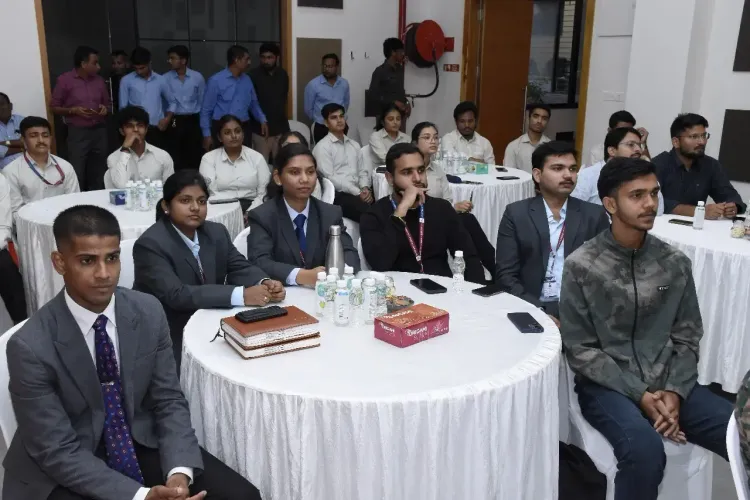
The second session of the Atal Smaran Lecture Series witnessed enthusiastic participation from officials and staff of the General Administration Department and SPIPA, representatives of AMA, along with faculty and students from defense and strategic studies.
Point of View
It is crucial to recognize the significance of the discussions held during the 'Atal Smaran Lecture Series'. The event not only honors Atal Bihari Vajpayee's legacy but also serves as a platform for reflection on the values that underpin effective governance and public service in India.
NationPress
16 Oct 2026
Frequently Asked Questions
What is the 'Atal Smaran Lecture Series'?
The 'Atal Smaran Lecture Series' is an initiative by the Gujarat government to commemorate the centenary of Bharat Ratna and former Prime Minister Atal Bihari Vajpayee through lectures and discussions across the state.
Who delivered the keynote address at the second session?
The keynote address was delivered by Sujan R. Chinoy, the Director General of the Manohar Parrikar Institute for Defence Studies and Analyses.
What was the central theme of the second session?
The theme of the second session was 'Guided by Vision, Governed by Values'.
How did Vajpayee's approach to politics differ from others?
Vajpayee was known for his integrity, open-mindedness, and ability to engage with various ideologies without personalizing political disagreements.
What impact did Vajpayee have on India's foreign relations?
Vajpayee played a pivotal role in strengthening India's relationships with neighboring countries, especially China and Pakistan, and was instrumental in shaping India's post-Cold War foreign policy.