How Have Bangladesh's Electors Spoken? Now, Will the New Government Deliver?
Synopsis
The recent elections in Bangladesh have marked a significant shift as voters rejected extremism and embraced a more inclusive governance led by the BNP. With impressive voter turnout and a notable presence of women in parliament, the results reflect the electorate's desire for progressive change. Now, the challenge lies in meeting the expectations of the citizens as the new government takes charge.
Key Takeaways
Election results indicate a rejection of extremism.
Voter turnout was notably high at 59.44%.
Women’s representation in parliament is still low.
The BNP's victory reflects public trust and expectations.
Political landscape changes with absence of key figures.
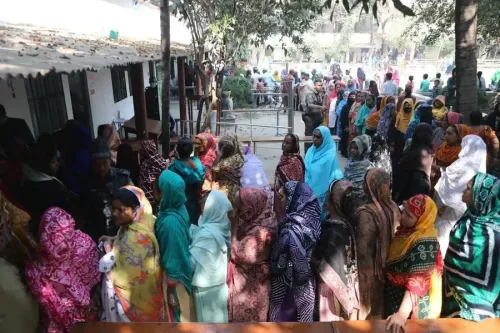
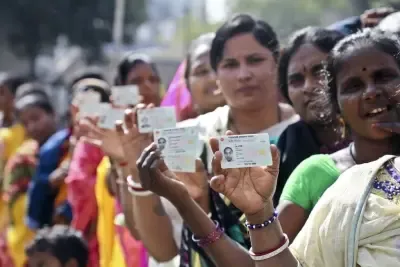
New Delhi, Feb 13 (NationPress) The outcome of the Bangladesh elections has been positively received by the media, viewed as a decisive rejection of fundamentalism and gender inequality. An alliance led by a more progressive party garnered the confidence of an impressive 59 percent of the nation’s 12.8 crore voters who cast their ballots on Thursday.
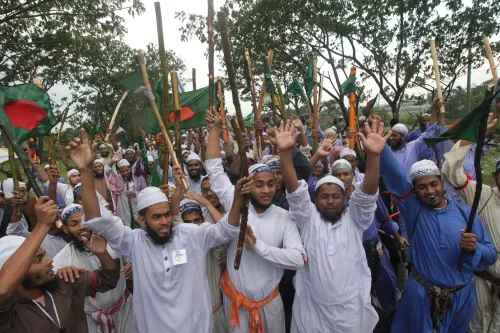
“BNP achieves a remarkable victory as Jamaat's religious strategy falters,” reported The Business Standard, while weekly Blitz labeled it “A quiet rebellion against extremism and pro-Pakistan sentiment: BNP secures a decisive win in general elections.”
In a rapid evaluation of the election results on Friday, the Dhaka Tribune noted: “Seven women candidates were elected to parliament.”
If this is indeed the total number of women representatives in a 300-member Parliament, it indicates that Bangladesh still has considerable work to do regarding gender equality. The report highlighted that out of these, six were from the Bangladesh Nationalist Party (BNP), and one was an independent candidate.
In its analysis of the BNP’s huge victory, The Business Standard pinpointed several factors that distinguished this election.
“This election demonstrated that the electorate is religious, but they will not tolerate theological extremism. They rightly chose a governance system that is pluralistic and moderate,” it remarked.
Interestingly, Thursday’s elections were preceded by student elections at various universities, where the student group aligned with the Bangladesh Jamaat-e-Islami achieved a significant victory. This sparked expectations that the conservative, pro-Pakistan party had an advantage among the youth, who make up a portion of the 12.8 crore voters in Bangladesh.
“The election results also highlight the emergence of women’s empowerment. More than half of the electorate are women, and they rejected the notion that they are unsuitable for leadership roles. Male voters were equally discontent with such archaic views from a political party seeking to govern the nation,” the newspaper further commented.
This is the first election in decades where both of the prominent Begums, who have historically dominated the political landscape, were absent.
Begum Khalida Zia, who led the BNP following her husband’s death, passed away in late December. Her political rival, Begum Sheikh Hasina, is currently in exile, facing a death sentence since the fall of her Awami League government in August 2024. Hasina heads the party established by her father, Sheikh Mujibur Rahman, recognized as the chief architect of Bangladesh.
Meanwhile, “On February 12, 2026, Bangladesh opted for balance over extremism, democracy over dogmatic politics, and sovereignty over subtle subservience,” noted the Blitz.
“The lesson transcends party lines. A nation that fought for linguistic and political freedom will not easily surrender it to ideological nostalgia or external influences. The electorate has spoken with the decisive power of ballots rather than barricades,” it added.
“If BNP acknowledges that its victory was less about conquest and more about trust, Bangladesh may very well enter a new chapter – one not defined by allegiances to distant powers, but by confidence within its own borders,” it further stated.
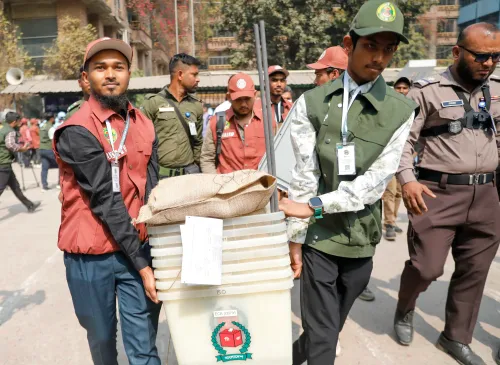
Following considerable speculation and analysis after the general election, the media on Friday cited the Election Commission reporting Thursday's voter turnout in the 13th parliamentary election and referendum at 59.44 percent.
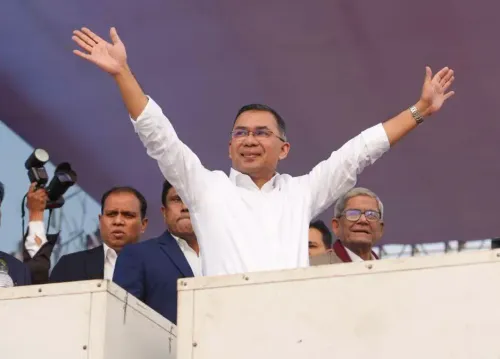
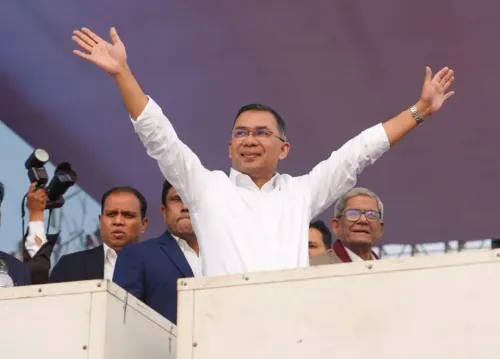
The mandate is clear; now it is up to the BNP and its leader, Tarique Rahman, to fulfill the aspirations of a vast majority of its citizens.
Point of View
I believe this election signals a transformative moment for Bangladesh. The electorate has decisively rejected extremism and embraced a vision of governance that prioritizes inclusivity and progress. The BNP must recognize that their victory is rooted in public trust, and they need to deliver on their promises to foster a new era of democratic governance.
NationPress
9 Oct 2026
Frequently Asked Questions
What was the voter turnout in the Bangladesh elections?
The voter turnout in the Bangladesh elections was reported at 59.44 percent.
How many women were elected to parliament?
Seven women candidates were elected to the parliament.
What was the significance of the election results?
The election results were seen as a rejection of fundamentalism and a move towards more inclusive governance.
Who led the winning party in the elections?
The winning party, BNP, was led by Tarique Rahman.
What does the election signify for Bangladesh's future?
The election signifies a shift towards democratic governance and a rejection of extremism, indicating a desire for progress among the electorate.