Bangladesh's China pact risks US trade deal, shifts South Asia's strategic balance

Synopsis
Bangladesh PM Tarique Rahman is in China negotiating a $2.2 billion fighter jet deal — even as clauses in Dhaka's US trade pact explicitly push Bangladesh to limit arms purchases from 'certain countries' widely read as China. The contradiction is stark: Dhaka wants US trade concessions and Chinese jets simultaneously, and the fine print suggests Washington may not allow both.
Key Takeaways
Bangladesh PM Tarique Rahman is visiting China to finalise a reported deal for 24 J-10CE fighter jets and UAV technology .
The US-Bangladesh trade pact , signed on 9 February 2025 , contains clauses directing Dhaka to limit arms purchases from 'certain countries' — interpreted as China and Russia .
The jet deal is valued at approximately $2.2 billion , with deliveries expected in 2026–2027 .
Advanced aircraft near India's Siliguri Corridor and a joint UAV facility with CETC near New Bogra Airbase have raised security concerns in New Delhi .
The US pact allows Washington to terminate the agreement and reimpose tariffs under Executive Order 14257 if Bangladesh signs preferential deals with 'non-market countries' that undermine it.
India's Ministry of External Affairs told a parliamentary committee in December it is closely monitoring China's expanding strategic infrastructure presence in Bangladesh.
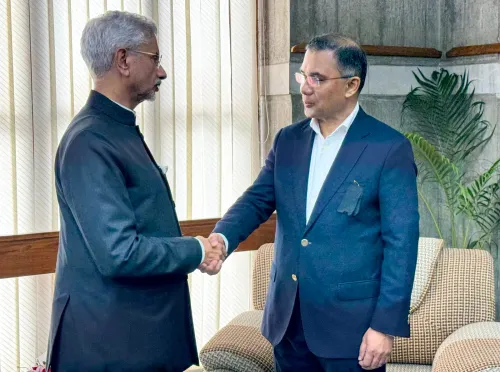
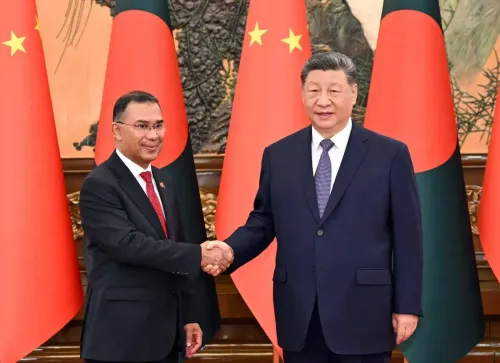
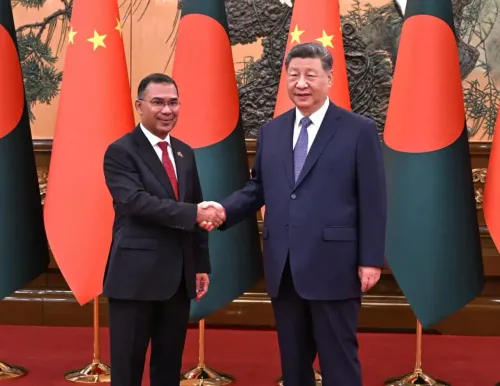
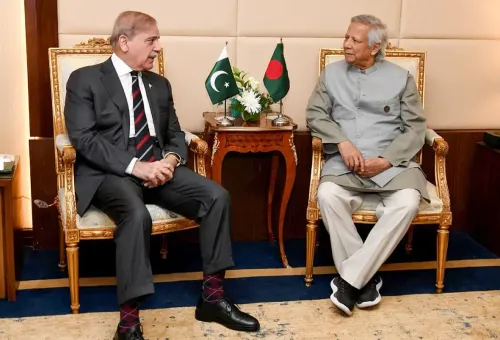
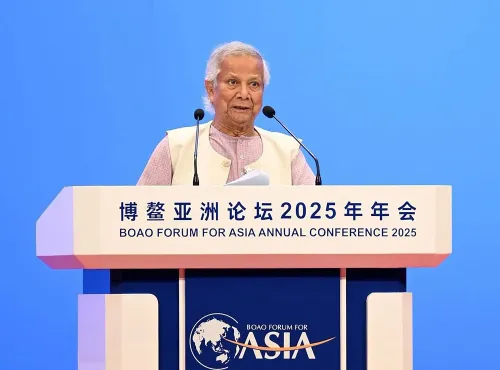
Bangladesh Prime Minister Tarique Rahman is visiting China to deepen economic and defence ties, with the reported acquisition of 24 J-10CE fighter jets and UAV technology at the centre of discussions — a move that analysts say signals a strategic tilt toward Beijing that could directly contradict commitments embedded in Dhaka's US trade pact signed on 9 February 2025. The visit, which also includes a keynote address at the World Economic Forum's 'Summer Davos' in Dalian, comes amid growing scrutiny of Bangladesh's ability to balance its obligations to Washington against its deepening courtship of China.
What the US Trade Pact Actually Says
The agreement, signed by an interim government just three days before Bangladesh's general election — itself a source of wide criticism — contains clauses that stop short of an outright arms ban but create binding expectations. Article 4.3 of the pact stipulates that if Bangladesh enters into a new bilateral free trade or preferential economic agreement with a 'non-market country' that undermines the deal, the United States may terminate the agreement and reimpose reciprocal tariff rates set under Executive Order 14257 of 2 April 2025.
Separately, Section 6, 'Commercial Considerations', directs that 'Bangladesh shall endeavor to increase purchases of U.S. military equipment and limit military equipment purchases from certain countries.' Media reports, including coverage in Bangladesh's The Daily Star, have interpreted 'non-market country' and 'certain countries' as US regulatory terms widely understood to refer to China and Russia. The pact also bars Dhaka from purchasing nuclear reactors, fuel rods, or enriched uranium from countries deemed hostile to US interests — effectively blocking nuclear cooperation with either nation.
The Fighter Jets and the Siliguri Corridor
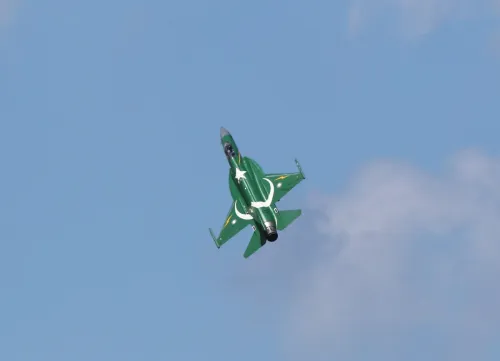
Bangladesh is reportedly negotiating the acquisition of up to 20 J-10CE multirole fighter jets from China, valued at approximately $2.2 billion, with deliveries expected between 2026 and 2027. The deal would significantly modernise Dhaka's air force — and, critically, position advanced aircraft in close proximity to India's Siliguri Corridor, the narrow strip in North Bengal — colloquially known as the 'Chicken's Neck' — that connects northeastern India to the mainland.
In addition, Bangladesh is setting up a joint UAV manufacturing facility with China Electronics Technology Group Corporation (CETC) near New Bogra Airbase, close to India's northern border. The facility reportedly includes technology transfer for medium-altitude long-endurance (MALE) and Vertical Takeoff and Landing (VTOL) drones, raising surveillance concerns in New Delhi.
India's Concerns and Strategic Calculus
For India, the issue is not Bangladesh's military modernisation per se but what it represents: China's systematic effort to tighten its arc of influence around India across South Asia. The Ministry of External Affairs told a parliamentary committee in December that New Delhi is closely monitoring Beijing's expanding footprint in Bangladesh, particularly in strategic infrastructure.
This comes amid a broader pattern. China has already embedded itself through Belt and Road Initiative (BRI) projects in Pakistan, Sri Lanka, Nepal, and Afghanistan — with mixed results and growing local resistance. Beijing's credibility in the region has taken hits from unfulfilled commitments, yet it continues to press forward in Bangladesh, particularly since the fall of the Awami League government.
The Strategic Contradiction Dhaka Must Resolve
The core tension is clear: Dhaka is attempting to retain US trade concessions while simultaneously deepening defence ties with China — two postures that the text of the trade agreement was arguably designed to make incompatible. Analysts note that large-scale Chinese arms purchases could trigger diplomatic friction with Washington and, in a worst case, economic consequences if the US invokes termination clauses.
Discussions during Rahman's visit also reportedly include Beijing's support for the Teesta River restoration project, adding a development dimension to what is already a complex strategic equation. As Rahman deepens ties with Beijing, Dhaka's choices will test the durability of its US trade pact — and could materially reshape the balance of power across South Asia.
Point of View
Which means its democratic legitimacy is already contested. What is often missed in coverage is that the Siliguri Corridor dimension makes this as much India's crisis as Bangladesh's: a Chinese-equipped air force and a CETC drone facility on India's northern flank is a qualitative shift, not a routine procurement. If Washington invokes the termination clause, Dhaka faces a tariff shock it can ill afford; if it does not, the clause becomes a dead letter — and every other US partner in the region will notice.
NationPress
22 Sept 2026
Frequently Asked Questions
What defence deals is Bangladesh reportedly finalising with China?
Bangladesh is reportedly negotiating the acquisition of up to 24 J-10CE multirole fighter jets valued at approximately $2.2 billion, with deliveries expected in 2026–2027, along with UAV technology including a joint manufacturing facility with China Electronics Technology Group Corporation near New Bogra Airbase. The deals are the centrepiece of PM Tarique Rahman's current visit to China.
How does Bangladesh's US trade pact restrict arms purchases from China?
The trade pact, signed on 9 February 2025, includes a clause in Section 6 directing Bangladesh to 'endeavor to increase purchases of U.S. military equipment and limit military equipment purchases from certain countries' — widely interpreted as China and Russia. Article 4.3 further allows the US to terminate the agreement and reimpose tariffs if Bangladesh enters preferential deals with 'non-market countries' that undermine it.
Why is India concerned about Bangladesh's Chinese fighter jets?
India is concerned because the J-10CE jets would be positioned in close proximity to the Siliguri Corridor — the narrow strip in North Bengal connecting northeastern India to the mainland — and a joint UAV facility near New Bogra Airbase raises surveillance concerns along India's northern border. India's Ministry of External Affairs confirmed in December that it is closely monitoring China's expanding strategic infrastructure presence in Bangladesh.
What is the Siliguri Corridor and why does it matter strategically?
The Siliguri Corridor, also called the 'Chicken's Neck', is a narrow strip of land in North Bengal that serves as the only land connection between northeastern India and the rest of the country. Its strategic sensitivity means that advanced military assets positioned nearby by a neighbouring country are of acute concern to Indian defence planners.
What happens if Bangladesh violates the terms of its US trade pact?
Under Article 4.3 of the agreement, if Bangladesh enters a preferential deal with a 'non-market country' that undermines the pact and consultations fail to resolve US concerns, Washington may terminate the agreement and reimpose the reciprocal tariff rates set under Executive Order 14257 of 2 April 2025, potentially delivering a significant economic blow to Dhaka.