Did Bengal File a Caveat in Supreme Court Regarding I-PAC Raid?

Synopsis
In a significant legal move, the West Bengal government has filed a caveat in the Supreme Court to ensure that its arguments are considered regarding the Enforcement Directorate's petition following recent raids at I-PAC. This development highlights the ongoing tensions between state authorities and federal agencies amidst serious allegations of financial misconduct.
Key Takeaways
West Bengal government files caveat in Supreme Court regarding ED’s investigation.
ED raids I-PAC office and director’s residence linked to coal smuggling case.
Investigation involves financial transactions of approximately Rs 2,742 crore .
Caveat ensures both parties are heard before any court orders.
Political ramifications may impact Trinamool Congress and I-PAC's future.
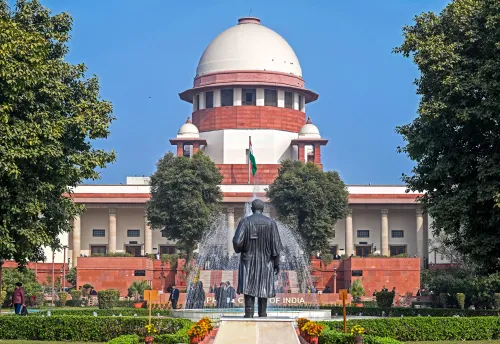
New Delhi/Kolkata, Jan 10 (NationPress) The government of West Bengal has submitted a caveat in the Supreme Court regarding the Enforcement Directorate’s (ED) petition concerning the raids conducted at the Indian Political Action Committee’s (I-PAC) office and the home of its director, Pratik Jain.
Sources from the state secretariat indicated that the request was made for the Supreme Court to consider the state's arguments prior to making any decisions on the case.
The ED has initiated legal action in the Calcutta High Court pertaining to the I-PAC issue, with the proceedings adjourned until January 14.
This caveat was filed to guarantee that the ED’s claims are not considered without a hearing from both parties involved.
It is significant to note that in numerous instances, the Supreme Court has issued rulings after only hearing one side’s perspective.
However, with a caveat in place, the Supreme Court must take into account arguments from both sides.
On Thursday, the ED executed searches at the I-PAC office and at Pratik Jain’s residence in Kolkata related to a coal smuggling case. The CBI had previously lodged an FIR related to this case in 2020.
Following the FIR, the ED launched an investigation under the Prevention of Money Laundering Act (PMLA), 2002, looking into financial transactions totaling about Rs 2,742 crore.
Allegations suggest that part of these funds was utilized for I-PAC’s operations via hawala transactions, particularly in Goa. In connection with this investigation, searches were carried out at 10 different sites in Delhi and Kolkata, including the residence of Pratik Jain and the company’s office in Salt Lake Sector V.
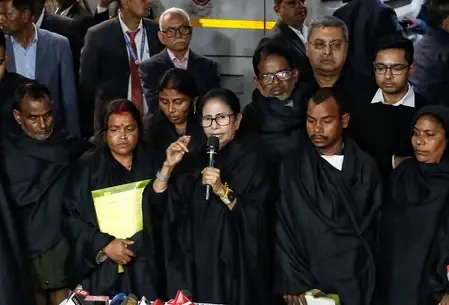
The ED accused West Bengal Chief Minister Mamata Banerjee of allegedly using police to seize crucial documents during an authorized search. Additionally, the ED claimed that various digital devices (laptops, mobile phones, hard drives) and significant papers were forcibly taken by police during the search.
According to the ED, this interference hindered the investigation and interrupted digital forensic analysis. The ED further asserted that even though officials accessed the I-PAC office and commenced their search, they faced obstruction from state police.
Subsequently, the ED approached the Calcutta High Court on Friday, requesting a CBI investigation against the Chief Minister. In response, the state government filed a counter-case in the High Court. Both the Trinamool Congress’ case and the ED’s case were adjourned, with hearings postponed until January 14.
The hearings, which were meant to occur on Friday before Justice Suvra Ghosh, were delayed due to a crowded courtroom. Justice Ghosh subsequently rescheduled the hearings for January 14.
Following this, the ED sought to expedite the hearing of its case through the Acting Chief Justice of the Calcutta High Court, but the request was denied.
In light of this, the ED submitted a petition to the Supreme Court, prompting the state government to file a caveat on Saturday.
Point of View
I observe that the West Bengal government's caveat in the Supreme Court is a strategic move to ensure fair representation in ongoing investigations. With the political climate growing increasingly charged, this development underscores the need for transparency and accountability from both state and federal bodies. The Nation stands firm on the side of democratic processes.
NationPress
14 Oct 2026
Frequently Asked Questions
What is the significance of the caveat filed by the West Bengal government?
The caveat ensures that the Supreme Court hears arguments from both the West Bengal government and the Enforcement Directorate before making any decisions, preventing unilateral actions.
What prompted the Enforcement Directorate to investigate I-PAC?
The investigation into I-PAC is linked to allegations of financial misconduct related to a coal smuggling case, with claims of substantial funds being used for I-PAC's activities.
What are the potential consequences of this legal battle?
This ongoing legal confrontation may have significant implications for the political landscape in West Bengal, particularly regarding the operations of I-PAC and the Trinamool Congress.
When is the next hearing for this case?
The next hearing for the case is scheduled for January 14 in the Calcutta High Court.