Bhupender Yadav Addresses International Tiger Day 2026 in Delhi

Synopsis
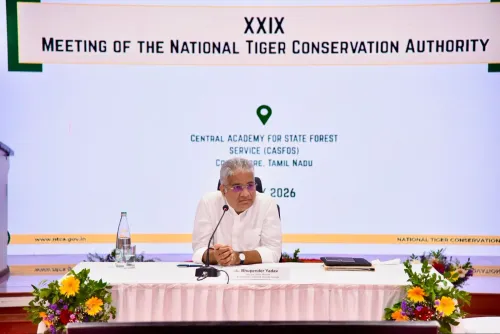
Union Environment Minister Bhupender Yadav addressed an International Tiger Day event in Delhi on 29 July 2026, reaffirming India's commitment to tiger conservation through Project Tiger and the NTCA, as the world marks the annual observance born from the 2010 St. Petersburg Tiger Summit.
Key Takeaways
Union Environment Minister Bhupender Yadav addressed an International Tiger Day 2026 event in New Delhi on 29 July 2026 .
International Tiger Day was established after the 2010 Global Tiger Summit in St.
Petersburg to drive global tiger recovery.
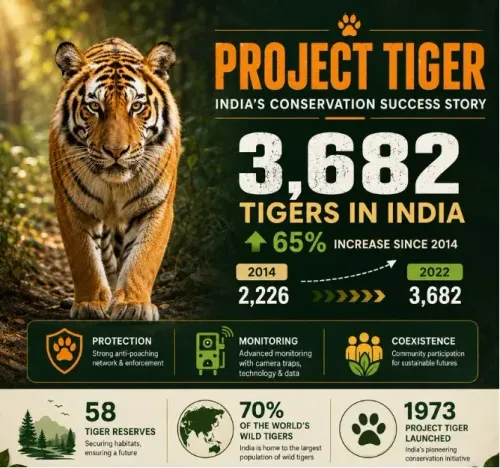
India's flagship wildlife programme, Project Tiger , was launched in 1973 and remains one of the world's longest-running large-carnivore conservation schemes.
The National Tiger Conservation Authority (NTCA) , under Yadav's ministry, oversees tiger reserves and population monitoring across India.
Key milestones to watch include the next All India Tiger Estimation report and any new tiger reserve notifications or funding decisions.
On the one day the world stops to count its tigers, Union Environment Minister Bhupender Yadav stood at a Delhi event on 29 July 2026 to mark International Tiger Day — an annual reckoning with how far the species has come, and how far it still has to go.
A Day Born From a Crisis Summit
International Tiger Day is not a ceremonial afterthought. It was born from urgency — the 2010 Global Tiger Summit in St. Petersburg, convened when wild tiger populations had collapsed to alarming lows worldwide. Nations signed on to a shared recovery target, and 29 July became the annual checkpoint. India, home to the world's largest wild tiger population, has been central to that story ever since.
Project Tiger: Five Decades of the Flagship Programme
The domestic backbone of India's conservation push is Project Tiger, launched in 1973 — one of the world's oldest and most cited wildlife recovery programmes. Overseen by the National Tiger Conservation Authority (NTCA), a statutory body under Yadav's own ministry, the scheme created a network of dedicated tiger reserves, paired anti-poaching enforcement with habitat protection, and made periodic all-India tiger estimations a policy instrument. The results have been held up internationally as a model for large-carnivore recovery.
Successive Environment Ministers have used the July 29 platform to spotlight domestic milestones and reaffirm India's commitments to global partners. Yadav's appearance this year continues that tradition — with the ministry and the NTCA watching closely for the next population estimate and any new reserve notifications.
What Conservation Watchers Are Tracking
The immediate questions for India's tiger programme are concrete: the timing of the next All India Tiger Estimation report, potential notifications of new tiger reserves, and funding allocations from the ministry. Each of these will determine whether the numbers that have made India's conservation story compelling continue to hold — or face new pressures from habitat fragmentation and human-wildlife conflict at reserve edges.
On a day defined by global solidarity for a single species, the minister's presence in Delhi signals that tiger conservation remains a flagship political and ecological commitment — not a background file.
Point of View
International Tiger Day has become a reliable platform to project India's conservation credentials on the global stage — a rare area of cross-party consensus that doubles as soft power. Yadav's participation reinforces the ministry's positioning of Project Tiger as a flagship success, even as scrutiny over habitat fragmentation and human-wildlife conflict intensifies at reserve boundaries. The annual event also keeps the NTCA's work in public view ahead of the next tiger census, which will be the real test of whether the upward population trend has held. Conservation watchers will parse any announcements from the Delhi event for signals on new reserve notifications or funding commitments.
NationPress
29 Jul 2026
Frequently Asked Questions
When is International Tiger Day celebrated?
International Tiger Day is observed every year on 29 July . It was established at the 2010 Global Tiger Summit in St. Petersburg to promote awareness and action for wild tiger conservation.
What is Project Tiger in India?
Project Tiger is a centrally sponsored wildlife conservation programme launched by the Indian government in 1973 . It created a network of protected tiger reserves and is credited with helping reverse the decline of wild tiger populations in India.
What does the National Tiger Conservation Authority do?
The National Tiger Conservation Authority (NTCA) is a statutory body under India's Ministry of Environment, Forest and Climate Change. It oversees the management of tiger reserves, monitors tiger populations, and coordinates anti-poaching efforts nationwide.
Who is Bhupender Yadav?
Bhupender Yadav is India's Union Minister of Environment, Forest and Climate Change and a senior leader of the BJP . He is responsible for wildlife policy, including oversight of Project Tiger and the NTCA.
How many tigers are there in India?
India is home to the world's largest wild tiger population. The exact current count is determined through periodic All India Tiger Estimation surveys conducted by the NTCA; the next report will provide the most up-to-date figures.