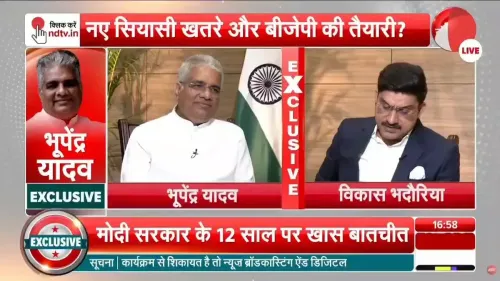
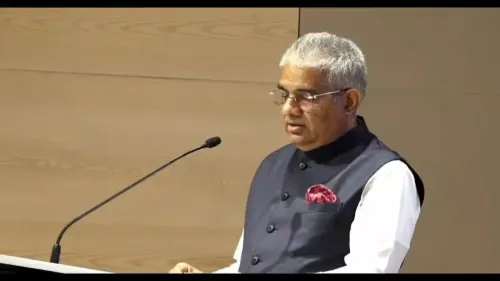
Bhupender Yadav Urges Industry to Raise Farm Investment
Synopsis
Union Environment Minister Bhupender Yadav called on Indian industry to raise investment in the agriculture sector, urging private capital to play a larger role in modernising one of India's most critical economic pillars.
Key Takeaways
Bhupender Yadav , Union Minister of Environment, Forest and Climate Change, publicly urged Indian industry to increase investment in agriculture on 19 November 2026 .
The appeal came in Hindi on X: 'I would urge that our industry increase its investment in India's agriculture sector.' The call from the Environment Ministry signals that agri-investment is increasingly framed around sustainability and climate resilience, not just productivity.
Private investment in agriculture is seen as essential for improving cold chains, logistics, food processing, and farmer incomes across India's roughly 140 million farm households.
Such ministerial appeals often precede formal policy incentives in upcoming budget cycles or industry consultation rounds.
India's agriculture sector needs more private capital — and Union Environment Minister Bhupender Yadav is making that case directly to industry on Thursday, 19 November 2026. In a pointed appeal, the senior BJP leader called on Indian businesses to step up their investment in farming, signalling the government's intent to draw private resources into one of the economy's most foundational sectors.
Posting on X in Hindi, Yadav said: 'मैं आपसे आग्रह करूंगा कि हमारी Industry भारत के कृषि क्षेत्र में अपना निवेश बढ़ाए' — 'I would urge that our industry increase its investment in India's agriculture sector.' The language is direct: not a suggestion, but a request from a Union Cabinet minister to the private sector.
Why an Environment Minister is Talking Agriculture Investment
The appeal carries an added dimension precisely because it comes from the Environment Ministry, not the Agriculture Ministry. India's farming sector sits at the intersection of food security and ecological stress — from groundwater depletion to stubble burning — making private investment in sustainable agricultural technology a natural concern for Bhupender Yadav's portfolio. Any serious push for agri-investment in India now has to reckon with climate resilience, soil health, and water efficiency.
Indian governments have repeatedly tried to coax private capital into agriculture, recognising that public spending alone cannot modernise the sector's infrastructure, cold chains, and value-addition capacity. The gap between farm-gate prices and consumer prices remains wide, and private investment in processing and logistics is widely seen as the lever that could close it.
What Industry Participation in Agriculture Could Mean
When a Cabinet minister invites industry to increase agricultural investment, the target typically spans agri-tech startups, food-processing conglomerates, logistics firms, and input manufacturers. Upgraded supply chains directly reduce post-harvest losses — a persistent drag on farmer incomes. Investment in precision farming tools and sustainable inputs also aligns with the government's broader push to cut agriculture's environmental footprint.
The timing matters too. With Union Budget 2027 consultations likely underway, such public calls from ministers often precede formal policy incentives — tax breaks, production-linked schemes, or eased land-use norms — designed to give industry a concrete reason to act on the appeal.
India has roughly 140 million farm households. Getting private investment flowing into their supply chains, storage, and technology would not just lift incomes — it would reshape the structural fault lines of one of the world's largest agricultural economies. The minister has set the ask. The budget season will reveal whether the incentive architecture follows.
Point of View
Not separate silos. This aligns with a broader BJP governance pattern of cross-ministerial ownership over sectors that touch both growth and green commitments. The public nudge to industry — ahead of what could be a pivotal budget season — also suggests the government wants private capital to do the heavy lifting on agri-infrastructure that fiscal constraints may limit the state from funding alone. Watch whether this translates into concrete incentive structures, or remains an aspirational call.
NationPress
19 Nov 2026
Frequently Asked Questions
What did Bhupender Yadav say about agriculture investment?
Bhupender Yadav urged Indian industry to increase its investment in India's agriculture sector, posting in Hindi on X on 19 November 2026 that he would request businesses to raise their agri-sector commitments.
Why is the Environment Minister talking about agriculture investment?
India's agriculture sector is deeply linked to environmental concerns such as water use, soil degradation, and air pollution from farm waste. The Environment Ministry has a stake in ensuring that private investment in farming aligns with sustainability and climate resilience goals.
How does private investment help Indian farmers?
Private investment in cold chains, food processing, agri-tech, and logistics reduces post-harvest losses, narrows the gap between farm-gate and consumer prices, and can raise farmer incomes significantly over time.
Who is Bhupender Yadav?
Bhupender Yadav is a senior BJP leader from Rajasthan and India's Union Minister of Environment, Forest and Climate Change. He is a Cabinet-rank minister in the central government.
What could follow Yadav's call for industry to invest in agriculture?
Such ministerial appeals often precede formal policy measures — including tax incentives, production-linked schemes, or eased regulatory norms — announced during budget sessions or industry consultations to give businesses a concrete reason to increase agri-sector investment.