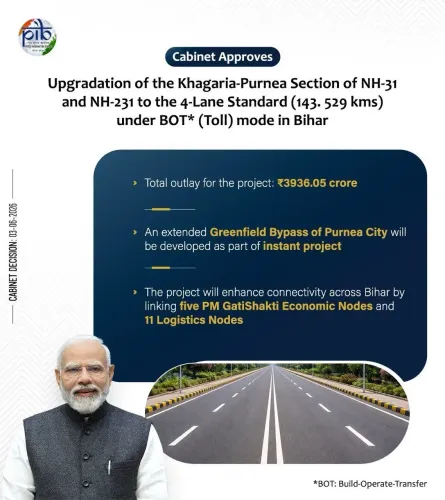
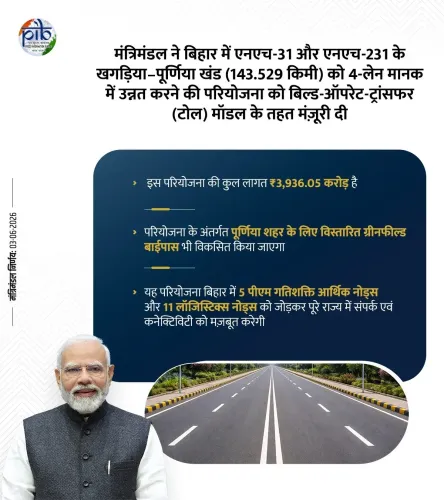
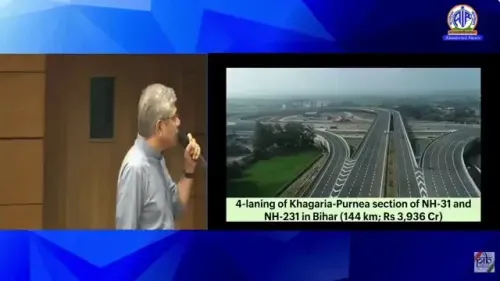
Bihar CMO: Khagaria-Purnia 4-laning to boost Seemanchal, Kosi links
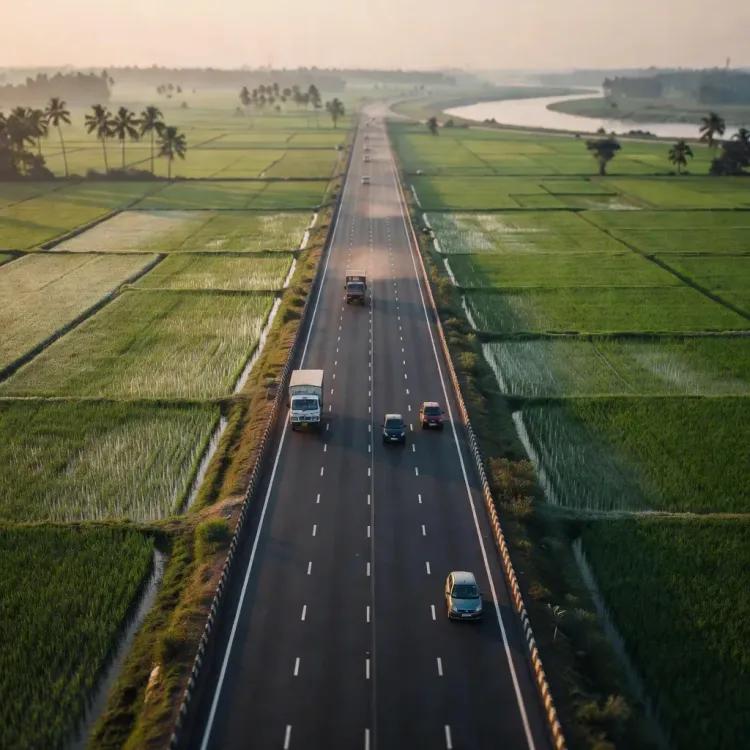
Synopsis
The Chief Minister's Office of Bihar announced that four-laning of the Khagaria-Purnia section will strengthen connectivity across Seemanchal and Kosi regions, calling the project central to Bihar's road infrastructure push and regional economic growth in the state's flood-prone eastern districts.
Key Takeaways
The Bihar CMO announced four-laning of the Khagaria-Purnia highway section on 3 June 2026 .
The upgrade is expected to strengthen connectivity across Seemanchal and the Kosi region.
Beneficiary districts include Purnia , Katihar , Araria and Kishanganj .
The project is framed as part of Bihar's wider road infrastructure and regional growth agenda.
Tendering, land acquisition and construction timelines remain to be announced.
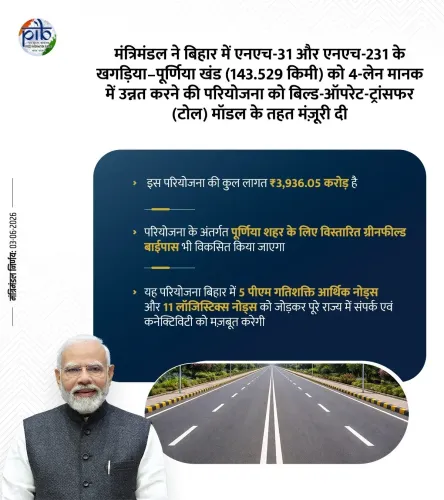
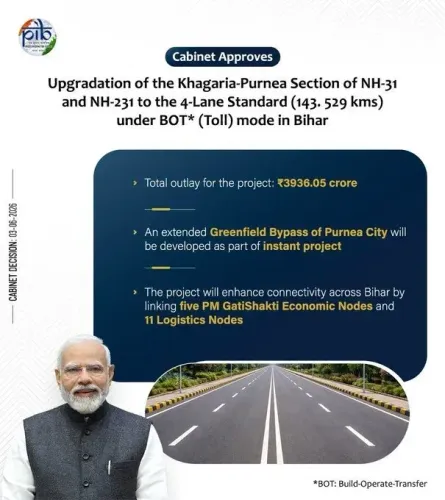
The Chief Minister's Office of Bihar on 3 June 2026 said the four-laning of the Khagaria-Purnia highway section will significantly strengthen road connectivity across the Seemanchal and Kosi regions of the state. The statement, posted on X, framed the upgrade as a key plank in Bihar's wider push to modernise road infrastructure and accelerate regional economic growth.
In the post, the CMO stated that 'the upgradation of the Khagaria-Purnia section to four lanes will strengthen connectivity of the Seemanchal and Kosi regions,' adding that the project 'will play an important role in strengthening road infrastructure in the state, accelerating regional economic development and establishing linkages between different areas.' The original Hindi phrasing — सीमांचल एवं कोसी क्षेत्र की कनेक्टिविटी सुदृढ़ होगी (connectivity of Seemanchal and Kosi regions will be strengthened) — underlines the eastern-Bihar focus of the announcement.
Context
The Khagaria-Purnia stretch is a critical arterial link cutting across north-eastern Bihar, joining the flood-prone Kosi belt with the Seemanchal districts of Purnia, Katihar, Araria and Kishanganj. The corridor has historically suffered from congestion and seasonal disruption, making its expansion to four lanes a long-standing demand of traders, transporters and commuters in the region.
The CMO's message positions the project within a broader connectivity narrative, linking eastern districts with the rest of Bihar's highway grid and onward to neighbouring states.
Policy backdrop
Successive Bihar administrations since 2005 have placed road upgradation at the centre of the state's development agenda, with particular emphasis on widening two-lane corridors in the eastern and northern districts. Projects of this scale typically blend state spending with central highway schemes such as Bharatmala, under which several national highway stretches in Bihar have already been converted into four-lane corridors.
Earlier completed segments along the NH-31 and NH-107 corridors have set the template — faster movement of goods, reduced travel time and improved access to markets and hospitals for districts that were long considered peripheral.
Stakeholders and impact
The immediate beneficiaries, according to the CMO's framing, are residents of Seemanchal and the Kosi belt — regions where flood vulnerability and weak road links have constrained farm incomes and trade. Farmers moving perishable produce, small traders running cross-district supply chains, and migrant workers travelling to Punjab, Delhi and the North-East are all expected to gain from a wider, faster corridor.
Improved connectivity is also likely to draw private investment into logistics, warehousing and agro-processing along the route, sectors that have been slow to take root in eastern Bihar despite its agricultural depth.
What's next
The CMO's post does not specify a tendering timeline, funding split or completion date for the four-laning work. Attention will now turn to the tendering schedule, the pace of land acquisition along the alignment, and any follow-up announcements on bridges, service roads or spurs that connect smaller towns in Seemanchal and the Kosi belt to the upgraded corridor.
If executed on schedule, the project could mark another step in Bihar's attempt to convert highway expansion into measurable gains in regional growth — and into a political dividend in districts that have repeatedly flagged connectivity as their top development demand.
Point of View
As with earlier four-laning projects, will be execution speed and land acquisition, not intent.
NationPress
20 Sept 2026
Frequently Asked Questions
What is the Khagaria-Purnia four-laning project?
It is the planned upgradation of the Khagaria-Purnia highway section in Bihar from its current configuration to a four-lane corridor, aimed at improving connectivity across the Seemanchal and Kosi regions of eastern Bihar.
Which regions will benefit from the Khagaria-Purnia upgrade?
The Seemanchal region — covering Purnia, Katihar, Araria and Kishanganj — and the flood-prone Kosi belt are expected to benefit most through stronger road links, faster travel and better access to markets.
Why is road connectivity important for Seemanchal and Kosi?
Both regions have historically faced weaker road infrastructure and seasonal flood disruption, which has constrained trade, agriculture and access to services. Better highways are seen as a key lever for regional economic growth.
When will the Khagaria-Purnia four-laning be completed?
The Bihar CMO's announcement did not specify a construction or completion timeline. Tendering schedule and land acquisition progress will determine the project's pace.
How does this project fit Bihar's wider infrastructure plans?
It aligns with Bihar's long-running focus since 2005 on widening highways in eastern and northern districts, often combining state funds with central schemes such as Bharatmala to upgrade two-lane stretches to four lanes.