BKS backs Indus Waters Treaty suspension, demands irrigation push for Punjab, Haryana, Rajasthan, J&K
Synopsis
The RSS-affiliated Bharatiya Kisan Sangh has formally endorsed the Centre's Indus Waters Treaty suspension — but with a demand attached: redirect that water into irrigation infrastructure for Punjab, Haryana, Rajasthan, and J&K, where groundwater is falling and 68% of Rajasthan's farmland still depends on rain. The resolution turns a geopolitical moment into an agricultural pressure point.
Key Takeaways
The Bharatiya Kisan Sangh (BKS) passed a resolution at its Ludhiana Executive Committee meeting backing the Centre's suspension of the Indus Waters Treaty .
BKS demanded that Indus River system waters be used to build irrigation facilities in Punjab, Haryana, Rajasthan , and Jammu and Kashmir .
The combined population of the four regions has grown nearly fivefold since Independence to 16 crore , while water resources have declined.
Over 68% of cultivable land in Rajasthan and 12% in Punjab and Haryana still depends on rainfall; irrigated acreage in Jammu has not increased.
BKS also called for faster river-linking, resolution of inter-state water disputes, and adequate budget allocations for climate-related irrigation challenges.
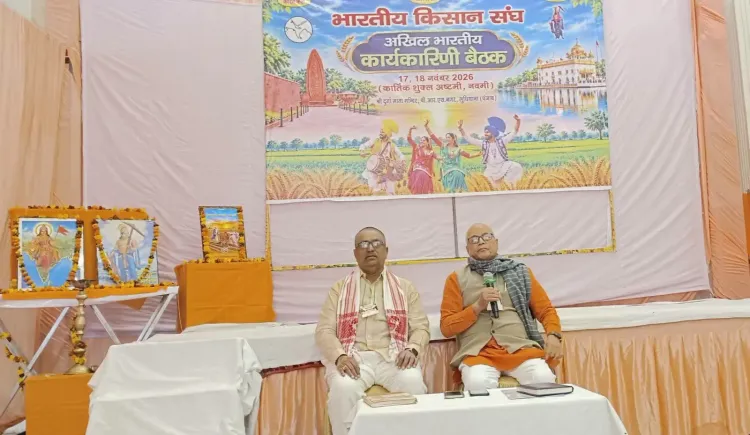
The Bharatiya Kisan Sangh (BKS), the Rashtriya Swayamsevak Sangh (RSS)-affiliated farmers' organisation, has backed the Centre's decision to suspend the Indus Waters Treaty, citing Pakistan-sponsored terrorism and cross-border drug trafficking, while urging the government to redirect Indus River system waters toward building robust irrigation infrastructure across Punjab, Haryana, Rajasthan, and Jammu and Kashmir. The demand was formalised through a resolution adopted at the conclusion of the BKS Executive Committee's two-day meeting in Ludhiana on Wednesday.
Key Demands from the Resolution
The BKS resolution called on the government to utilise the now-suspended treaty's river waters exclusively for Indian farmers and national development. BKS General Secretary Mohini Mohan Mishra invoked Prime Minister Narendra Modi's phrase, stating, 'Water and blood cannot flow together,' and added, 'Water of rivers in India should be used for the country's farmers and in national interest alone.'
The organisation also demanded faster progress on river-linking projects, adequate budget allocations to address climate-related challenges including El Niño, droughts, and floods, and dedicated irrigation project funding for the affected states. Farmers in the region were urged to cooperate on issues such as land availability for canal construction and river-linking corridors.
The Groundwater and Irrigation Crisis
The BKS pointed to a worsening water crisis underpinning its demands. According to the organisation's statement, the combined population of Jammu and Kashmir, Punjab, Haryana, and Rajasthan has grown nearly fivefold since Independence to approximately 16 crore, while water resources in the region have been declining.
The statement noted that 12% of cultivable land in Punjab and Haryana still depends on rainfall, while the figure rises steeply to over 68% in Rajasthan. Irrigated acreage in Jammu has seen no meaningful increase. The BKS warned that without a strengthened irrigation network, the dual threats of falling groundwater levels and desertification — particularly in Rajasthan — would only intensify.
Inter-State Water Disputes in Focus
The BKS also highlighted long-running inter-state water disputes between Punjab, Haryana, and Rajasthan, arguing that a reliable supply from the Indus River system could serve as the foundation for resolving these disputes. The organisation positioned irrigation development as central to achieving the 'Developed India 2047' vision, contending that boosting agricultural productivity in these water-stressed regions is inseparable from broader national development goals.
Meeting and Leadership
The two-day Executive Committee meeting in Ludhiana covered seven sessions, addressing the irrigation demands, an upcoming membership drive, migration trends, and the broader national and global situation. BKS Organisation Secretary Dinesh Kulkarni spoke in the closing session on the membership drive and current affairs.
Senior BKS leadership present included all-India President K. Sai Reddy, Vice Presidents Sushila Vishnoi, Perumal, and Vishal Chandrakar, Assistant Organisation Secretary Gajendra Singh, Treasurer Rajendra Paliwal, National Secretary Babubhai Patel, and Communication Head Raghvendra Singh Patel, among others from Punjab's state unit.
With the Indus Waters Treaty suspension marking a significant shift in India's water diplomacy, the BKS resolution signals growing pressure from the farm sector to convert the geopolitical move into tangible irrigation gains on the ground.
Point of View
Haryana, and Rajasthan have long battled groundwater depletion and unresolved inter-state river disputes, and no administration has fully resolved the Sutlej-Yamuna Link canal standoff. The risk is that the treaty suspension, justified on counter-terrorism grounds, is used to paper over structural delays in domestic water infrastructure without a binding timeline. If river-linking and canal projects are not fast-tracked with verified milestones, farmers in Rajasthan — where over two-thirds of cultivable land still depends on rain — will find the geopolitical pivot translated into nothing more than another resolution on paper.
NationPress
18 Nov 2026
Frequently Asked Questions
Why has the BKS supported the suspension of the Indus Waters Treaty?
The Bharatiya Kisan Sangh backed the Centre's decision to suspend the Indus Waters Treaty citing Pakistan-sponsored terrorism and cross-border drug trafficking. The organisation also argued that Indus River waters should be redirected exclusively for Indian farmers and national development rather than flowing to Pakistan under the treaty framework.
What specific irrigation demands has the BKS made?
The BKS has demanded development of irrigation infrastructure in Punjab, Haryana, Rajasthan, and Jammu and Kashmir using water from the Indus River system. It also called for faster river-linking projects, resolution of inter-state water disputes, and dedicated budget allocations for irrigation and climate-related challenges including El Niño, droughts, and floods.
How serious is the water crisis in the states the BKS highlighted?
According to the BKS statement, the population of J&K, Punjab, Haryana, and Rajasthan has grown nearly fivefold to 16 crore since Independence while water resources have declined. Over 68% of cultivable land in Rajasthan still depends on rainfall, as does 12% in Punjab and Haryana, and irrigated acreage in Jammu has not grown.
What is the BKS and what is its organisational affiliation?
The Bharatiya Kisan Sangh is an RSS-affiliated farmers' organisation that advocates for agricultural interests across India. Its all-India President is K. Sai Reddy, and it operates state units across multiple states including Punjab.
Where and when was the BKS resolution on the Indus Waters Treaty adopted?
The resolution was adopted at the BKS Executive Committee's two-day meeting that concluded on Wednesday in Ludhiana, Punjab. The meeting covered seven sessions addressing irrigation, the membership drive, migration, and broader national issues.