Anurag Thakur: Budget 2026-27 gives HP ₹2,911 cr for rail
Synopsis
BJP MP Anurag Thakur has announced that Union Budget 2026-27 allocates ₹2,911 crore to Himachal Pradesh for railway expansion, modernisation, safety, and electrification — claiming the figure is 27 times the Congress-era allocation and reflecting the Modi government's sustained push for Himalayan rail connectivity.
Key Takeaways
The Union Budget 2026-27 has approved ₹2,911 crore for Himachal Pradesh across railway expansion, modernisation, safety, and electrification.
BJP MP Anurag Thakur claims the allocation is 27 times higher than what the previous Congress government provided for the state's railways.
Himachal Pradesh , a mountainous state with historically limited rail access, has been a focus of the Modi government's Himalayan connectivity agenda since 2014.
The four-vertical mandate — expansion, modernisation, safety, electrification — mirrors the NDA's broader railway upgrade strategy for difficult-terrain states.
Electrification aligns with Indian Railways' net-zero carbon emissions goal, while safety funding addresses terrain-specific engineering risks.
Project-wise utilisation and tender timelines for the approved funds will be closely watched in the coming months.
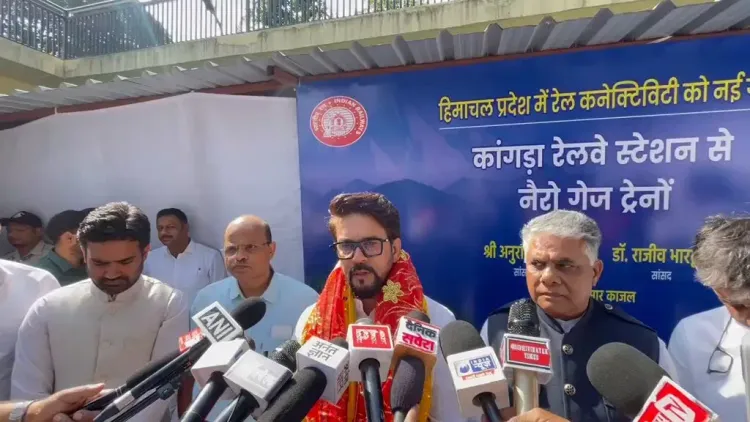
BJP MP Anurag Thakur on Tuesday, June 2, 2026, highlighted that the Union Budget 2026-27 has approved ₹2,911 crore for Himachal Pradesh to fund railway network expansion, modernisation, safety projects, and electrification under the Modi government. Thakur, who represents Hamirpur in the Lok Sabha, credited the allocation to Prime Minister Narendra Modi's sustained focus on hill-state connectivity.
Context
In his post, Thakur wrote that the Modi government has 'सदा ही विशेष योगदान रहा है' ('always made a special contribution') to railway development in Himachal Pradesh. He further claimed the approved sum is 27 times the amount allocated by the previous Congress-led government, framing the figure as a benchmark of the NDA's infrastructure commitment to the state.
Himachal Pradesh, often called Devbhoomi (land of gods), has historically faced limited rail connectivity owing to its mountainous terrain. Road dependence has long made the state vulnerable to disruptions caused by landslides and extreme weather, making railway investment a politically and practically significant issue for residents.
Policy Backdrop
Since 2014, successive Union Budgets have raised capital outlay for Indian Railways modernisation, with a particular emphasis on electrification targets, track renewal, and safety systems in difficult-terrain states. The Bhanupali–Bilaspur–Beri rail link, approved for survey and funding in 2019, was one of the earlier milestones in the central government's Himalayan connectivity push.
The 2026-27 allocation, as described by Thakur, covers four verticals: network expansion, modernisation, safety projects, and electrification — a broad mandate that mirrors the multi-pronged railway upgradation strategy pursued across hill and northeastern states in recent years. Higher capital expenditure on these verticals has been a consistent feature of NDA-era railway budgets.
Stakeholders and Impact
For Himachal Pradesh's roughly 75 lakh residents, improved rail infrastructure would reduce dependence on road transport, lower freight costs for agricultural produce, and provide more reliable connectivity to plains cities such as Chandigarh and Delhi. The tourism sector — a backbone of the state's economy — stands to benefit significantly from better all-weather rail access to key destinations.
The electrification component carries environmental and operational benefits, aligning with Indian Railways' broader goal of achieving net-zero carbon emissions. Safety project funding addresses a long-standing concern in Himalayan rail operations, where terrain-related risks demand specialised engineering solutions.
What's Next
Attention will now turn to project-wise utilisation of the ₹2,911 crore — specifically, which rail corridors receive priority, whether new line surveys are commissioned, and how quickly tenders are floated for safety and electrification works. Himachal Pradesh's state government and local MPs are expected to engage with the Railway Ministry to fast-track projects with the highest connectivity impact. The 27-times comparison to Congress-era allocations is likely to feature prominently in the BJP's campaign messaging ahead of future state elections.
Point of View
Tangible budget win in his home state, reinforcing the party's infrastructure narrative ahead of future electoral cycles. The 27-times comparison to Congress-era spending is a sharp political framing device, though independent verification of the baseline figure will determine how durable that claim proves. More broadly, the allocation fits a consistent NDA pattern of channelling higher capital expenditure into hill and northeastern states to demonstrate governance reach in geographically challenging regions. The real test will be execution: timely project delivery has historically lagged behind headline budget numbers in Himalayan rail infrastructure.
NationPress
19 Sept 2026
Frequently Asked Questions
How much money has been approved for Himachal Pradesh railways in Budget 2026-27?
The Union Budget 2026-27 has approved ₹2,911 crore for Himachal Pradesh covering railway network expansion, modernisation, safety projects, and electrification, according to BJP MP Anurag Thakur.
What did Anurag Thakur say about Himachal Pradesh railway budget?
Anurag Thakur stated that the Modi government approved ₹2,911 crore for Himachal Pradesh's rail network in Budget 2026-27, calling it 27 times higher than allocations made during the Congress government.
Why does Himachal Pradesh need more railway investment?
Himachal Pradesh's mountainous terrain limits rail connectivity and makes the state heavily dependent on roads, which are vulnerable to landslides and weather disruptions, making railway expansion critical for residents and tourism.
What projects are covered under the ₹2,911 crore Himachal Pradesh railway allocation?
The allocation covers four areas: railway network expansion, modernisation, safety projects, and electrification of existing lines in Himachal Pradesh.
What is the Bhanupali–Bilaspur–Beri rail link?
The Bhanupali–Bilaspur–Beri rail link is a proposed railway line in Himachal Pradesh for which the central government approved surveys and funding in 2019 as part of its broader Himalayan connectivity initiative.