Cabinet Approves 3 Chemical Parks Under Bhavy Rasayan Yojana
Synopsis
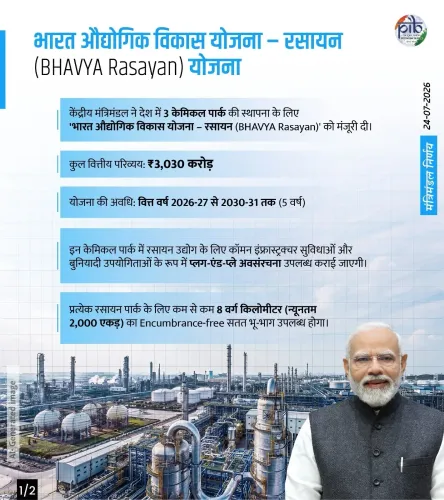
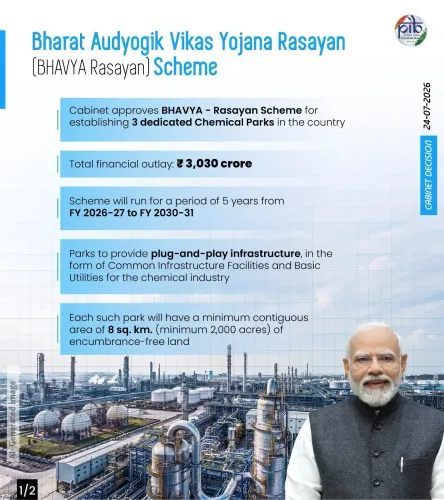
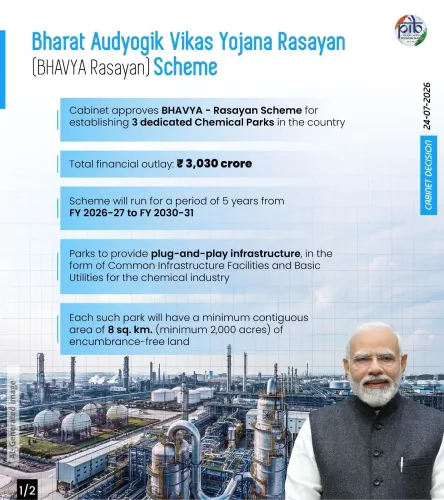
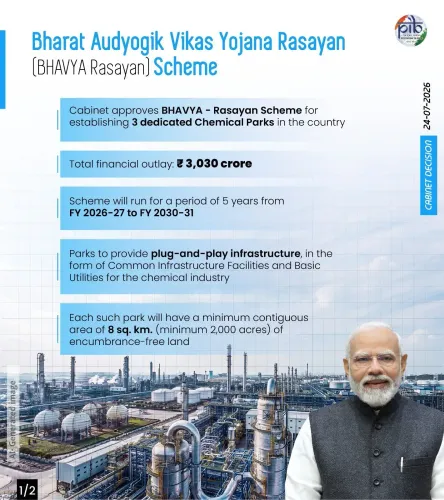
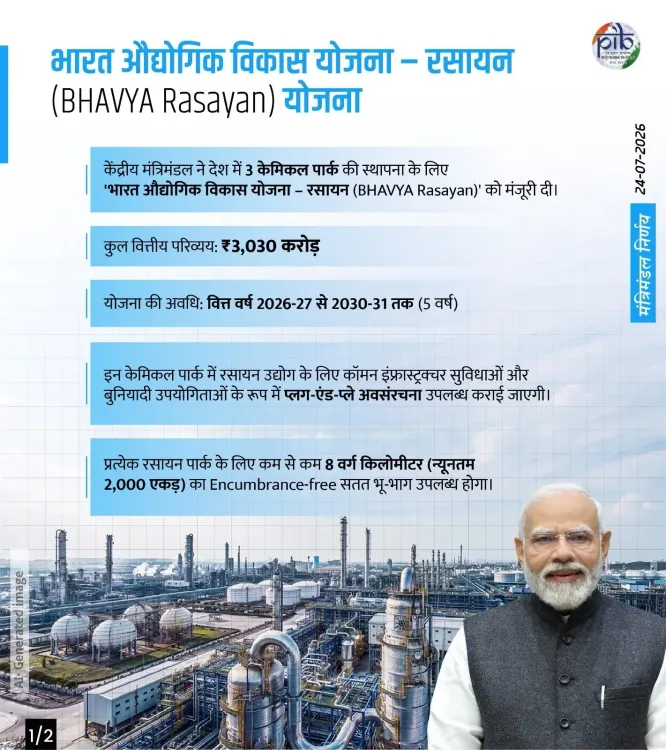
The Union Cabinet chaired by PM Narendra Modi has approved three chemical parks under the Bhavy Rasayan Yojana, Union Minister Mansukh Mandaviya announced on 24 July 2026, framing it as a key Atmanirbhar Bharat step to strengthen domestic chemicals manufacturing.
Key Takeaways
The Union Cabinet, chaired by PM Narendra Modi , approved the creation of 3 chemical parks on 24 July 2026 .
The parks will be built under the Bhavy Rasayan Yojana ('Grand Chemicals Scheme').
The decision is framed as part of the Atmanirbhar Bharat (self-reliant India) initiative to reduce import dependence in chemicals.
The move continues a post-2014 policy pattern of developing large-scale industrial clusters across sectors including pharmaceuticals, electronics and textiles.
Locations, investment models and implementation timelines for the three parks are yet to be officially announced.
Key beneficiaries include domestic chemical manufacturers , petrochemical investors and downstream industries such as agrochemicals and specialty chemicals.
Union Labour and Sports Minister Mansukh Mandaviya announced on Friday, 24 July 2026 that the Union Cabinet, chaired by Prime Minister Narendra Modi, has approved the establishment of three chemical parks under the 'Bhavy Rasayan Yojana' — a scheme aimed at giving the domestic chemicals sector a significant boost under the Atmanirbhar Bharat framework.
Mandaviya posted on X, stating: 'PM Shri Narendra Modi ji ki adhyakshata mein Cabinet ne Bhavy Rasayan Yojana ke tahat 3 rasayanik park banane ka aham nirnay liya hai' — ('Under the chairmanship of PM Shri Narendra Modi ji, the Cabinet has taken an important decision to build 3 chemical parks under the Bhavy Rasayan Yojana'). He described the move as a step that 'will give the chemicals sector a new flight' in the direction of a self-reliant India.
Context
The Cabinet decision marks a notable expansion of India's industrial cluster strategy into the chemicals space. The Bhavy Rasayan Yojana — broadly translating to 'Grand Chemicals Scheme' — is positioned as a dedicated policy vehicle for creating purpose-built chemical manufacturing zones. The announcement was made under the #CabinetDecisions banner, signalling it as part of a broader set of decisions cleared at the same Cabinet meeting.
India's chemicals sector is a significant contributor to the national economy but has historically relied on imported intermediates and finished chemicals, particularly from China. The creation of dedicated chemical parks is intended to address this structural dependency by enabling scale, shared infrastructure and concentrated investment.
Policy Backdrop
The decision builds on a long lineage of cluster-based industrial policy. India's Petroleum, Chemicals and Petrochemicals Investment Regions (PCPIR) policy, approved in 2007, first laid out the framework for integrated chemical industry clusters with dedicated infrastructure. The post-2014 policy environment under PM Modi has deepened this approach, applying similar cluster models to pharmaceuticals, electronics and textiles.
The Atmanirbhar Bharat initiative, launched in May 2020, brought renewed urgency to domestic chemicals manufacturing by explicitly targeting import substitution and value addition. The three new chemical parks under the Bhavy Rasayan Yojana represent a continuation of that strategic direction, extending the self-reliance push into a sector seen as foundational to broader manufacturing competitiveness.
Stakeholders and Impact
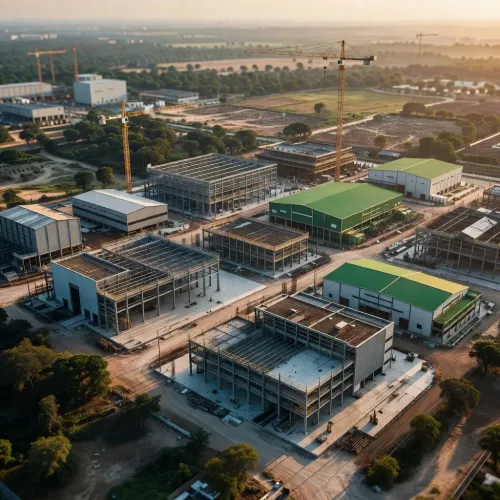
The primary beneficiaries of the scheme are expected to be domestic chemical manufacturers and petrochemical investors seeking plug-and-play industrial infrastructure. Dedicated chemical parks typically offer common utilities, effluent treatment facilities, logistics connectivity and regulatory clearances — reducing the time and cost burden for individual firms.
For the broader economy, the parks are designed to attract foreign direct investment and position India as an alternative global supply base for chemicals — a goal that has gained urgency as global supply chains seek diversification. Downstream industries including agrochemicals, specialty chemicals, dyes and pharmaceuticals stand to benefit from improved input availability.
What's Next
The immediate focus will be on the release of specific locations, investment models and implementation timelines for each of the three parks. State-level agreements and land allocation will be critical milestones, as chemical park development typically requires close coordination between the central government and host state administrations.
Any follow-up budget allocations or viability-gap funding announcements will be closely watched by industry. The scheme's success will ultimately depend on the pace of on-ground execution — an area where earlier cluster initiatives have faced delays — making the next phase of implementation announcements particularly consequential for investor confidence in the sector.
Point of View
Extending a model already applied to pharmaceuticals and electronics into a sector with significant import-substitution potential. For the BJP-led government, the announcement reinforces the Atmanirbhar Bharat narrative ahead of what is likely to be a politically active legislative period, with chemicals positioned as the next frontier of manufacturing self-reliance. The choice to route the announcement through Minister Mandaviya — whose portfolio spans labour and sports rather than chemicals — suggests the Cabinet decision was communicated broadly across the council of ministers as a collective achievement. The scheme's credibility will hinge on execution speed: India's track record with PCPIR-era chemical clusters shows that policy approval and on-ground delivery can diverge sharply, making location and timeline disclosures the real test of intent.
NationPress
24 Jul 2026
Frequently Asked Questions
What is the Bhavy Rasayan Yojana?
The Bhavy Rasayan Yojana is a central government scheme under which the Union Cabinet approved the establishment of three dedicated chemical parks in India, aimed at boosting domestic chemicals manufacturing and reducing import dependence as part of the Atmanirbhar Bharat initiative.
How many chemical parks were approved by the Cabinet?
The Union Cabinet approved the creation of three chemical parks under the Bhavy Rasayan Yojana, as announced on 24 July 2026.
What is Atmanirbhar Bharat and how does this relate to chemicals?
Atmanirbhar Bharat is a self-reliance initiative launched by the Modi government in May 2020 that supports domestic manufacturing across sectors. The Bhavy Rasayan Yojana chemical parks are positioned as part of this initiative to reduce India's dependence on imported chemicals and intermediates.
Where will the three chemical parks under Bhavy Rasayan Yojana be located?
The specific locations of the three chemical parks have not yet been officially announced. Disclosure of locations, investment models and timelines is expected in subsequent government communications.
Who announced the Cabinet decision on chemical parks?
Union Minister Mansukh Mandaviya announced the Cabinet decision on his official X account on 24 July 2026, attributing the approval to the Cabinet meeting chaired by Prime Minister Narendra Modi.